
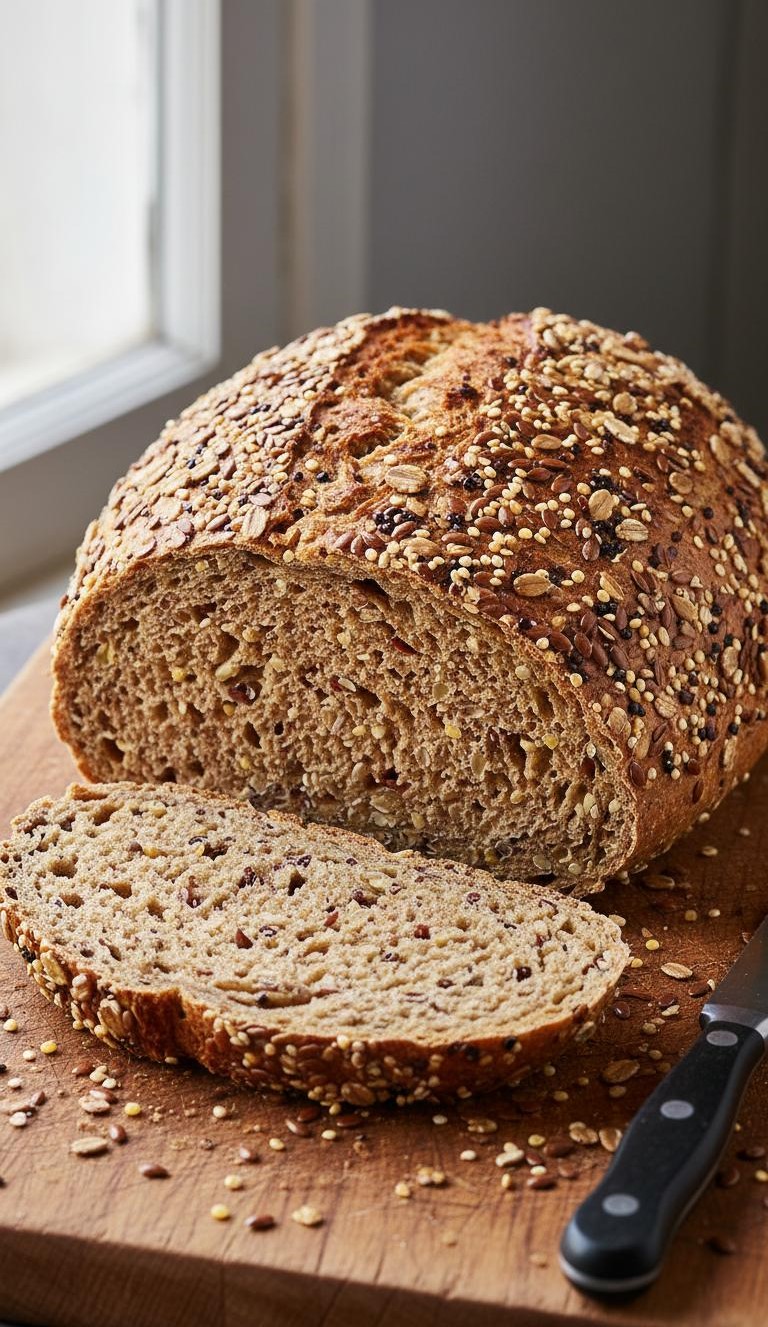
Dense, nutty slices with visible seeds and flecks of grain have transformed from health-food specialty to supermarket staple, yet the story of multigrain bread stretches back to ancient necessity rather than modern wellness trends. Multigrain bread history begins in the Neolithic era, when early farmers discovered that mixing various cereals — wheat, barley, millet, and rye — produced more reliable harvests than relying on a single crop. Ancient Egyptians baked flatbreads from emmer wheat and barley around 3000 BCE, while Roman soldiers carried buccellatum, a hard multigrain biscuit that sustained them across vast campaigns. The multigrain bread that fills contemporary artisan bakeries is essentially a return to these ancient practices, though the motivation has shifted from survival to nutrition.
Biblical texts repeatedly celebrate bread as divine provision and communal sustenance. Exodus 16 describes manna from heaven, while John 6:35 records Jesus declaring, “I am the bread of life.” The specific grains mentioned in scripture — wheat, barley, spelt, and millet — form the backbone of traditional multigrain bread. Ezekiel 4:9 offers one of the most precise ancient recipes: “Take wheat and barley, beans and lentils, millet and spelt; put them in a storage jar and use them to make bread for yourself.” This passage, sometimes called the Ezekiel bread formula, directly mirrors modern multigrain bread composition, proving that the concept of combining grains for enhanced nutrition is thousands of years old.
Several distinct varieties define the contemporary landscape. Seven-grain bread typically incorporates wheat, rye, oats, barley, flax, millet, and triticale, creating a complex flavor profile and substantial fiber content. Twelve-grain versions add sunflower seeds, sesame, quinoa, and amaranth for additional protein and texture. Sprouted multigrain bread, popularized by the Ezekiel brand, uses germinated grains that are theoretically easier to digest and more nutrient-dense. Sourdough multigrain combines the ancient fermentation technique with modern grain diversity, while gluten-free multigrain substitutes rice, sorghum, and buckwheat for traditional wheat. Some historical forms have faded. Medieval peasant breads often included peas, beans, and even acorns when grain was scarce, ingredients that would seem alien to modern palates. The dense, dark breads of northern Europe, once staples of subsistence diets, have been largely replaced by lighter, more refined versions.
Extremes in scale capture attention. Industrial bakeries produce multigrain bread in massive continuous batches, with loaves measured in tons rather than pounds. At the artisan end, micro-bakeries craft single loaves weighing barely a pound, each hand-shaped and scored with individual attention. The predecessor to all multigrain bread was the simple flatbread of ancient farmers, a practical solution to variable harvests that evolved into a deliberate nutritional strategy.
Global impact is substantial. The whole grain and multigrain bread market continues expanding as consumers reject highly processed white bread in favor of complex carbohydrates and fiber. What began as peasant necessity has become a wellness statement, with multigrain bread appearing in everything from hospital dietary plans to high-end restaurant bread baskets.
Symbolically, multigrain bread represents a return to wholeness. Where industrial white bread symbolized progress and purity, the visible seeds and varied textures of multigrain bread now signal authenticity, health consciousness, and connection to agricultural tradition. What changed most profoundly is intentionality; ancient bakers mixed grains because they had to, while modern consumers choose multigrain bread because they want to.
Rustic Honey-Oat Multigrain Bread
This is my own recipe, developed for home bakers seeking a hearty, flavorful loaf without commercial additives.
Ingredients:
- 2 cups whole wheat flour
- 1 cup bread flour
- 1/2 cup rolled oats
- 1/4 cup ground flaxseed
- 2 tbsp sunflower seeds
- 2 tbsp sesame seeds
- 1 tbsp active dry yeast
- 1 tsp salt
- 2 tbsp honey
- 1 1/4 cups warm water (about 110°F)
- 2 tbsp olive oil
Method: Combine the warm water and honey in a bowl, then sprinkle the yeast over the surface. Let it bloom for five minutes until foamy. In a large mixing bowl, combine both flours, oats, flaxseed, sunflower seeds, sesame seeds, and salt. Pour in the yeast mixture and olive oil, then stir until a shaggy dough forms. Turn onto a lightly floured surface and knead for eight to ten minutes until the dough becomes smooth and elastic, though it will remain slightly tacky from the seeds.
Place the dough in an oiled bowl, cover with a damp cloth, and let rise in a warm spot for about one hour, or until doubled in size. Punch down gently, shape into a loaf, and place in a greased 9×5 inch pan. Cover again and let rise for forty-five minutes. Preheat the oven to 375°F. Just before baking, brush the top with water and sprinkle additional oats and seeds for texture. Bake for thirty-five to forty minutes until the crust is deep golden and the loaf sounds hollow when tapped. Cool completely on a wire rack before slicing; this resting period is essential for the crumb to set properly.
This multigrain bread keeps well for three days at room temperature and freezes beautifully for up to three months. The honey provides subtle sweetness that balances the earthy grains, while the olive oil keeps the crumb tender despite the heavy whole wheat content.