
Thin layers of dough whispering beneath crushed nuts and golden syrup have defined Turkish celebrations for centuries. Turkish Baklava stands as one of the most refined desserts to emerge from Ottoman culinary tradition, a pastry that demands patience, skill, and butter measured by the ladle. Its history traces back to the nomadic Turkic tribes of Central Asia, who layered simple flatbreads with nuts and honey. When these traditions entered the Ottoman palace kitchens of Topkapi in the fifteenth century, imperial chefs transformed the rustic concept into an art form, rolling dough so thin it could be read through like silk.
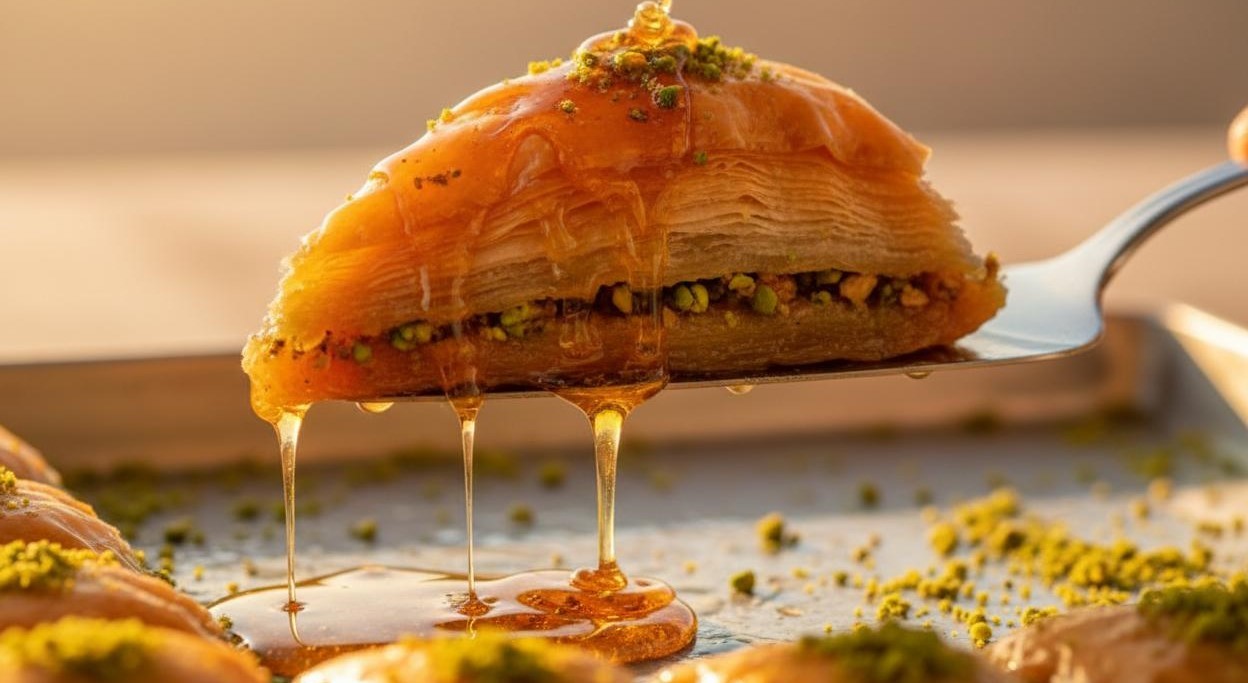
Several distinct varieties dominate contemporary confectionery. The pistachio version from Gaziantep, using locally grown Antep fıstığı, remains the gold standard, its emerald nuts contrasting against amber syrup. Walnut baklava offers a deeper, earthier flavor, particularly popular in autumn when fresh harvests arrive. Kaymaklı baklava incorporates clotted cream between layers, creating a richness that balances the sweetness of the şerbet. Şöbiyet features semolina-based cream rather than nuts, while burma baklava rolls the dough into spirals resembling shredded wheat. Some historical forms have faded. Medieval versions occasionally incorporated black pepper or cloves into the syrup, a spice profile that retreated as tastes shifted toward pure sweetness.
Extremes in scale capture the eye. Traditional bakeries produce massive trays measuring nearly a meter in length, yielding hundreds of diamond-shaped portions for weddings and Ramadan celebrations. At the intimate end, miniature squares barely larger than a postage stamp serve as elegant accompaniments to Turkish coffee, demonstrating that the pastry adapts to any occasion. The process itself remains remarkably consistent regardless of size. Master bakers stretch dough into paper-thin sheets, brush each layer with clarified butter, scatter nuts, and bake until the pastry emerges golden and crackling. Cooled syrup — never hot, never honey — is poured over the surface, allowing the pastry to absorb sweetness without losing its crisp structure.
Global impact is substantial. Gaziantep’s mastery of Turkish Baklava earned UNESCO recognition as an intangible cultural heritage, cementing its status as a craft worthy of preservation. The dessert now travels far beyond Anatolia, appearing in Middle Eastern and Central Asian markets, though purists insist that the combination of local pistachios, specific wheat varieties, and technique cannot be replicated outside southeastern Turkey. What began as palace luxury has become a democratic symbol of hospitality, offered with equal solemnity.
Symbolically, Turkish Baklava represents the sweetness of shared moments. Where ancient nomads carried layered breads for sustenance, modern hosts arrange trays to honor guests. What changed most profoundly is accessibility. Once restricted to imperial kitchens and wealthy households, Turkish Baklava now fills bakery windows in every Turkish city, its price varying from humble street portions to premium boxes shipped globally. From Central Asian campfires to refrigerated display cases, Turkish Baklava continues proving that the most delicate pastry can carry the weight of an entire culture.



One response to “Turkish Baklava: History, Types and Traditional Preparation”
Magnificent 🙏👏👏🌸🥰