Cattle herders on the vast Hungarian plain were stirring cauldrons of Hungarian goulash long before it became a restaurant menu staple or a tourist’s introduction to Central European cuisine. These csikós—mounted cowboys of the Puszta—needed sustenance that could be cooked over open fires, preserved without refrigeration, and provide enough energy for days of hard riding. Their solution was a simple, brilliant alchemy: tough beef, slow-simmered with onions and the local dried red pepper that would eventually become paprika. The result was Hungarian goulash—gulyás in the original, meaning simply “herdsman’s stew”—a dish that carried the soul of a nation in its smoky, scarlet broth.
The transformation of Hungarian goulash from cowboy fuel to national icon began in the late eighteenth century, when paprika arrived in earnest from the Balkans and found ideal growing conditions in the southern Hungarian plains around Szeged and Kalocsa. By the 1800s, Hungarian goulash had migrated from the Puszta to Budapest’s burgeoning restaurants, where chefs refined the recipe without betraying its rustic roots. The essential elements remained: beef shoulder or shank, slowly browned with a massive quantity of onions, simmered with paprika, caraway, and potatoes until the meat surrendered to the spoon. The addition of tomatoes and peppers came later, a New World contribution that thickened the broth and added complexity. The csipetke—small egg noodle dumplings pinched by hand—were the final touch, a starchy comfort that made the stew a complete meal.
The history of Hungarian goulash is inseparable from the history of paprika. In 1876, the Hungarian government established the Szeged Paprika Milling Company, standardizing production and ensuring that Hungarian goulash would have a consistent, vibrant red color. By the early twentieth century, the dish had become a symbol of Magyar identity, a culinary declaration of distinction from the German and Slavic cultures that surrounded Hungary.
Extremes of Hungarian goulash culture are both spectacular and intimate. The largest Hungarian goulash ever prepared was cooked in a cauldron at a festival in Szeged, using over 1,500 kilograms of beef and requiring a team of chefs to stir with oars. At the opposite extreme, the “goulash soup” served in Budapest’s elegant New York Café—barely a teacup portion, adorned with a swirl of sour cream and a sprig of dill—represents the dish at its most refined, a far cry from the cowboy cauldron. The most expensive Hungarian goulash on record was likely served at a state dinner during the Habsburg era, incorporating imported truffles and aged Tokaji wine, ingredients that would have horrified the csikós who first scraped the pot.
Today’s Hungarian goulash landscape is dominated by two primary traditions. The “authentic” Puszta version remains a thick, paprika-heavy stew, often served from a kettle over an open fire at tourist farms where visitors can watch csikós perform equestrian tricks. The “Budapest restaurant” version is soupier, more elegant, and frequently garnished with sour cream and fresh parsley. Outside Hungary, Hungarian goulash has mutated dramatically. The American “goulash”—ground beef, tomatoes, and macaroni—is a casserole that shares only its name with the original. The Austrian Rindsgulasch uses more wine and less paprika, while Czech and Slovak versions incorporate sauerkraut and sausage. Yet some traditions have faded. The “herdsman’s goulash” cooked in a cast-iron kettle buried in embers, the method of the original csikós, survives now only in heritage demonstrations and rural festivals. The use of szalonna—Hungarian smoked fatback—to render the initial cooking fat has been largely replaced by neutral vegetable oils.
What preceded Hungarian goulash was the ancient Eurasian tradition of boiling tough meat with aromatics until tender, a technique that predates Hungary itself. The leap to national icon required the discovery of paprika, the romantic nationalism of the nineteenth century, and the Habsburg empire’s culinary cosmopolitanism.
Today, Hungarian goulash generates millions in tourism revenue, with visitors to Budapest ranking it among their most anticipated culinary experiences. It symbolizes Hungarian identity, pastoral nostalgia, and the transformative power of paprika. What changed most profoundly is the context. Once, Hungarian goulash was cooked by men on horseback, stirred with wooden paddles in iron cauldrons over prairie fires. Now, it is simmered in Dutch ovens in Brooklyn apartments, slow-cooked in German Schnellkochtöpfe, and served in Michelin-starred restaurants with foam and microgreens. The csikós who first combined beef, onion, and paprika would not recognize the presentations, but he would recognize the aroma—that deep, earthy, smoky scent that rises from the pot and carries across centuries, reminding everyone who smells it that hunger, once, was the mother of this invention.
Classic Hungarian Goulash Recipe
Ingredients:
2 lbs beef chuck or shank, cut into 1.5-inch cubes
3 large onions, finely chopped
3 tbsp Hungarian sweet paprika (különleges)
1 tsp Hungarian hot paprika (csípős)
2 tbsp lard or neutral oil
3 cloves garlic, minced
2 medium tomatoes, diced
2 green peppers, diced
4 medium potatoes, cubed
1 tsp caraway seeds, crushed
1 bay leaf
6 cups beef broth
Salt and black pepper to taste
Fresh parsley, chopped (for garnish)
Sour cream (for serving)
Instructions:
Render the fat: Heat lard in a heavy Dutch oven or cast-iron pot over medium heat. Add onions and cook slowly until deeply golden and caramelized, about 15-20 minutes. This is the soul of the dish—do not rush.
Bloom the paprika: Remove pot from heat. Stir in both paprikas and garlic immediately, allowing the residual heat to toast the spices without burning. The mixture should turn a vibrant scarlet.
Sear the beef: Return to medium heat. Add beef cubes and sear until browned on all sides, about 8-10 minutes. The meat will release juices—let them reduce slightly.
Build the base: Add tomatoes, peppers, caraway, bay leaf, and a pinch of salt. Stir to combine. Pour in beef broth until meat is just covered. Bring to a gentle boil, then reduce to low simmer.
Slow cook: Cover and simmer for 1.5 hours, stirring occasionally. The beef should yield to gentle pressure but not fall apart.
Add potatoes: Stir in potato cubes. Continue simmering uncovered for 30-40 minutes until potatoes are tender and broth has thickened slightly.
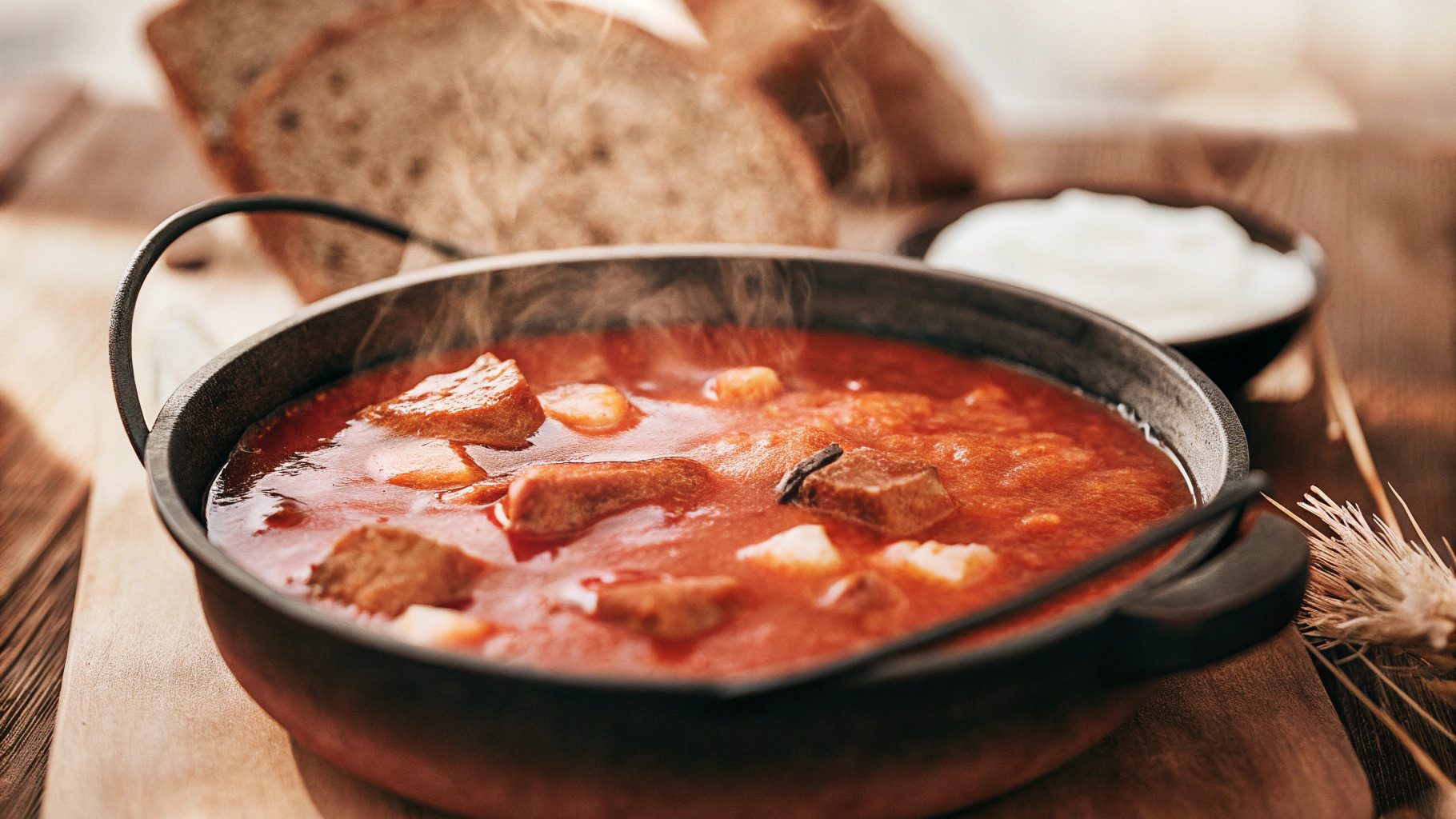
Adjust and serve: Remove bay leaf. Taste and adjust salt and pepper. The broth should be rich, red, and deeply savory. Ladle into bowls, garnish with fresh parsley, and serve with a dollop of sour cream and crusty bread on the side.
Tips:
Paprika is everything: Use genuine Hungarian paprika, not generic supermarket blends. The sweet (édes) and hot (csípős) combination creates authentic depth.
No flour, no roux: Traditional goulash thickens naturally from potatoes and reduced broth. Never add flour.
Make ahead: Like all stews, goulash improves after a day of rest. Refrigerate overnight and reheat gently.
Csipetke option: For extra authenticity, pinch small egg noodle dumplings (csipetke) directly into the simmering pot during the final 15 minutes.
Serves: 6
Prep time: 30 minutes
Cook time: 2.5 hours
Total time: 3 hours