Long before it became a supermarket staple, cabbage emerged from the rocky Mediterranean coastline as a modest leafy plant botanists call Brassica oleracea. Genetic and linguistic evidence points to the Aegean region as the cradle of domestication, where ancient Greek farmers began cultivating wild cabbage more than 3,000 years ago. Those early growers could hardly have imagined that selective breeding would eventually produce over 100 distinct varieties spanning six continents.
Sacred texts do not mention cabbage by name, though the Talmud references colewort—an ancient ancestor—in discussions of daily sustenance. Biblical passages celebrating seed-bearing plants and abundant harvests indirectly honor the spirit of this resilient vegetable, even if the word itself never appears on scripture pages.
Ancient civilizations valued cabbage first as medicine rather than food. Greek physicians, including Hippocrates, prescribed it for kidney ailments and digestive troubles, while Roman naturalist Pliny the Elder documented nearly ninety therapeutic applications. Roman banquets famously featured cabbage as a supposed shield against intoxication; guests would consume leaves with vinegar before drinking wine. Sailors later relied on fermented cabbage—sauerkraut—to ward off scurvy during months at sea, transforming a humble vegetable into a lifesaving provision.
The wild predecessor of modern cabbage was an unremarkable coastal plant with loose leaves and thick stems, entirely unlike the dense heads found in produce aisles today. Through centuries of artificial selection, farmers coaxed wildly different forms from that single species: kale by favoring leaves, kohlrabi by widening stems, broccoli and cauliflower by manipulating flower buds, and Brussels sprouts by encouraging lateral buds. Some ancient varieties have vanished entirely. The mysterious herb silphium, once paired with cabbage in the oldest recorded Greek salad, went extinct during antiquity. Other historical types, like the cold-sensitive Pompeii cabbage described by Pliny, survive only in classical texts.
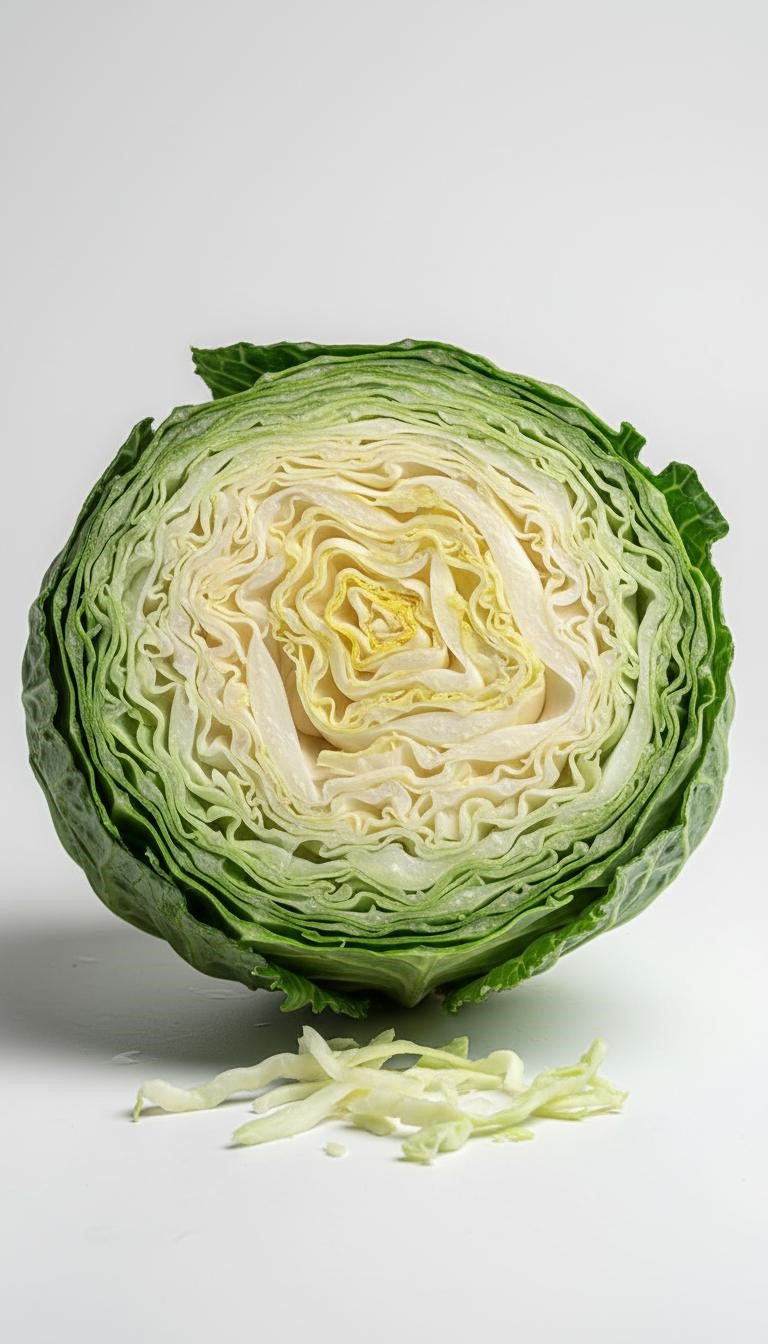
Today’s most popular varieties reflect this remarkable diversity. Green cabbage dominates global markets, accounting for roughly seventy percent of production, while red cabbage attracts health-conscious consumers with its anthocyanin-rich profile. Savoy cabbage, developed in sixteenth-century Germany, offers crinkled leaves and delicate flavor prized by chefs. Asian cuisines rely heavily on Napa and bok choy, both descendants of the same Brassica lineage yet radically different in texture and taste.
Records for extreme cabbage cultivation capture public imagination. In 2012, Scott Robb of Palmer, Alaska, set the Guinness World Record with a colossal 138.25-pound green cabbage, grown under the Midnight Sun with nearly twenty hours of daily light. At the opposite end of the spectrum, miniature forms like baby bok choy and single-serving Brussels sprouts demonstrate how selective breeding can shrink the vegetable to bite-sized proportions.
Global cabbage production now exceeds seventy-one million metric tons annually, placing it among the top five vegetable crops worldwide. China alone contributes nearly half of all output, followed by India, Russia, and South Korea. From German sauerkraut to Korean kimchi, from Nigerian stews to American coleslaw, cabbage anchors traditional dishes across cultures.
Symbolically, cabbage carries surprising weight. In Chinese culture, the word bai cai sounds like “one hundred wealth,” making the vegetable a Lunar New Year emblem of prosperity. During the early twentieth century, both American and Russian slang adopted “cabbage” as a term for money, perhaps because green banknotes resembled folded leaves. Its layered structure has inspired metaphors for human complexity—peeling back each leaf reveals something new underneath.
What changed most dramatically over millennia is cabbage’s social status. Once considered a Roman luxury fit for scholarly treatises, it became medieval peasant fare, then a maritime medical necessity, and finally a global commodity available year-round. Modern breeding has emphasized shelf life and transport durability, sometimes sacrificing the intense sweetness of freshly harvested heads. Yet despite industrialization, this ancient vegetable continues connecting dinner tables to Mediterranean cliffs and Greek physicians, proving that the simplest ingredients often carry the deepest histories.