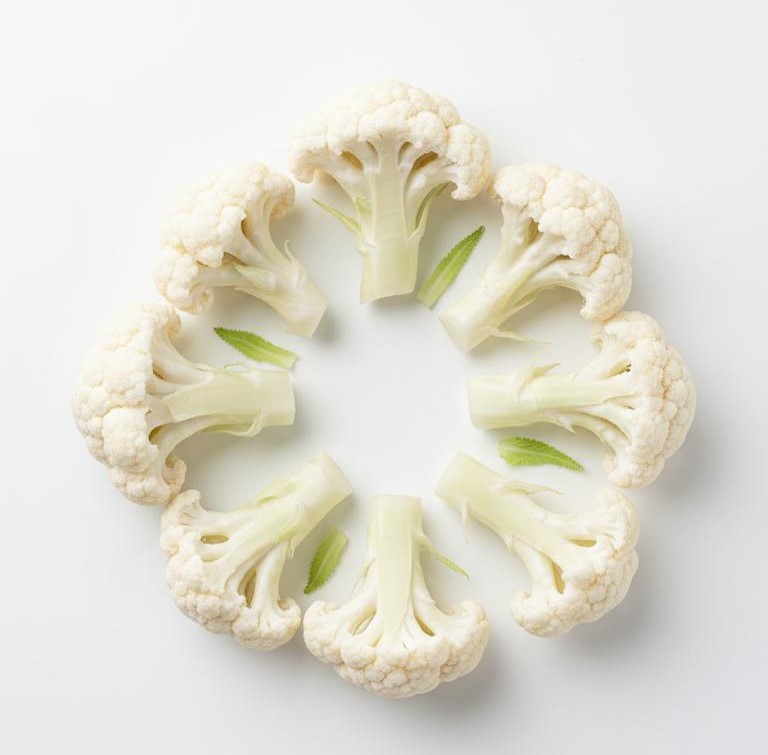
Long before it became a low-carb icon, cauliflower emerged from the sun-baked cliffs of the Mediterranean as an unassuming wild cabbage. Botanists trace its lineage to Brassica oleracea, the same rugged coastal plant that gave rise to broccoli, kale, and Brussels sprouts. Genetic evidence points toward the Aegean region as the cradle of cultivation, where ancient farmers began coaxing dense, pale flower heads from weedy ancestors roughly 2,500 years ago.
Ancient writers did notice its forebears. Roman naturalist Pliny the Elder praised cyma in his Natural History around 77 AD, describing the flowering shoots of an early Brassica variety as the most pleasant-tasting of all cabbages. Medieval Arab botanists Ibn al-‘Awwam and Ibn al-Baitar documented cauliflower more precisely in the 12th and 13th centuries, linking its origins to Cyprus and establishing a seed trade that fed European gardens for centuries. By the 15th century, Italian horticulturists had refined the vegetable into something recognizable today, and from Genoa it traveled to France, where it remained rare until the reign of Louis XIV.
The wild predecessor of modern cauliflower was a loose-leaved coastal plant—hardly the compact, snow-white curd found in produce bins now. Through relentless selective breeding, farmers arrested the plant’s normal flowering process to create the dense head, or curd, that defines the crop. Some historical varieties have vanished entirely. The Cornish type, once used to develop India’s tropical cauliflower strains, was abandoned as newer cultivars took over. Other antique forms survive only in seed banks and scholarly footnotes.
Today’s most popular varieties reveal the plant’s remarkable plasticity. White cauliflower still dominates global markets, yet colored mutations have carved out loyal followings. Purple cauliflowers borrow anthocyanins from red cabbage, while orange varieties—first discovered as a chance mutation in a Canadian field in 1970 and later refined at Cornell University—deliver extra vitamin A. Green cauliflower and Romanesco, with its mesmerizing fractal spirals, attract chefs seeking visual drama. The four major groups—Italian, Northern European annual, Northwestern European biennial, and Asian—reflect distinct climates and culinary traditions.
Extreme specimens capture public imagination. In 2014, British gardener Peter Glazebrook set the Guinness World Record with a cauliflower weighing 27.48 kilograms, roughly sixty pounds, with foliage spreading six feet in diameter. At the opposite scale, miniature cultivars and single-serving Romanesco heads demonstrate how breeders can shrink the plant without sacrificing flavor.
Global cauliflower production now exceeds twenty-six million metric tons annually, with China and India together accounting for roughly seventy-five percent of the world’s supply. The United States, Spain, and Mexico contribute significant volumes, yet the vegetable’s cultural impact extends far beyond tonnage. Over the past decade, cauliflower has experienced a stunning renaissance as a low-carb and gluten-free substitute, transforming into rice, pizza crusts, tortillas, and crackers. American per capita availability, which peaked at 3.6 pounds in 1946 before falling to 1.2 pounds in 2012, rebounded to nearly 3 pounds by 2019.
Symbolically, cauliflower carries subtle weight. Its name derives from the Italian cavolfiore, meaning cabbage flower, and for centuries its pale, brain-like curd suggested intellect and contemplation. Romanesco’s logarithmic spirals have fascinated mathematicians as much as chefs, embodying natural geometry. In earlier eras, cauliflower signified luxury and refinement; today it signals health consciousness and dietary adaptability.
What changed most profoundly is the vegetable’s identity. Once a temperamental crop requiring blanched leaves and careful tending to shield its delicate curd from sunlight, it has become an industrial ingredient and a home-kitchen staple. Modern breeding emphasizes shelf stability and versatility over the delicate, almost buttery flavor of heritage varieties. Yet from Cypriot seed markets to Canadian mutation fields, from Louis XIV’s court to keto-diet cookbooks, cauliflower continues proving that a single species, patiently shaped by human hands, can reinvent itself across millennia.