
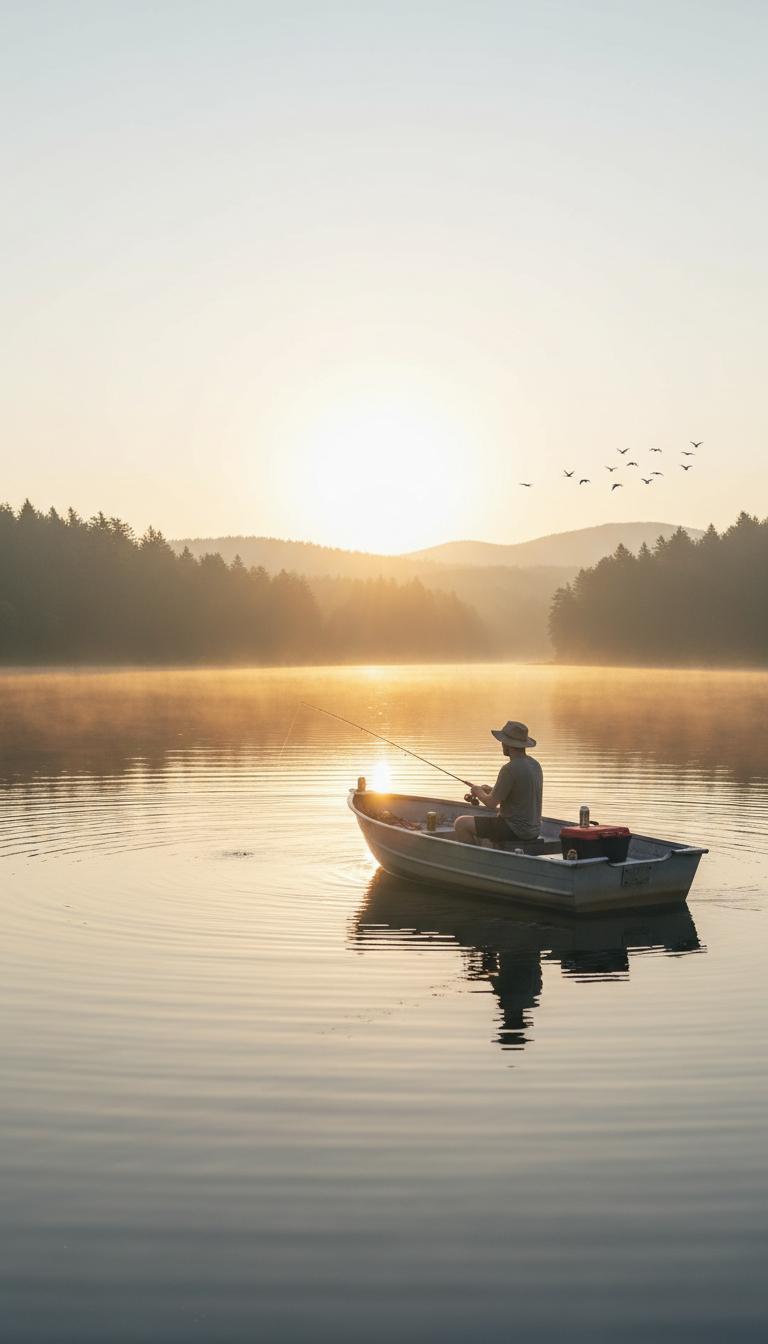
The lake does not announce itself. Unlike the ocean, which crashes and withdraws in theatrical cycles, a lake simply waits. Its surface may ripple or freeze, but beneath the plane of light and air, life continues in a slower, older rhythm. For as long as humans have needed protein and patience, lake fishing has offered both in equal measure. It is the most democratic form of angling, requiring neither a boat built for storms nor tackle designed for marlin. A stick, a line, and a worm will suffice. Yet this simplicity conceals a history as deep and layered as the thermocline itself.
The earliest evidence of lake fishing is almost impossible to separate from river fishing in the archaeological record. Both environments offered the same essential transaction: still or slow-moving water where fish concentrated, where nets could be cast and traps set with predictable results. The predecessor of all organized fishing was the simple gorge—a sharpened sliver of bone or wood that lodged in the fish’s throat when the line was pulled. By the Mesolithic period, roughly ten thousand years ago, lakeshore communities across Europe, Asia, and the Americas had developed sophisticated weirs, nets, and hooks tailored to local species. The Swiss lake dwellings of the Neolithic, preserved in the mud of Alpine waters, contain some of the finest surviving examples: bone hooks, flax nets, and preserved fish bones that reveal a diet heavily dependent on perch, pike, and various cyprinids.
The Bible mentions lake fishing with a specificity that the ocean rarely receives. The Sea of Galilee, actually a freshwater lake fed by the Jordan River, is the setting for some of the New Testament’s most pivotal scenes. Simon Peter, Andrew, James, and John were all halieis—a Greek term that can mean either fishermen or sailors, but in this context clearly describes men who cast nets from small boats on a lake. The miracle of the loaves and fishes, the calling of the disciples, and the post-resurrection breakfast on the shore all center on this modest body of water. For early Christians, the lake fisherman became a foundational archetype: patient, humble, and spiritually receptive. The fish itself—ichthys—became a secret symbol of the faith, though this referred more broadly to aquatic life than specifically to lake species.
Medieval Europe developed lake fishing into a regulated resource. Monasteries, which controlled vast tracts of land including lakes and ponds, managed fish stocks with the same bureaucratic precision they applied to grain harvests. Carp, originally imported from Asia to European monastery ponds in the 12th and 13th centuries, became the dominant cultivated lake fish. The monks valued carp for its ability to survive in stagnant, low-oxygen water and its rapid growth rate. By the late Middle Ages, carp ponds were a standard feature of noble estates from Bohemia to Bavaria, and the fish became synonymous with feast days, particularly Christmas Eve in Central European traditions.
The species that dominate lake fishing today vary dramatically by geography and climate. In North America, the black bass family—largemouth and smallmouth—reign supreme among sport anglers, though walleye, northern pike, muskellunge, and various panfish species like bluegill and crappie command enormous followings. The Great Lakes support commercial and recreational fisheries for salmon, trout, and whitefish that behave like oceanic species in their size and migration patterns. In Europe, pike, perch, zander, and various carp species remain the classic targets, with coarse fishing—angling for non-salmonid species—evolving into a distinct culture with its own etiquette and equipment traditions. African lakes like Victoria and Tanganyika support massive tilapia and Nile perch fisheries that sustain millions, though overfishing and invasive species have devastated native cichlid populations.
What has changed most profoundly is the relationship between the angler and the lake. For millennia, fishing was subsistence or commerce. The sport angler—the person who catches fish for pleasure and releases them alive—is a relatively modern invention, emerging in earnest in 19th-century Britain with the codification of fly-fishing and catch-and-release ethics. Izaak Walton’s The Compleat Angler, published in 1653, is often cited as the foundational text of recreational fishing, though its focus was primarily on rivers. Lake fishing as a dedicated leisure pursuit exploded in the 20th century with the democratization of automobiles, affordable fiberglass boats, and the post-war expansion of suburban populations with weekend time to fill.
The modern lake angler operates in a landscape of paradox. Technology has transformed the sport: sonar fish finders, GPS mapping, and precision-engineered lures allow anglers to locate and tempt fish with scientific efficiency. Yet the same technology has sparked a counter-movement toward simplicity—tenkara-style minimalism, hand-carved wooden lures, and a renewed reverence for the quiet that originally drew people to lakeshores. Social media has turned trophy catches into content, yet has also fueled conservation awareness and catch-and-release practices that would have baffled earlier generations who viewed every fish as calories.
Symbolically, the lake fisherman occupies a space of contemplative solitude. Unlike the deep-sea angler battling elements and monsters, the lake angler faces a more intimate opponent. The water is knowable, the horizons close enough to feel personal. The lake does not threaten; it merely withholds. Success requires not strength but understanding—of temperature layers, seasonal migrations, the precise moment when a bass will strike a surface lure. It is fishing as meditation, and this is why the image of the solitary figure on a quiet lake remains one of our culture’s most persistent icons of peace.
From monastery ponds to bass boats equipped with more electronics than the Apollo missions, lake fishing has proven endlessly adaptable. It has fed empires, inspired prophets, and given millions of ordinary people a reason to wake before dawn. The lake does not care whether you come for dinner or for peace. It simply waits, as it has always waited, beneath the surface.