
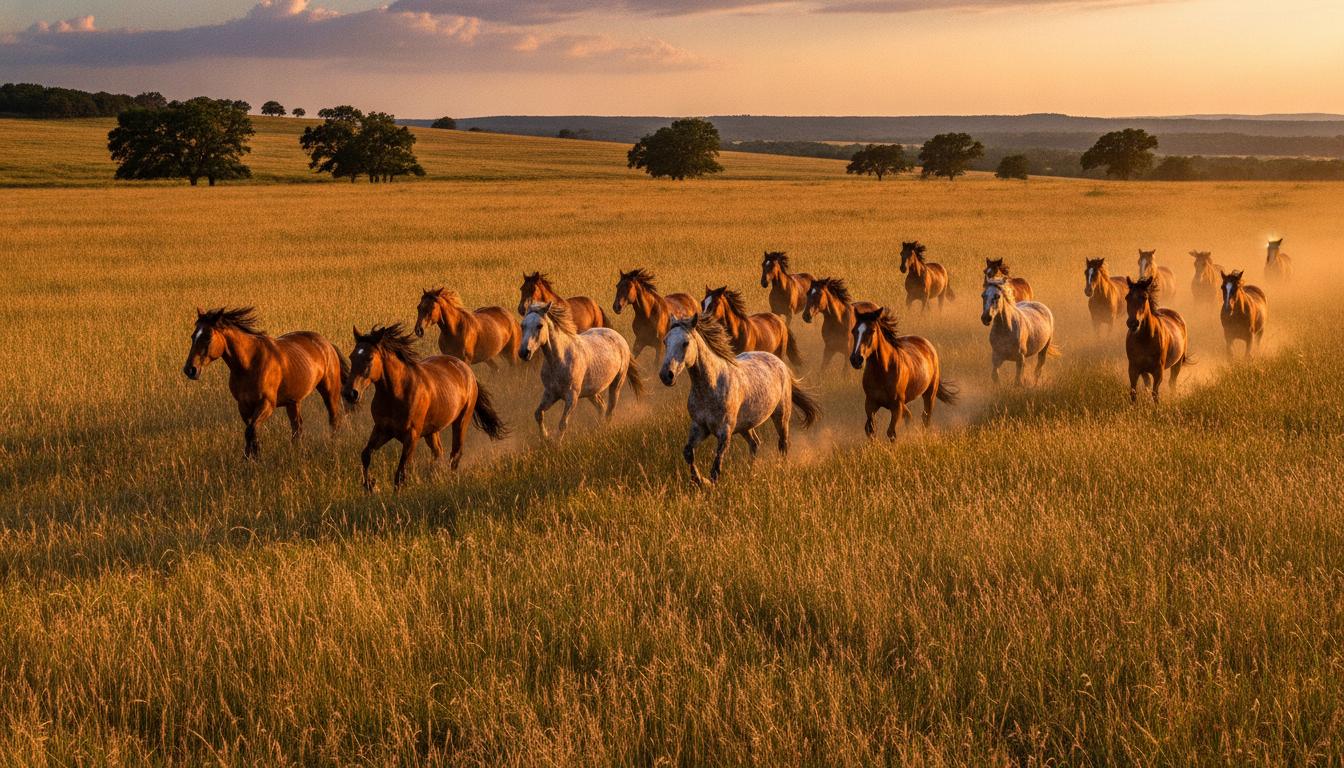
Before the internal combustion engine, before the steam whistle, before the sail even, there was a different kind of power on Earth. It stood sixteen hands high at the shoulder, breathed through flared nostrils, and could carry a human farther and faster than any animal before or since. The horse did not merely change history. It compressed it, collapsing distances that once measured in months into days, and in doing so, rewrote the geography of empire, agriculture, and the human soul.
The story begins not with grandeur, but with a small, dog-sized creature called Eohippus, the “dawn horse,” browsing on leaves in North American forests some fifty-five million years ago. Over millennia, this modest ancestor evolved through multiple forms, growing larger, developing the single hoof, and migrating across land bridges into Asia and Europe. Then, in one of evolution’s stranger plot twists, horses went extinct in the Americas around ten thousand years ago, victims of climate change and early human hunting pressure. They survived only in the Old World, meaning that when Columbus arrived in the New World, he reintroduced an animal that had essentially come home.
The domestication of the horse represents one of the most consequential partnerships in human history. Archaeological evidence points to the Pontic-Caspian steppe, the vast grasslands north of the Black Sea, around six thousand years ago. The Botai people of modern Kazakhstan were among the earliest to keep horses for milk and meat, but the true revolution came slightly later, when someone—some forgotten genius—climbed onto a horse’s back and stayed there. The date is debated, but by four thousand years ago, horseback riding had transformed the Eurasian steppe into a highway of migration, trade, and conquest.
The Bible mentions horses with the ambivalence of a text that knows their power. In Genesis, the patriarchs ride donkeys and camels; horses appear later, associated with Egypt and military might. The Book of Exodus describes Pharaoh’s chariots pursuing the Israelites, and the prophet Isaiah warns that Israel’s trust in horses rather than in God will lead to destruction. Yet by the time of Solomon, horses had become symbols of royal wealth and international prestige. The king maintained four thousand stalls for chariot horses and imported them from Egypt and Kue, a trade so lucrative that it is mentioned as one of his defining achievements. In the Book of Revelation, the Four Horsemen of the Apocalypse ride white, red, black, and pale horses—images so enduring that they have shaped Western eschatology for two millennia.
The ancient Greeks and Romans elevated the horse to near-divine status. The Trojan Horse, whether historical or mythological, remains one of the most potent symbols of deception in Western culture. Alexander the Great’s horse Bucephalus was said to be so fierce that only Alexander could ride him; when the horse died in battle, Alexander founded a city in his name. Roman cavalry defined the expansion of the empire, and the Circus Maximus hosted chariot races that drew crowds of hundreds of thousands. The horse was not merely transport. It was entertainment, status, and military supremacy rolled into a single muscular package.
The taxonomy of modern horses is both vast and surprisingly narrow. All domestic horses belong to the species Equus caballus, but centuries of selective breeding have produced distinct types optimized for wildly different purposes. The Arabian, with its dished face and high tail carriage, is the oldest purebred horse, its lineage traced back four thousand years in the deserts of the Arabian Peninsula. The Thoroughbred, developed in 18th-century England through the crossing of native mares with imported Arabian, Turkoman, and Barb stallions, dominates modern racing. The Quarter Horse, bred for sprinting short distances in the American West, remains the most popular breed in the United States by registration numbers. Draft breeds like the Clydesdale, Percheron, and Shire once pulled plows and wagons across continents; today, they survive primarily in parades, breweries, and the hearts of enthusiasts who refuse to let their massive gentleness vanish.
Geographically, the United States has the largest horse population of any nation, followed by Mexico, China, and Brazil. Yet the emotional center of horse culture arguably remains in the steppes of Central Asia, where Mongolia maintains the highest ratio of horses to humans in the world, and where the traditional sport of kokpar—a brutal form of polo played with a goat carcass—continues a nomadic tradition that predates recorded history.
What has changed most dramatically is the horse’s relationship to necessity. Until the early 20th century, horses powered agriculture, transportation, warfare, and communication. The Pony Express crossed America in ten days. Cavalry charges decided the fates of nations. Urban streets were layered with manure and the percussive rhythm of hooves. Then, in the span of a single generation, the automobile and the tractor rendered the horse obsolete for practical purposes. The population collapsed. Breeds that had once numbered in the millions faced extinction. The American Mustang, descended from Spanish colonial stock, was hunted to near-elimination. The Cleveland Bay, once the preferred carriage horse of British royalty, dwindled to fewer than a hundred individuals.
Yet the horse refused to disappear. It transformed from engine to companion, from tool to therapist. Equine-assisted therapy programs now serve veterans with PTSD, children with autism, and individuals recovering from trauma. The global equestrian industry generates billions annually in sport, breeding, and leisure. Social media has created a new class of equine influencer—rescue horses with millions of followers, trainers who broadcast their methods to global audiences, and breeds like the Friesian, with its flowing black mane and Baroque presence, that have become symbols of equine beauty in the digital age.
Symbolically, the horse occupies a space of almost unbearable richness. It represents freedom and control simultaneously—the wild mustang and the disciplined dressage mount. It carries the warrior and the healer, the conqueror and the conquered. In mythology, it is prophetic; in dreams, it is the unconscious itself, galloping beyond the reach of language.
From a small forest browser to a global cultural force, the horse has proven that partnership can outlast utility. We no longer need them to plow our fields or carry our mail. We need them for something older and harder to name: the reminder that power can be beautiful, that speed can be silent, and that sometimes the most human thing we can do is sit quietly while something magnificent breathes beside us.