
The story begins in the sun-scorched vineyards of Emilia-Romagna, where Roman cooks already reduced grape must into a sweet, dense syrup called sapa. By the Middle Ages, monasteries around Modena and Reggio Emilia had begun storing these reductions in wooden casks, discovering that years of evaporation and fermentation produced something extraordinary. What emerged was not mere vinegar. It was aceto balsamico—the name itself drawn from balsam, the ancient word for healing elixir. Renaissance nobility treated it as medicine, sipping small doses for digestion, and families began passing barrel sets down through generations as part of a daughter’s dowry. A battery of barrels was never just property; it was liquid ancestry.
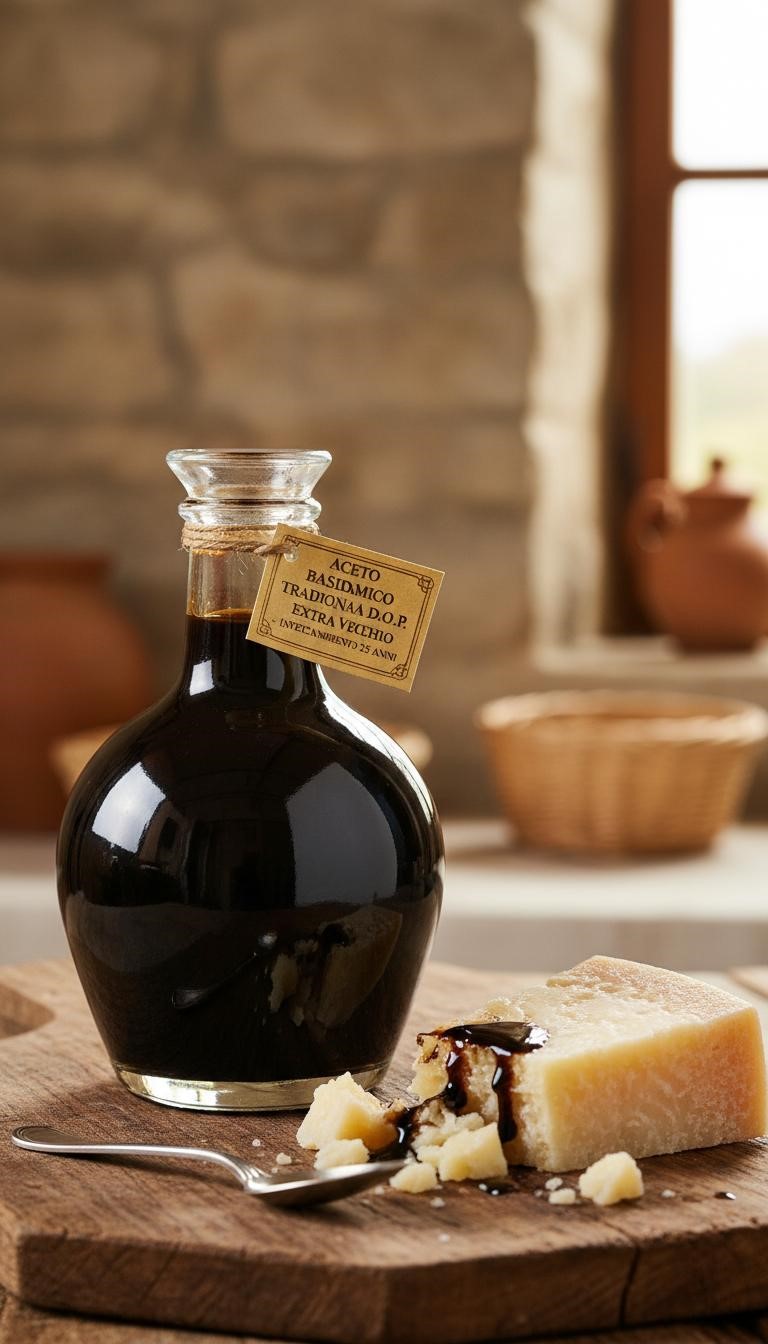
The authentic tradition remains fiercely local. True Aceto Balsamico Tradizionale DOP can come only from Modena or Reggio Emilia, produced from cooked Trebbiano grape must and aged through a sequence of progressively smaller barrels—oak, chestnut, cherry, ash, mulberry, and juniper—each lending its whisper to the final symphony. The Affinato spends a minimum of twelve years in darkness; the Extra Vecchio, like the one in the photograph, endures for at least twenty-five. By law, nothing else may be added. No caramel. No wine vinegar. No shortcuts.
Yet the twentieth century nearly drowned the tradition in imitation. Mass-market bottles flooded shelves worldwide, blending wine vinegar with caramel coloring and calling the result balsamic. The real thing became endangered not by disappearance but by impersonation. Today, protected designations exist precisely because authenticity had to be legally defended against its own popularity.
The cheese beside the bottle matters as much as the vinegar itself. Parmigiano Reggiano, with its crystalline crunch and savory depth, provides the perfect stage for balsamic’s sweet-acid complexity. Pecorino aged to brittleness, or the gentler Grana Padano, offer alternative dialogues. The pairing is never accidental. The salt and umami of the cheese catch the vinegar’s dark fruit and wood smoke, creating a balance that needs no bread, no garnish, no distraction.
Globally, balsamic vinegar has become one of Italy’s most recognizable culinary ambassadors, drizzled over strawberries in Tokyo, reduced into glazes in California, and whisked into dressings in Sydney. But its heart remains in those quiet attics above Modena, where vinegar masters move liquid from barrel to barrel with the gravity of priests performing liturgy.
What changed most is our relationship with waiting. In an era of instant everything, balsamic vinegar demands the one ingredient technology cannot synthesize: decades. Every bottle of Extra Vecchio contains a quarter-century of seasonal breath, of summer heat and winter chill, of a family’s quiet vigilance. When poured over cheese, it is not merely a condiment. It is time itself, made delicious.