
A Recipe Older Than Most Countries
In the quiet library of Admont Abbey, high in the Austrian Alps, a centuries-old manuscript keeps one of Europe’s sweetest secrets. Tucked between its pages, written in fading ink, is a recipe from 1653 — for a cake that would become the Linzer torte. That makes it arguably the oldest cake recipe in the world, older than the United States, older than most kingdoms of Europe. While empires rose and fell, this humble recipe survived — passed from hand to hand, kitchen to kitchen, century to century.
But a recipe is never just a list of ingredients. It is a story of the place that created it.
The City of Linz and Its Golden Dough
Linz, the elegant city on the Danube, was in the 17th century a crossroads of the world. Ships brought exotic treasures upstream: cinnamon from Ceylon, cloves from the Moluccas, lemons from the Mediterranean. Someone — perhaps a clever baker’s wife, perhaps a monastery cook — had the brilliant idea of folding all of that into a dough made of ground hazelnuts and almonds.
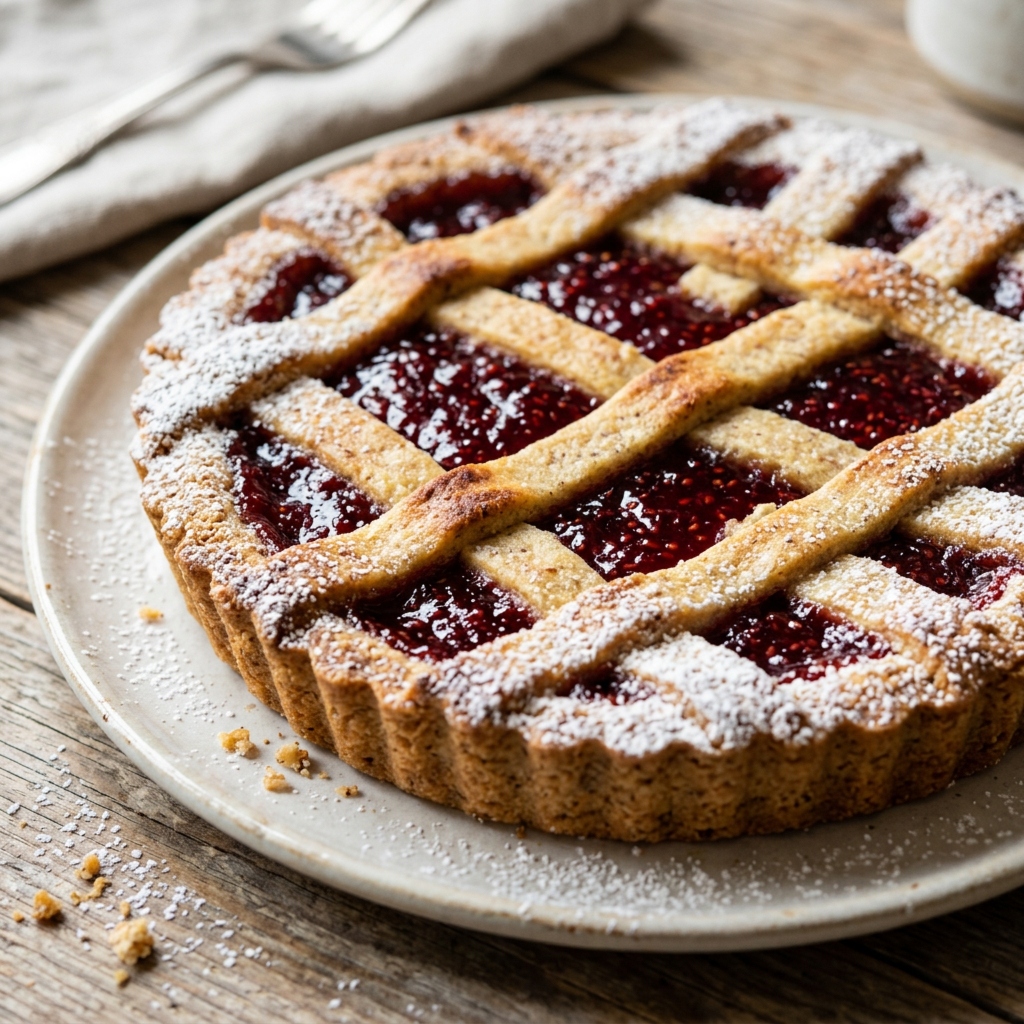
The result was revolutionary: a crust that was part pastry, part treasure chest, spiced like a winter market and rich with nuts. And then came the finishing touch — a layer of bright red currant or raspberry jam, hidden like a ruby under a golden lattice of dough strips.
Legend whispers that the lattice was inspired by the gothic windows of Linz Cathedral — whether true or not, no one can say. But look at a Linzer torte today, and you will still see those little “windows” glowing with red light, exactly as they did almost four centuries ago.
From Coffeehouses to Christmas Markets
By the 19th century, the Linzer torte had conquered Vienna. In the grand coffeehouses of the imperial capital, where writers, musicians and philosophers debated the fate of the world, the torte became a symbol of Austrian Gemütlichkeit — that untranslatable word for cozy, unhurried pleasure. It was the cake of family Sundays, of Christmas markets smelling of mulled wine, of grandmothers rolling dough on flour-dusted tables.
The Great Journey Across the Ocean
But the story doesn’t end in Austria. In the 1800s, thousands of German and Austrian immigrants packed their belongings — and their recipes — and crossed the Atlantic. The Linzer torte sailed with them to America, where it slowly transformed. The big festive cake became smaller, more practical: Linzer cookies, little rounds with a peek-hole of jam in the center, known in German as “Linzer Augen” — Linzer eyes.
Today, those eyes look out from American bakery windows every December, while the original torte still graces Austrian Christmas tables — two continents, one recipe, one shared memory.
A Cake That Time Couldn’t Touch
What makes the Linzer torte immortal? Perhaps it is its honesty — no cream, no fancy decoration, just nuts, spices, jam and dough. Or perhaps it is the lattice itself: a pattern so beautiful it never needed to change.
Every time someone criss-crosses those strips of dough over red jam, they repeat a gesture made in the 1600s, in a kitchen long gone, in a world long gone. The Linzer torte is not just a dessert. It is a time machine — and it still tastes like history.