
Few vegetables can claim a resume as long as celery’s. Long before it became a crunchy snack or the base of soups and stocks, Apium graveolens grew wild in the salt marshes of the Mediterranean, where ancient Egyptians gathered it for medicine and ritual. When archaeologists opened the tomb of Tutankhamun in the 1920s, among the treasures was something surprisingly humble: a garland of wild celery, left to accompany the young pharaoh into the afterlife some 3,300 years ago.
The ancient Greeks called it selinon and loved it with almost contradictory passion. Homer describes wild celery growing around Calypso’s cave in the Odyssey, while on the island of Sicily a whole city, Selinous, took its name from the plant and stamped its leaves on coins. Greek athletes who won the Nemean Games were crowned with celery wreaths, the equivalent of today’s gold medals, yet the herb was also woven into funeral garlands and associated with mourning. Celery carried that double symbolism of victory and farewell for centuries, while Roman naturalist Pliny the Elder praised its medicinal powers and recommended chewing the seeds.
Curiously, the Bible never mentions celery by name, although the plant certainly grew in the ancient Near East. Its close relatives appear repeatedly — dill, cumin, coriander — so historians suspect celery was known there simply under different local names.
For most of its history, people ate celery’s leaves and seeds rather than the crisp stalks we know today. The Romans used it as a seasoning, and medieval Europeans chewed it as a digestive remedy. The stalk celery we recognize was born in the gardens of Italy and France in the 17th century, when growers discovered that covering the plant with soil kept it pale, tender, and sweet. The laborious trenching method made celery a luxury so prestigious that 19th-century American households displayed it in special glass vases at formal dinners. Only in the late 1800s did growers like Calvin Keeney breed self-blanching, stringless varieties such as Pascal, finally bringing celery to ordinary tables.
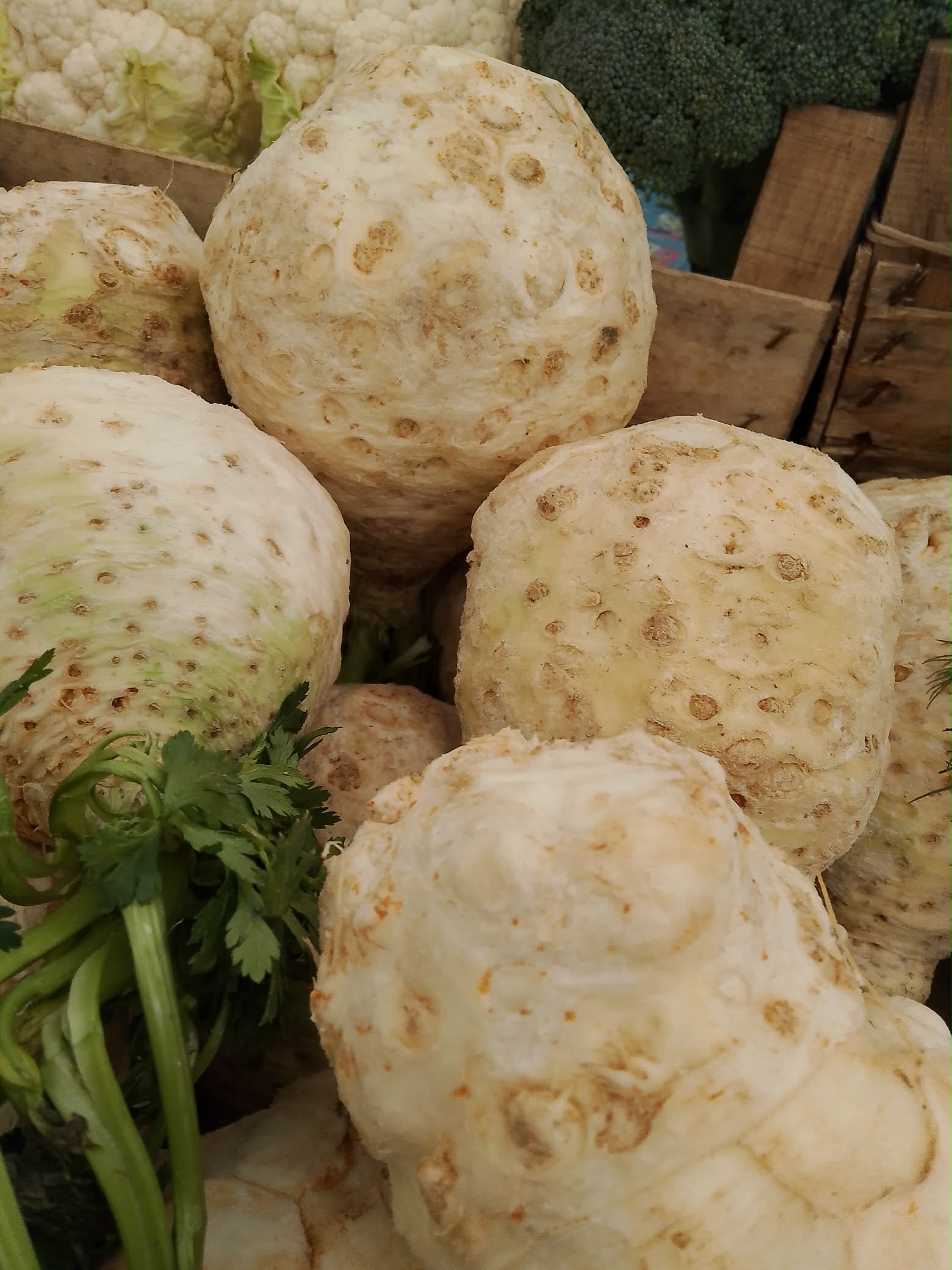
Botanically, three forms exist. Stalk celery (Apium graveolens var. dulce) is the familiar ribbed bunch; celeriac (var. rapaceum) is grown for its knobby root, a staple of French bistro cuisine; leaf celery (var. secalinum), the closest to wild smallage, flavors soups in Eastern Europe and Asia. In China, where the plant has been cultivated for centuries, cooks prefer thinner, more aromatic stalks, including crimson-tinged red varieties unknown in the West.
Today celery is quietly everywhere: diced in the mirepoix of French cooking, spooning up peanut butter in American lunchboxes, and juiced by the liter in wellness routines. China produces the bulk of the world’s crop, while the United States, especially Michigan, remains a major grower. Modern breeding delivered varieties that stay crisp longer, resist disease, and need no blanching, transforming a delicacy into an everyday staple.
And yet celery’s old symbolism lingers. Health writers celebrate it as nature’s water bottle — about 95 percent liquid, barely 16 calories per stalk, rich in vitamin K and fiber. From a pharaoh’s wreath to a supermarket staple, celery keeps proving that the simplest plants often carry the richest stories.