
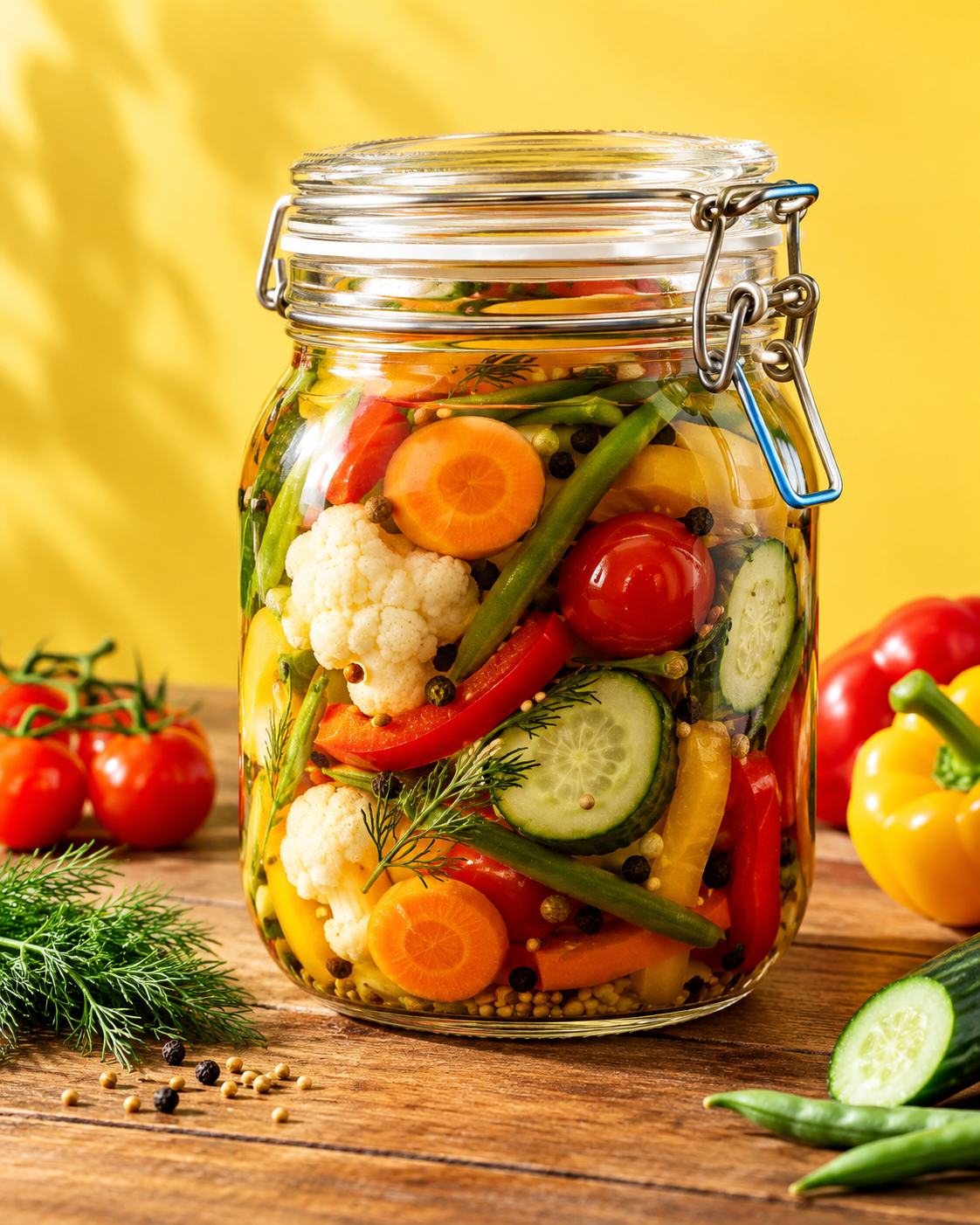
Long before supermarkets and refrigeration, humanity solved one of its oldest problems with salt, vinegar, and patience — turning the autumn harvest into food that could survive until spring. The tradition of preserving vegetables, is far older than any written recipe book, and its roots stretch back nearly four millennia.
Most food historians agree that the first preserved vegetables appeared in Mesopotamia and the Indus Valley around 2000 BC. The cucumber, originally from the Himalayan foothills, was carried west along ancient trade routes and became one of the first vegetables ever pickled — records suggest the Babylonians were salting cucumbers in vinegar as early as 2030 BC. In a world without canning jars, salt fermentation was revolutionary: it kept food edible, prevented illness, and made long winters survivable.
Over the centuries, preserved vegetables became more than survival food. In Central European households, a full pantry of jars symbolized prosperity, diligence, and a well-ordered home. Sauerkraut — fermented cabbage documented in China thousands of years ago before spreading through Europe — was once prized by sailors, as its vitamin C content protected crews on long voyages. Pickled cucumbers became a staple from Russia to America, carried by immigrants who refused to abandon the taste of home.
Today, the most beloved preserved vegetables remain pickled cucumbers, sauerkraut, pickled peppers, ajvar, green tomato relish, and mixed pickled salads. Some varieties, however, have nearly disappeared — not because they were forgotten, but because modern agriculture changed everything. Heirloom pepper and tomato varieties once grown in village gardens were replaced by uniform hybrids bred for transport rather than flavor, so the small-batch preserves made from them slowly vanished. Urbanization also played its part: fewer families have gardens, cellars, or time for days of boiling jars.
Yet the story has come full circle. Fermentation is experiencing a remarkable global revival, driven by growing interest in gut health, probiotics, and natural foods. What was once labor born of necessity is now a culinary craft — artisanal small-batch pickles appear at farmers’ markets, chefs experiment with kimchi and kombucha, and young families rediscover their grandmothers’ recipes.
From Babylonian salt cellars to modern glass jars, preserved vegetables tell the story of human ingenuity. A simple cucumber in vinegar is never just food — it is memory, heritage, and the quiet triumph of autumn over winter.