
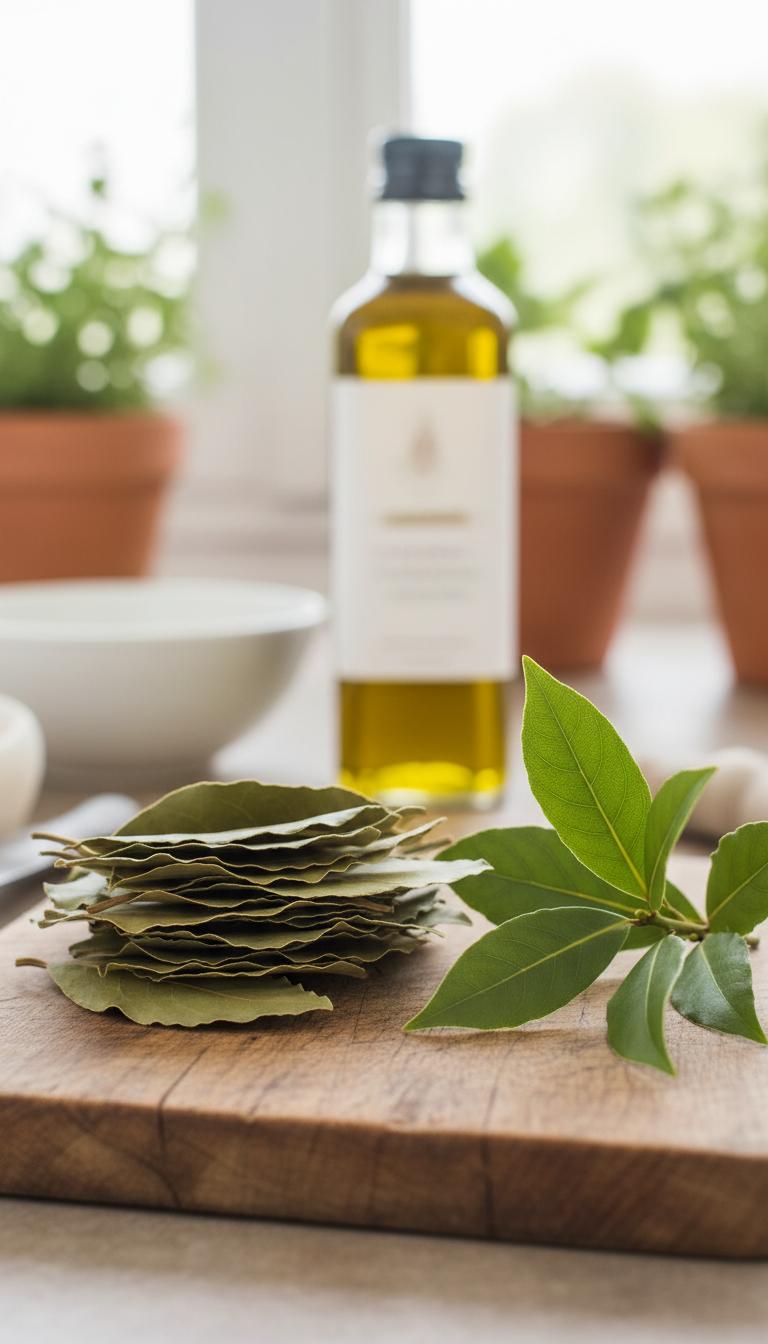
Tucked inside a dusty jar at the back of nearly every kitchen cabinet sits a leaf that once crowned conquerors. The bay leaf, or Laurus nobilis, has witnessed the rise and fall of empires, inspired one of mythology’s most poignant transformations, and survived the journey from divine symbol to humble soup seasoning. Its story is quieter than that of cinnamon or pepper, yet it carries a weight of symbolism that few kitchen staples can match.
The ancient Greeks treated the bay tree as sacred to Apollo, god of prophecy, music, and light. According to Ovid, the nymph Daphne escaped the god’s unwanted advances by transforming into a laurel tree, after which Apollo declared the plant his eternal emblem. Victors of the Pythian Games near Delphi received wreaths woven from its glossy branches, a tradition the Romans later adopted for their triumphant generals. When Julius Caesar paraded through Rome’s streets, the wreath upon his head was not gold but bay, a living symbol that he was, for that moment, something more than mortal.
The Bible offers a rare botanical cameo that many readers overlook. In Psalm 37:35, the King James Version renders the Hebrew as “I have seen the wicked in great power, and spreading himself like a green bay tree.” The image of the wicked flourishing like a spreading laurel speaks to the tree’s ancient reputation for vigorous, almost arrogant vitality. In Isaiah 44:14, some translations identify the wood used for idol-making as laurel or cypress, further embedding the tree in the spiritual landscape of the biblical world. It was never burned as incense nor pressed into sacred oil, yet its presence in scripture reveals a plant deeply familiar to the Mediterranean imagination.
The mythology surrounding this leaf is woven into the very language of achievement. The term “bachelor,” as in a university degree, derives from the Latin bacca lauri—”berry of the laurel”—referring to the wreath awarded to poets and scholars. To “rest on one’s laurels” originally meant to retire from competition while still wearing the victor’s crown, a phrase that has traveled from the stadium to the boardroom while losing none of its ancient judgment. The Poet Laureate of the United Kingdom still carries a title that whispers of Delphi’s groves.
Botanically, the bay leaf family is more diverse than most cooks realize. The true Mediterranean bay, Laurus nobilis, produces the narrow, olive-green leaves familiar to French and Italian kitchens, releasing subtle notes of eucalyptus and clove when simmered. The California bay, Umbellularia californica, offers a more aggressive, camphor-heavy punch that can overwhelm a delicate sauce if used carelessly. In India, tej patta—the leaf of Cinnamomum tamala—serves an entirely different culinary function in biryanis and kormas, while Indonesia’s daun salam (Syzygium polyanthum) carries a faint cinnamon whisper that perfumes Southeast Asian broths. These are not mere regional substitutes but distinct botanical personalities that happen to share a name.
The bay tree itself can reach twelve meters in height, an evergreen giant that resists the spectacular record-breaking of other spices. No one has baked the world’s largest bay leaf; instead, the plant’s grandeur lies in its longevity, with specimens living for decades in Mediterranean courtyards. The youngest spring leaves, barely an inch long and impossibly tender, are occasionally harvested in Greek mountain villages for a brief seasonal treat, as close to a “micro” version as this ancient plant allows.
Certain bay traditions have simply dried up and blown away. The Roman corona civica, a wreath of bay granted to citizens who saved others in battle, required actual living branches until the empire’s decline, when gold replicas took their place. The once-common practice of strewing fresh bay leaves on floors to perfume a room through foot traffic vanished with the invention of modern ventilation and, frankly, the vacuum cleaner. Wild Laurus varieties from North Africa’s Atlas Mountains, prized by Carthaginian traders, have faded into botanical obscurity as commercial cultivation consolidated around the Mediterranean coast.
What preceded the bay leaf’s culinary reign was likely the wild harvesting of Laurus nobilis in the Anatolian highlands, where the tree grew in such profusion that locals must have experimented with its aromatic potential long before Greek colonists formalized its use. The leap from temple offering to stew pot probably happened gradually, as priests and cooks shared the same Mediterranean sunlight.
Today, the bay leaf holds a peculiar position in global cuisine. It is essential—no bouquet garni is complete without it—yet it is also the subject of endless internet debates about whether it actually does anything. Food scientists have identified eucalyptol and pinene in its oils, compounds that subtly round out acidity and add depth during long simmers, but its contribution is architectural rather than flashy. The global essential oil market extracts tonics from bay for soaps and perfumes, while the dried leaf trade moves millions of units annually through supermarket chains.
What changed most profoundly is our relationship to its symbolism. A leaf that once declared divine favor and military supremacy now rests in a cardboard cylinder priced at three dollars. The modern cook tosses it into a bolognese without ceremony, yet the moment the heat releases its ancient oils, something of Apollo’s grove lingers in the steam. The bay leaf did not lose its power; we simply stopped wearing it on our heads and started hiding it in our sauces.