
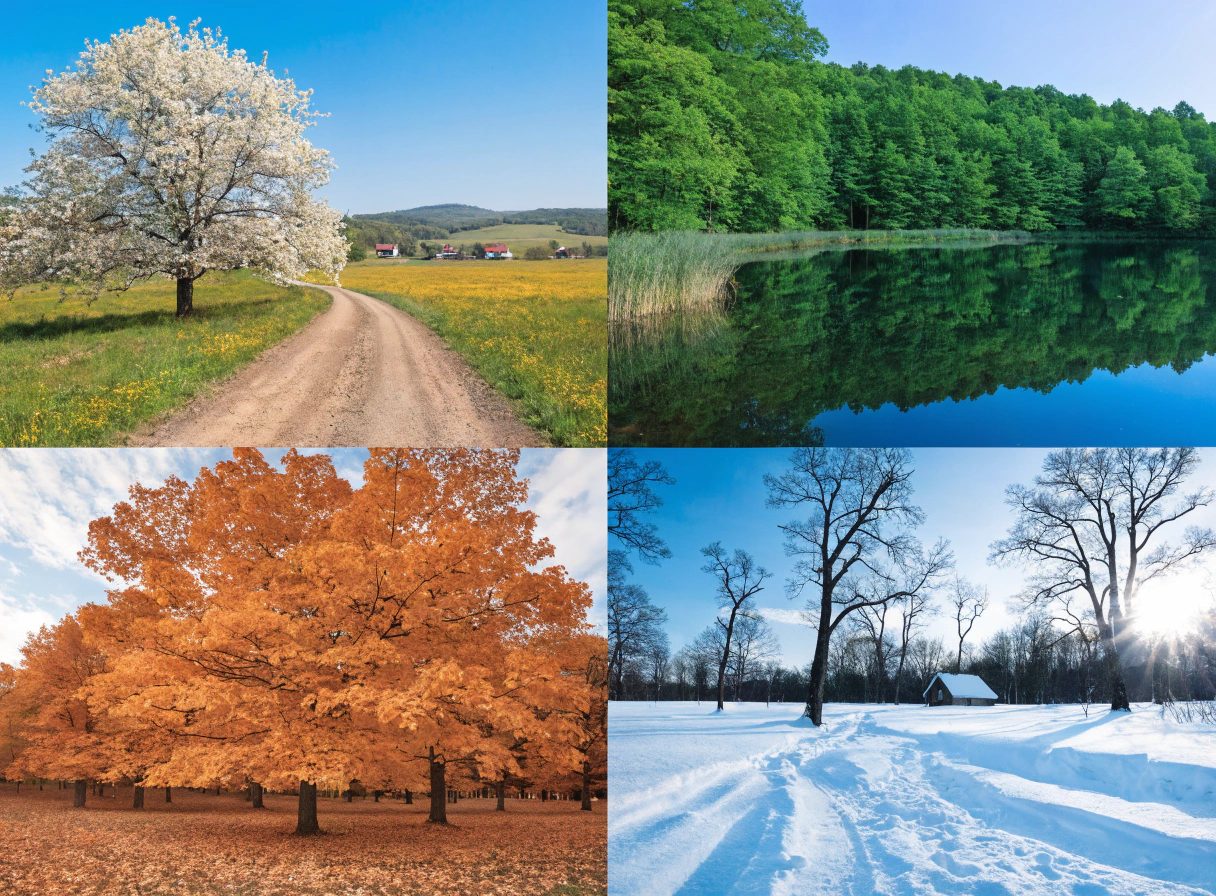
The seasons did not begin with human understanding, but our comprehension of them marks one of civilization’s earliest intellectual achievements. Astronomically, the cycle of spring, summer, autumn, and winter has pulsed for roughly four and a half billion years, ever since a catastrophic collision with a proto-planet knocked Earth off its vertical axis and sentenced us to an eternal 23.5-degree tilt. That cosmic accident is the true architect of every harvest festival, every winter migration, and every poet who ever mourned the falling leaves. Without it, our planet would lack the climatic variation that shaped agriculture, mythology, and the very rhythm of human life.
The Bible acknowledges this divine architecture with striking clarity. In Genesis 8:22, God promises Noah that “while the earth remaineth, seedtime and harvest, and cold and heat, and summer and winter, and day and night shall not cease.” The passage treats the seasons as a covenant, a guarantee of cosmic order after the chaos of the flood. Ecclesiastes 3:1 declares that “to every thing there is a season, and a time to every purpose under the heaven,” while the prophet Daniel credits the Almighty with changing “the times and the seasons.” These verses reveal a culture that saw seasonal change not as mere weather but as evidence of divine governance.
Yet the four-season model familiar to the Western world is only one way of reading the earth’s calendar. Ancient India divided the year into six ritus, from the scorching Grishma to the monsoon-soaked Varsha. Traditional Chinese astronomy recognized twenty-four solar terms, each roughly fifteen days long, guiding everything from planting millet to slaughtering pigs. Indigenous Australian cultures often observed as many as six seasons, dictated not by solstices but by the flowering of specific plants or the breeding cycles of animals. The ancient Egyptians ignored our modern divisions entirely, structuring their year around the Nile’s three phases: inundation, growth, and harvest.
The monuments our ancestors left behind testify to an obsession with tracking these transitions. At Newgrange in Ireland, a passage tomb built around 3200 BCE—predating the Egyptian pyramids—features a roof box that captures the winter solstice sunrise and illuminates the inner chamber for seventeen minutes each year. Stonehenge aligns with the summer solstice sunrise, while the ancient Maya constructed El Castillo at Chichén Itzá so that the spring and autumn equinoxes cast serpent-shaped shadows down its northern staircase. These were not simply calendars but theaters of cosmic drama, where priests and farmers gathered to confirm that the wheel was still turning.
The extremes of seasonal experience are staggering. In the polar regions, the tilt creates seasons so absolute that entire months dissolve into unbroken daylight or endless darkness. At the equator, the concept of four seasons becomes almost meaningless; temperature varies by mere degrees across the year, and locals often recognize only wet and dry periods. Even within the astronomical cycle, the seasons are not equal: due to Earth’s elliptical orbit, the Northern Hemisphere’s summer is approximately five days longer than its winter, a celestial asymmetry that has subtly shaped the evolution of growing seasons for millennia.
What preceded our modern seasonal awareness was the raw survival instinct of Ice Age hunters, tracking mammoth migrations and berry ripening without abstract names for the transitions. The first formal calendars emerged in Mesopotamia around 3000 BCE, when scribes began recording the heliacal rising of stars to predict the Nile’s flood or the Euphrates’ spring surge.
Today, the seasons still govern a global agricultural economy worth trillions, dictating when Argentine soybeans are planted and when German wheat is harvested. Yet something profound has shifted. Climate change is compressing winters and stretching summers beyond their historical bounds, causing cherry blossoms in Kyoto to bloom earlier than any recorded year and disrupting the hibernation cycles of species that have followed the same clock for millennia. Psychologically, Seasonal Affective Disorder now afflicts millions in high-latitude nations, a medical recognition that our biochemistry remains tethered to light cycles no office fluorescent can replace.
Symbolically, the seasons remain our most powerful metaphor for mortality itself. Spring is birth, summer is youth, autumn is maturity, and winter is the necessary end that precedes renewal. The ancient Greeks encoded this in the myth of Persephone, whose annual descent into the underworld explained winter’s barrenness and spring’s return. What changed is our relationship to that myth. We once accepted winter as a time of scarcity and rest; now we ship strawberries from Peru in December and blast air conditioning through August heat waves. The seasons have not disappeared, but our willingness to submit to them has. The tilt still turns, the solstice still comes, but we have learned to look away.