The Sea Star: Ancient Navigator of Earth’s Oceans
Beneath the waves of every ocean on Earth, from the sunlit shallows of tropical reefs to the crushing darkness of the abyssal plain, moves one of evolution’s most enigmatic creations. The sea star — often called starfish, though it is no fish at all — carries within its five-armed form a history stretching back half a billion years, a lineage that predates the dinosaurs, the first forests, and even the earliest vertebrates. Its story is one of radical transformation, ecological dominance, and a symbolism that has captivated human imagination across millennia.
The evolutionary origins of sea stars were, until very recently, shrouded in mystery. In 2021, researchers from the University of Cambridge and the University of Western Australia unveiled Cantabrigiaster fezouataensis, a 480-million-year-old fossil from Morocco’s Anti-Atlas mountains that represents the earliest known ancestor of all starfish-like animals. This creature was extraordinary precisely because it was so unlike its modern descendants — it lacked roughly 60% of a contemporary sea star’s body plan, instead resembling a hybrid between a sea star and a crinoid, those wavy-armed filter-feeders anchored to the seabed by cylindrical stems. Then, in June 2025, an even more ancient revelation emerged: Atlascystis acantha, a 500-million-year-old fossil from the same Moroccan region, revealed that the earliest echinoderms possessed only two symmetrical arms and bilateral body plans — the same symmetry shared by humans and 99% of animal species. The five-armed form we recognize today evolved later through the duplication of a single ambulacrum, a transformation that represents one of evolution’s most dramatic body-plan innovations.
The sea star’s ancient lineage has produced extraordinary diversity. Approximately 2,000 species now inhabit Earth’s oceans, ranging from the impossibly small to the genuinely monstrous. The smallest known species, Parvulastra parvivipara, discovered in 1975 off South Australia’s Eyre Peninsula, measures less than 9 millimeters in diameter — smaller than a fingernail clipping. At the opposite extreme, Midgardia xandaros dwells in the Gulf of Mexico at depths around 2,000 feet, its twelve arms spanning an astonishing 53 inches despite a central disc barely one inch across. The sunflower sea star (Pycnopodia helianthoides), once abundant along North America’s Pacific coast from Alaska to Southern California, holds the record among well-studied species with up to 24 arms and a diameter exceeding three feet. Yet this magnificent creature now faces a catastrophic decline — a mysterious wasting disease has devastated populations, earning it a critically endangered listing from the International Union for Conservation of Nature, and scientists at the University of Washington are racing to breed them in captivity for potential reintroduction.
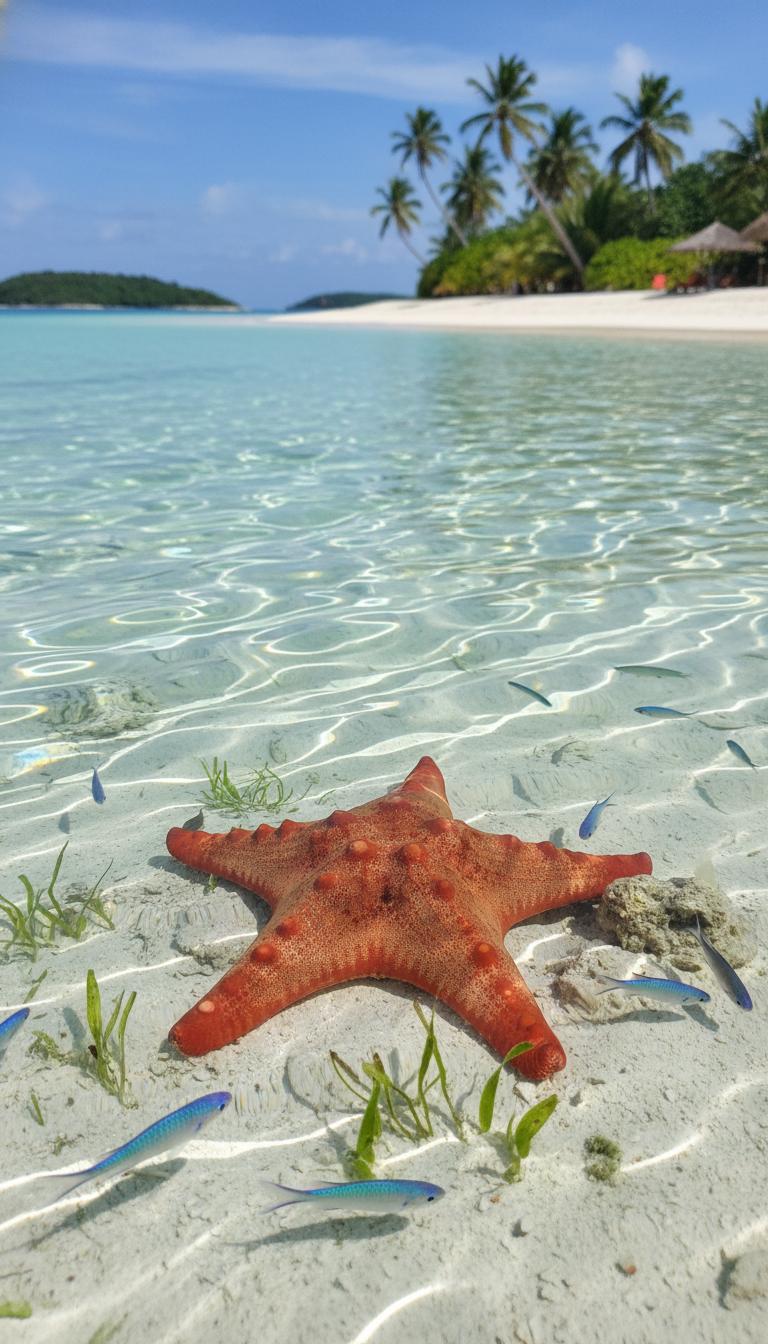
Humanity’s relationship with sea stars has shifted dramatically across centuries. Indigenous coastal communities harvested them for food, medicine, and spiritual purposes long before written records. In the Pacific Northwest, certain tribes incorporated sea stars into creation myths, while in the Caribbean, the red cushion sea star (Oreaster reticulatus) became so heavily collected by tourists that it now faces regional extinction. The Victorian era saw sea stars transformed into decorative objects, dried and varnished for parlor curiosities, while twentieth-century marine biology elevated them to model organisms for studying regeneration — a sea star can regrow an entire body from a single arm, a capacity that continues to fascinate researchers exploring tissue regeneration in humans.
Today, sea stars occupy a paradoxical position in global consciousness. They are simultaneously more visible and more threatened than ever before. Social media has made them icons of marine beauty, their photogenic forms generating millions of shares across platforms. Yet climate change, ocean acidification, and disease have triggered mass die-offs that have reshaped entire ecosystems. The sunflower sea star’s decline, for instance, has allowed sea urchin populations to explode unchecked, devastating kelp forests that support thousands of marine species and coastal economies. What was once a creature of ancient stability has become a barometer of environmental fragility.
The symbolism of the sea star has evolved accordingly. Where alchemists once saw in its five-pointed form the lapis philosophorum — the philosopher’s stone representing the perfected Self — and where sandplay therapists recognize it as a symbol of regeneration, ecological balance, and the union of opposites, modern environmentalists have adopted it as an emblem of resilience under siege. Its ability to regenerate lost limbs speaks to hope; its vulnerability to warming oceans speaks to urgency.
The sea star’s impact on the modern world extends beyond symbolism into hard economics. As keystone predators, they regulate marine food webs in ways that directly affect fisheries worth billions of dollars. Their unique water vascular system — a hydraulic network of tube feet powered by seawater — has inspired biomimetic engineering designs. Their regenerative capabilities drive cutting-edge research in stem cell biology and tissue engineering.
What has changed most profoundly is our understanding of what a sea star actually is. Once dismissed as a simple, primitive creature, we now know they possess complex nervous systems without centralized brains, can navigate using light-sensitive eyespots at the tips of their arms, and exhibit behaviors that challenge our definitions of intelligence. The sea star is no longer merely a pretty shape on the seafloor — it is a half-billion-year-old survivor that has witnessed mass extinctions, continental drift, and the rise of humanity, and now faces its greatest test in the form of anthropogenic climate change.
From the two-armed ancestor Atlascystis crawling across Cambrian seafloors to the critically endangered sunflower sea star of today’s Pacific, these creatures embody both the deep time of evolution and the immediacy of ecological crisis. They remind us that even the most ancient and resilient forms of life are not immune to the consequences of human action — and that their survival, like the stars they resemble, depends on whether we choose to be their guardians or their undoing.