
Walk through any supermarket and you will find corn in the chips, the soda, the cereal, and the yogurt. It is the invisible backbone of the modern food system, yet we rarely think about it as food. Corn has become so successful that it has disappeared into the machinery of daily life. But this plant was once sacred. And its story is older than civilization itself.
Corn was born in the highlands of southern Mexico, domesticated from a wild grass called teosinte roughly ten thousand years ago. The transformation is one of the most dramatic in plant history. Teosinte has hard, inedible kernels that shatter when ripe. Ancient farmers, through generations of selective breeding, created a plant with soft, sweet rows that stay on the cob. The result was a species that could not survive without human hands. Corn has no wild form. It exists only because we wanted it to.
For the civilizations of Mesoamerica, corn was not merely sustenance. It was identity. The Maya believed that the first humans were fashioned from corn dough by the gods. The Aztecs worshipped Centeotl, the maize god. The famous “Three Sisters” method — corn, beans, and squash grown together — was an agricultural revolution. The corn gave the beans a stalk to climb. The beans fed the soil. The squash shaded the ground. Together, they created a garden that could feed a family for a year.
When Columbus encountered corn in 1492, he carried it back to Spain. Within a century, it had spread across Europe, Africa, and Asia because it yielded more calories per acre than wheat or barley. In Italy, it became polenta. In Romania, it became mamaliga. But the spread came with a dark footnote. European settlers failed to adopt the Native American practice of treating corn with alkali, a process that releases niacin. Without it, pellagra epidemics followed. The grain that fed empires also revealed how dangerous it was to use a plant without understanding its culture.
Symbolically, corn carries weight across continents. In Native American traditions, the Corn Mother is a central figure of creation and renewal. The Hopi perform an annual corn dance to bring rain. In the American Midwest, tall corn is a symbol of summer itself. The saying “knee-high by the Fourth of July” is less a measurement than a prayer.
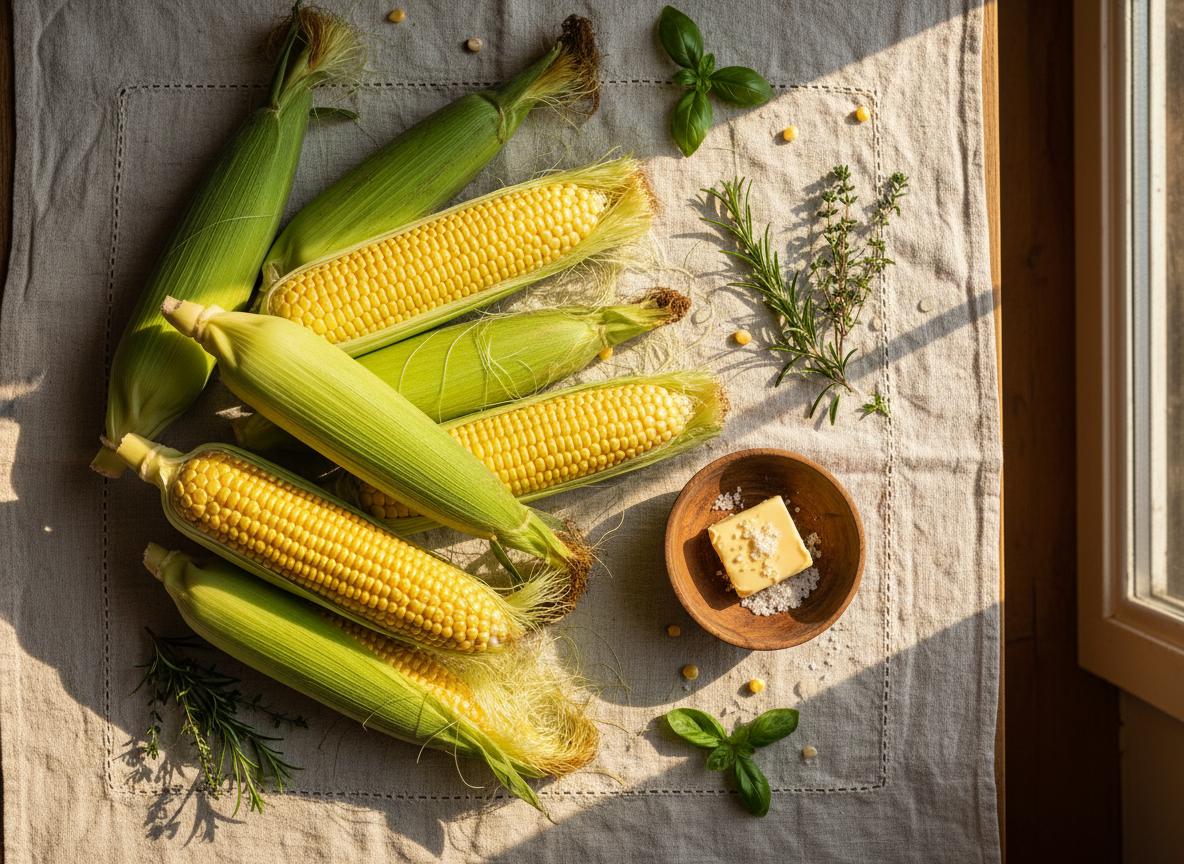
What do we make from it today? Sweet corn on the cob is the summer ritual — boiled for three minutes, buttered, salted, eaten with juice running down the wrists. But that is the smallest fraction of the harvest. Most corn becomes animal feed, ethanol for fuel, or high-fructose corn syrup, a sweetener so cheap that it found its way into bread, ketchup, soda, and salad dressing. The average American consumes corn in some form at nearly every meal, often without knowing it.
Here is a fact that surprises most people. An ear of corn has an even number of rows, almost always sixteen. The kernels are arranged in a Fibonacci spiral, the same mathematical pattern found in sunflowers and pinecones. Every ear is a tiny geometry lesson. And every kernel is a seed that will not grow unless it is removed from the cob and planted by hand. Corn cannot reseed itself. It is entirely dependent on us.
Storage is simple but unforgiving. The moment an ear is picked, the sugars begin converting to starch. At room temperature, sweet corn loses half its sugar in twenty-four hours. The old advice to boil water before you pick the corn is not a joke. It is chemistry. Refrigeration slows the conversion, but the best corn is still the one eaten within hours of harvest, preferably standing in a farm driveway with a paper napkin.
What has changed? Corn went from a sacred Mesoamerican creation to a global industrial commodity. The United States now grows roughly one-third of the world’s corn. We have engineered varieties for drought resistance, pest immunity, and ethanol yield. We have turned a plant that required human care into a plant that fuels machines.
Yet in late July, when the roadside stands appear and the steam rises from backyard pots, corn becomes what it always was. A summer gift. A messy, yellow, buttery reminder that some things are still best eaten with your hands, standing outside, while the sun stays up just a little longer than it should.