In 16th-century France, the word profiterole first appeared in François Rabelais’ satirical novel Gargantua, though the delicate choux puffs we recognize today were still centuries away from their final form. Food historians trace the pastry’s roots to Renaissance Italy, where legends credit Catherine de’ Medici’s chef Pantanelli with inventing choux dough. When the Florentine noblewoman married King Henry II of France in 1533, she reportedly brought her kitchen staff northward, planting the seeds of what would become a French national treasure. Modern scholarship dismisses this tale as a 19th-century romantic myth, yet the cross-border journey of choux pastry remains one of culinary history’s most enduring stories.
Sacred texts never name profiteroles directly, though the Bible celebrates sweetness and communal feasting in passages that echo the spirit of shared indulgence. The Book of Proverbs praises honey as a source of delight, while descriptions of the Promised Land flowing with milk and honey frame rich foods as divine blessings. In that broader sense, the pleasure of biting into a cream-filled puff fits a scriptural theme of gratitude for abundance.
The predecessor to modern profiteroles was surprisingly savory. In 17th-century France, the term described small hollow bread rolls stuffed with sweetbreads, truffles, artichoke bottoms, mushrooms, and poultry, often floating in soup. The name itself derives from the French verb profiter, meaning to profit or benefit, because aristocratic lords once distributed stale bread soaked in broth to servants as a small gratuity. François Massialot’s 1698 cookbook Le Cuisinier royal et bourgeois preserved several of these savory soup recipes, revealing a dish far removed from today’s dessert tables.
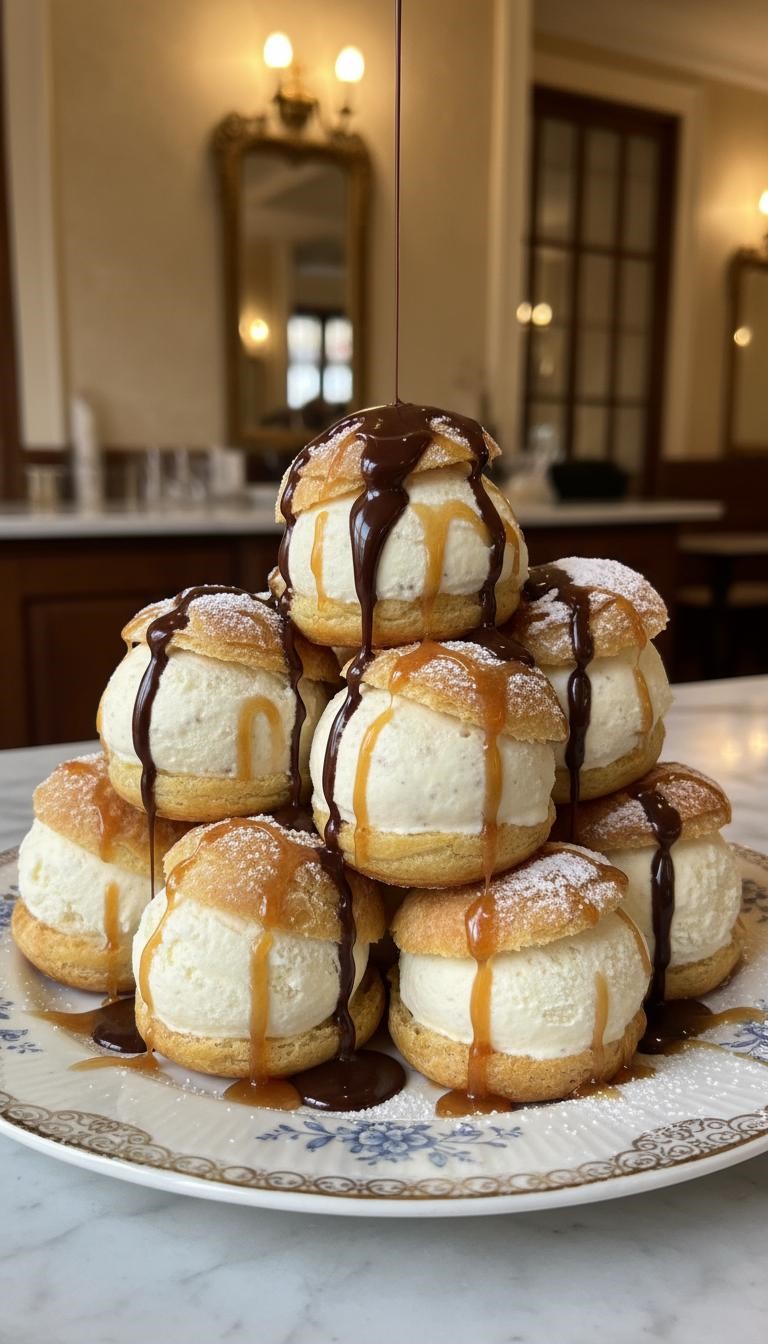
The transformation began in earnest during the 18th century, when royal pâtissier Jean Avice refined choux pastry into recognizable buns. By the 19th century, culinary titan Antonin Carême had perfected the recipe, filling the airy shells with cream and glazing them with caramel or chocolate. Carême didn’t stop at individual portions; he stacked profiteroles into towering croquembouches, binding them with spun sugar to create the spectacular wedding centerpieces still demanded across France today. Jules Gouffé’s 1870 Livre de cuisine formally defined the profiterole as a small choux pastry, cementing its place in the canon of French gastronomy.
Today’s varieties reveal remarkable versatility. Classic profiteroles arrive filled with whipped cream, crème pâtissière, or ice cream, then drenched in glossy chocolate or caramel sauce. Savory interpretations have made a comeback in haute cuisine, with chefs injecting cheese mousse, smoked salmon, or creamy seafood into the shells. International adaptations abound: Germans enjoy Windbeutel, Czechs savor větrník, and Japanese bakeries have turned the cream puff into a national obsession. Some historical forms, such as the 17th-century soup-bound version, have vanished entirely, while the pure choux expression has multiplied into craquelin-topped domes and fruit-glazed innovations.
Extreme creations capture public imagination. Massive croquembouches rising several feet high serve as dramatic wedding sculptures, while miniature profiteroles barely larger than a grape offer single-bite elegance at cocktail parties. No official Guinness record dominates the category, yet the visual spectacle of a caramel-drizzled tower continues to stop scrollers on social media feeds worldwide.
Symbolically, profiteroles represent the art of French celebration. Their presence signals birthdays, weddings, and Sunday lunches where families gather around shared sweetness. What changed most profoundly is accessibility. Once restricted to royal kitchens and aristocratic banquets, profiteroles now sit in supermarket freezers and neighborhood pâtisseries from Paris to Tokyo. From a lord’s leftover broth to a global dessert icon, these humble puffs prove that the most elegant pleasures often rise from the simplest ingredients.