
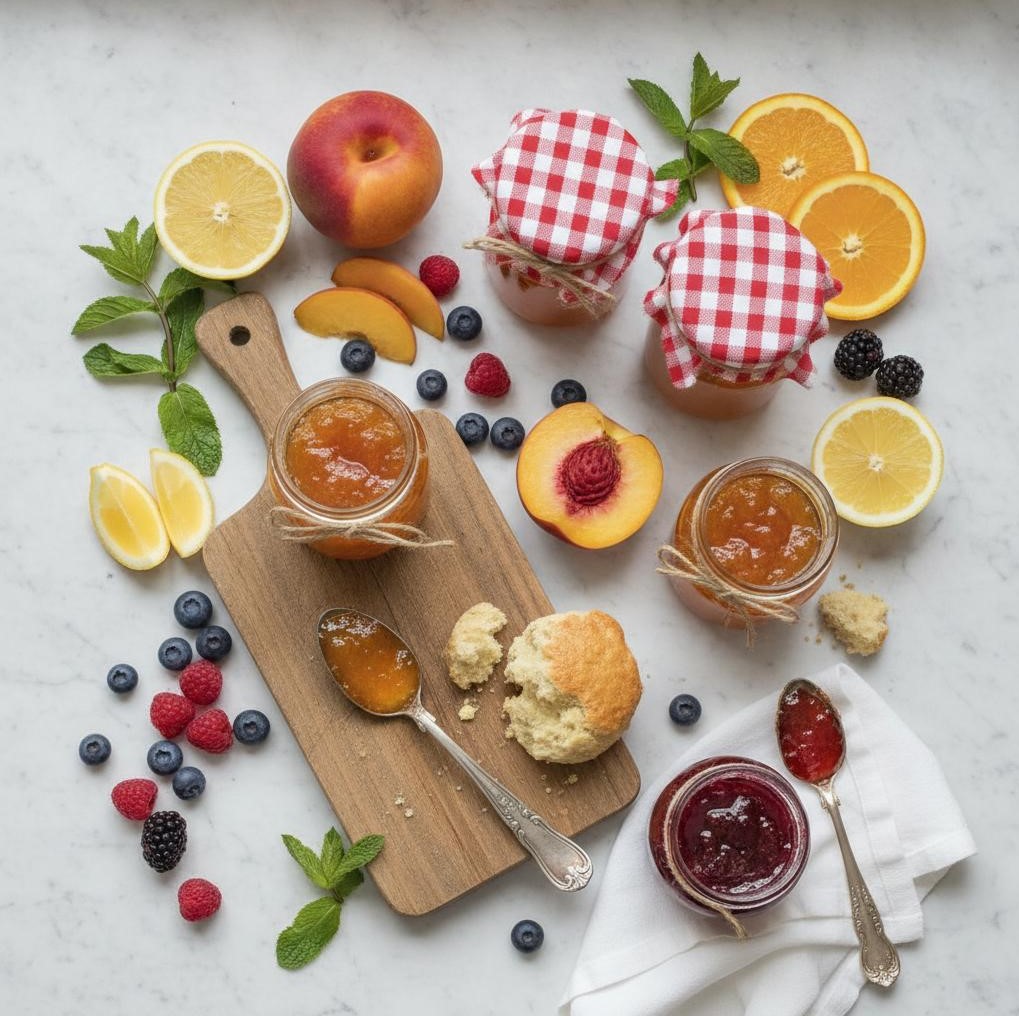
Preserving fruit with sugar stands among humanity’s oldest culinary arts, stretching back to the Stone Age when early communities first sought methods to save seasonal harvests. The history of jam and marmalade begins not in a factory but in the ancient Middle East, where honey served as the original preservative. Long before refined sugar reached Europe, Greeks and Romans used honey to coat quinces and other fruits, creating dense, sweet preparations that could survive harsh winters.
The first written recipe resembling modern jam appears in the Roman cookbook De Re Coquinaria, attributed to Marcus Gavius Apicius around the 4th century AD. This manuscript described soft fruit cooked with honey, cooled, and stored as a delicacy for the wealthy.
The history of jam and marmalade took a decisive turn during the Crusades, when soldiers returned from the Middle East carrying sugar to Western Europe. Suddenly, preservation became more reliable and the flavor profile cleaner. By the 16th century, the French astrologer Nostradamus had written an entire treatise on preserves in 1555, including recipes for cherry jam and candied orange peel. Marmalade itself emerged around 1561, when a physician reportedly crushed Seville oranges with sugar to treat Mary, Queen of Scots for seasickness. Though Portugal and Scotland both claim its origin, the word derives from the Portuguese marmelada, meaning quince paste.
Today’s shelves display an extraordinary variety among types of jam and marmalade. Strawberry dominates global sales, followed by raspberry, apricot, and bitter orange marmalade. Quince preserves maintain popularity across the Mediterranean, while lingonberry jam remains essential in Scandinavian pantries. Distinctions matter: jam contains crushed fruit, jelly uses strained juice, preserves hold whole chunks, and marmalade specifically features citrus peel suspended in gel.
Some ancient forms have vanished. Roman honey-preserved quinces rarely appear outside specialty shops, and the dense, sliceable quince paste of medieval Europe has been relegated to cheese boards. The predecessor to modern spreads was simply honey-coated fruit or dried pulp, techniques that required no refined sugar and no sealed glass jars.
Extremes attract global attention. Lebanon produced an apple jam jar weighing 1,200 kilograms for a festival record, while at the opposite end, single-serve hotel packets and miniature jars barely hold a teaspoon. The history of jam and marmalade reveals humanity’s enduring impulse to capture fleeting harvests in glass.
Global impact is measured in billions. The worldwide fruit jam, jelly, and preserves market reached approximately USD 9.8 billion in 2026, with projections climbing steadily. What began as elite delicacies served on silver at Versailles—Louis XIV famously demanded jam at every meal—has become a breakfast staple found in nearly every household.
Symbolically, the history of jam and marmalade reflects shifting social values. Once a display of aristocratic wealth, when sugar cost more than spices, these spreads now evoke comfort, nostalgia, and homemade care. What changed most dramatically is health consciousness. Where earlier generations celebrated pure sugar content, today’s consumers drive demand for low-sugar, organic, and preservative-free varieties. From Stone Age honey pots to artisanal small-batch labels, the history of jam and marmalade continues proving that preserving sweetness is a universal human instinct.