
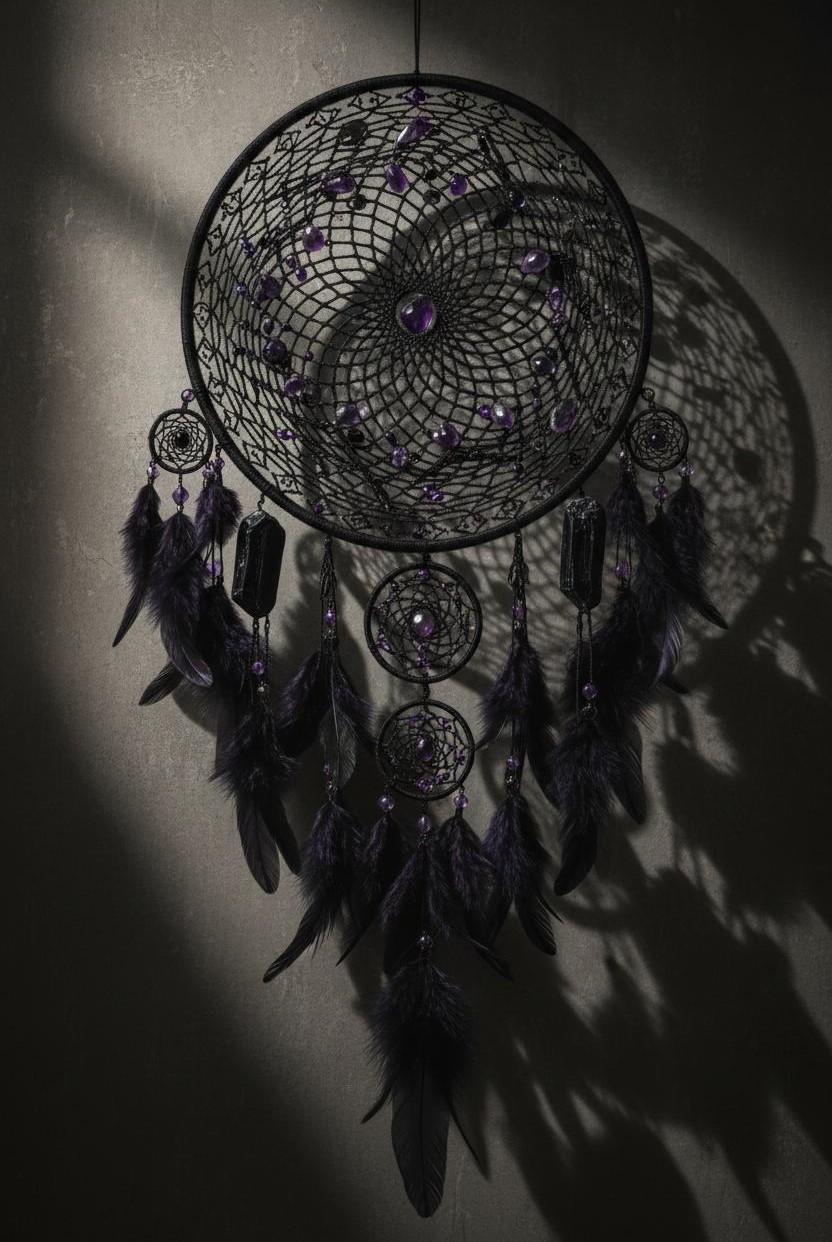
Dream Catcher Meaning and History: Origins, Types and Symbolism
Sacred willow hoops woven with sinew have guarded Indigenous sleepers for centuries, yet the dream catcher meaning reaches far beyond nursery walls into spiritual philosophy and cultural survival. The history of dream catchers begins not in a factory but in the oral traditions of the Ojibwe people, where Spider Woman—known as Asibikaashi—watched over infants and adults alike. As tribal communities spread across North America, the spider could no longer reach every cradle, so mothers and grandmothers began weaving protective webs from willow twigs and stinging nettle fiber, creating the first dream catcher as an extension of maternal care.
Ancient legends offer two primary origin stories. In the Ojibwe tradition, a grandmother named Nokomis saved a spider from her grandson, and the grateful creature spun a magic web that caught bad dreams while allowing good ones to pass through the center and drift down feathers to the sleeper. The Lakota version features Iktomi, a trickster spirit appearing as a spider, who wove a willow hoop and explained that the web would trap bright forces while dark ones slipped away and burned. Both narratives reveal that the dream catcher meaning was never merely decorative; it functioned as spiritual filtration, a sacred technology for sorting the subconscious.
Biblical texts, though originating on separate continents, resonate with this fascination for nocturnal visions. Genesis 37 recounts Joseph’s dreams of sheaves bowing and celestial bodies paying homage, while Daniel 2 describes the prophet interpreting Nebuchadnezzar’s troubling night visions. Joel 2:28 promises that old men shall dream dreams and young men shall see visions, a passage echoed in Acts 2:17. Job 33:15 notes that God speaks in dreams, in visions of the night when deep sleep falls on people. These verses establish that dream interpretation spans cultures, even if the specific dream catcher mechanism belongs to Indigenous North American wisdom.
Traditional construction followed strict natural protocols. The hoop represented the circle of life, the web mirrored spider silk catching harm like morning dew, and a single gemstone often adorned the center because Ojibwe weavers believed in one creator holding the web of existence together. Feathers originally served as tactile toys for infants rather than purely symbolic ornaments. This authentic dream catcher differed sharply from the mass-produced versions that flooded shopping malls during the 1980s, when the Pan-Indian Movement of the 1960s and 1970s had already spread the icon across tribes and into mainstream consciousness.
Today’s varieties range from palm-sized car charms to architectural installations. The largest dream catcher ever verified stretches 12.93 meters across, created by Dale Williams in Rama First Nation, Ontario, during April 2024. Weighing approximately 2,000 pounds and incorporating thousands of feet of sinew and rope, it stands as a monument to community collaboration. At the opposite extreme, miniature dream catcher jewelry—earrings, necklaces, and keychains—shrinks the sacred form into accessories barely larger than a coin, though purists debate whether such diminution preserves or dilutes the original intent.
Contemporary types include traditional willow-and-sinew wall hangings, 3D woven spheres, LED-lit modern interpretations, and macramé variations using cotton cord instead of nettle fiber. Some historical forms have effectively vanished. Cradle-board-mounted protective webs, once tied directly to infant carriers, have largely disappeared as child-rearing practices modernized. Authentic nettle-fiber construction has given way to synthetic materials and mass production, while the medicinal and spiritual context has often been stripped away in favor of bohemian aesthetics.
Global impact is difficult to quantify precisely, though the home decor market featuring dream catcher wall art shows sustained commercial vitality with hundreds of active buyers and steady year-over-year growth. What began as a specific Ojibwe protective charm has evolved into a universal symbol of filtered positivity, though this popularity carries controversy. Indigenous advocates note that when non-Native manufacturers mass-produce these items without cultural understanding, the dream catcher risks becoming emptied of its sacred significance.
Symbolically, the dream catcher meaning has shifted from tribal protection to personal mindfulness. Where ancient weavers sought to shield infants from illness and nightmares, modern consumers often hang them as reminders to filter negativity from daily life. What changed most dramatically is context: once a tool for survival in a spiritually animated world, the dream catcher now navigates between reverence and commodity, between ancient wisdom and Instagram aesthetics. From spider silk to synthetic cord, from cradle boards to car mirrors, the history of dream catchers continues evolving—proving that the human desire to curate our dreams remains as powerful as ever.