
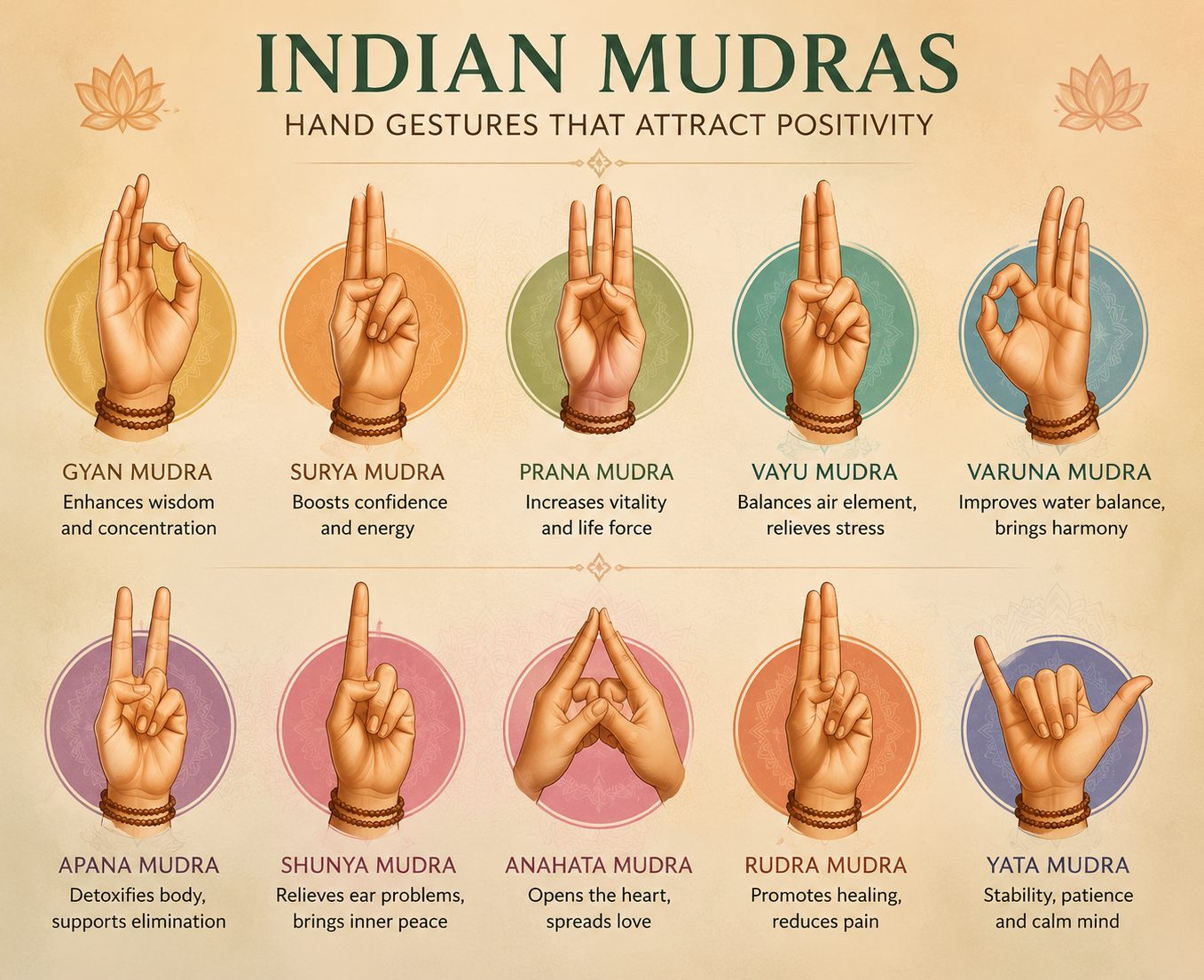
Sacred hand gestures carved into temple walls and practiced in ashrams for millennia represent one of India’s most profound contributions to global spirituality. Indian mudras are symbolic positions of the fingers and palms that channel subtle energy, communicate philosophical truths, and punctuate classical dance narratives. The history of Indian mudras stretches back to the Vedic period, roughly between 1500 and 500 BCE, when sages first codified these gestures as visible expressions of invisible cosmic forces. Long before written texts existed, this knowledge traveled through oral transmission from guru to disciple, embedding itself so deeply that Indian mudras became inseparable from Hindu, Buddhist, and Jain ritual life.
Ancient texts provide the structural foundation. The Natya Shastra, attributed to Bharata Muni around 200 BCE to 200 CE, cataloged single-hand and joint-hand gestures used in theatrical performance, establishing a vocabulary that classical dancers still speak fluently today. The Abhinaya Darpana expanded this lexicon, while yogic traditions preserved meditative Indian mudras like Jnana and Chin, where thumb and index finger meet to symbolize the union of individual consciousness with universal awareness. Anjali mudra, palms pressed together at the heart, transcends religious boundaries as a gesture of reverence recognized across Asia.
Biblical scriptures do not mention Indian mudras by name, yet they share a deep fascination with the spiritual power of hand positions. Psalm 28:2 describes the supplicant lifting hands toward the divine oracle, while Psalm 134:2 commands worshippers to raise their hands in the sanctuary. First Timothy 2:8 encourages praying with uplifted holy hands, and Solomon spreading his hands toward heaven in 1 Kings 8:22 mirrors the expansive, offering quality of gestures like Varada and Abhaya. These parallels suggest that human beings across civilizations intuitively understand the hand as a conduit between earthly limitation and heavenly possibility.
Contemporary practice reveals extraordinary diversity among Indian mudras. Jnana and Chin mudras dominate meditation cushions worldwide, encouraging introspection and grounded focus. Anjali mudra opens and closes yoga classes from Berlin to Los Angeles. Abhaya mudra, with raised right hand and palm facing outward, signals fearlessness and protection, while Varada mudra, hanging downward, grants boons and compassion. Dhyana mudra, both hands resting in the lap with thumbs touching, embodies absolute stillness and is most famously associated with seated Buddha images. In classical dance, Bharatanatyam and Odissi employ dozens of hastas to depict everything from blooming lotuses to charging elephants.
Some historical forms have faded from common use. Certain esoteric tantric Indian mudras once reserved for initiates have retreated into specialized monastic practice, while the elaborate martial gestures of ancient Indian battlefield rituals survive only in fragmented texts. The predecessor to all of these was likely the simple act of pressing palms together in greeting, a gesture so ancient it predates every organized religion.
Monumental art provides the most visible scale. The Spring Temple Buddha in China and the Great Buddha of Thailand both display Dhyana mudras spanning meters across, carved in stone and bronze for pilgrims to contemplate. At the opposite extreme, miniature depictions in palm-leaf manuscripts and contemporary jewelry shrink these gestures into objects smaller than a coin, yet the symbolic charge remains undiminished.
Global impact is undeniable. Indian mudras now appear in corporate wellness programs, mindfulness apps, and rehabilitation therapy for stroke patients recovering fine motor control. The global yoga industry, valued in the tens of billions, teaches Indian mudras as essential components of practice rather than exotic embellishments. What began as temple rituals and royal court performances has evolved into a universal language of wellbeing.
Symbolically, Indian mudras have shifted from esoteric spiritual technology to accessible self-care tools. Where ancient practitioners used them to seal specific energy channels, modern enthusiasts appreciate their calming psychological effect and cultural aesthetics. What changed most dramatically is context: once guarded behind Sanskrit barriers and caste restrictions, Indian mudras now circulate freely in translated manuals, YouTube tutorials, and wellness retreats. From Vedic fires to smartphone screens, these hand gestures continue proving that the body itself can become a prayer, a dance, and a path inward.