Before ice cream had flavors, it had colors. Not the artificial neon shades that fill modern freezers, but the soft, accidental hues that came from the ingredients themselves. The first frozen desserts, made by Persian engineers four thousand years ago who poured grape juice over mountain snow, were not white. They were the deep purple of wine. The first ice cream was a color before it was a taste.
The ancient Romans carried this idea forward. Emperor Nero sent runners to the Alps to collect snow, which he flavored with honey and fruit pulp. The result was a pastel palette — honey gold, berry rose, citrus ivory. Color was not decoration. It was proof of what you were eating. In a world without labels, the shade of your bowl told the story of your wealth. A saffron yellow meant you had access to the most expensive spice on Earth. A pistachio green meant trade routes from the Middle East reached your kitchen.
When ice cream arrived in Europe in the 1600s, color became theater. Italian Renaissance chefs served sculpted ice creams dyed with natural pigments at royal banquets. Spinach created green. Beetroot made pink. Cochineal insects produced red. The color of your ice cream was a statement of power and the chef’s access to rare ingredients.
The modern ice cream color changed in 1856, when William Henry Perkin discovered the first synthetic dye. Within decades, chemists had created stable food colors that did not fade and cost almost nothing. Strawberry ice cream no longer needed strawberries. The color became a promise that the flavor would follow, even when the flavor was manufactured in a lab. This is why studies show that people cannot identify ice cream flavors when blindfolded. We taste with our eyes first.
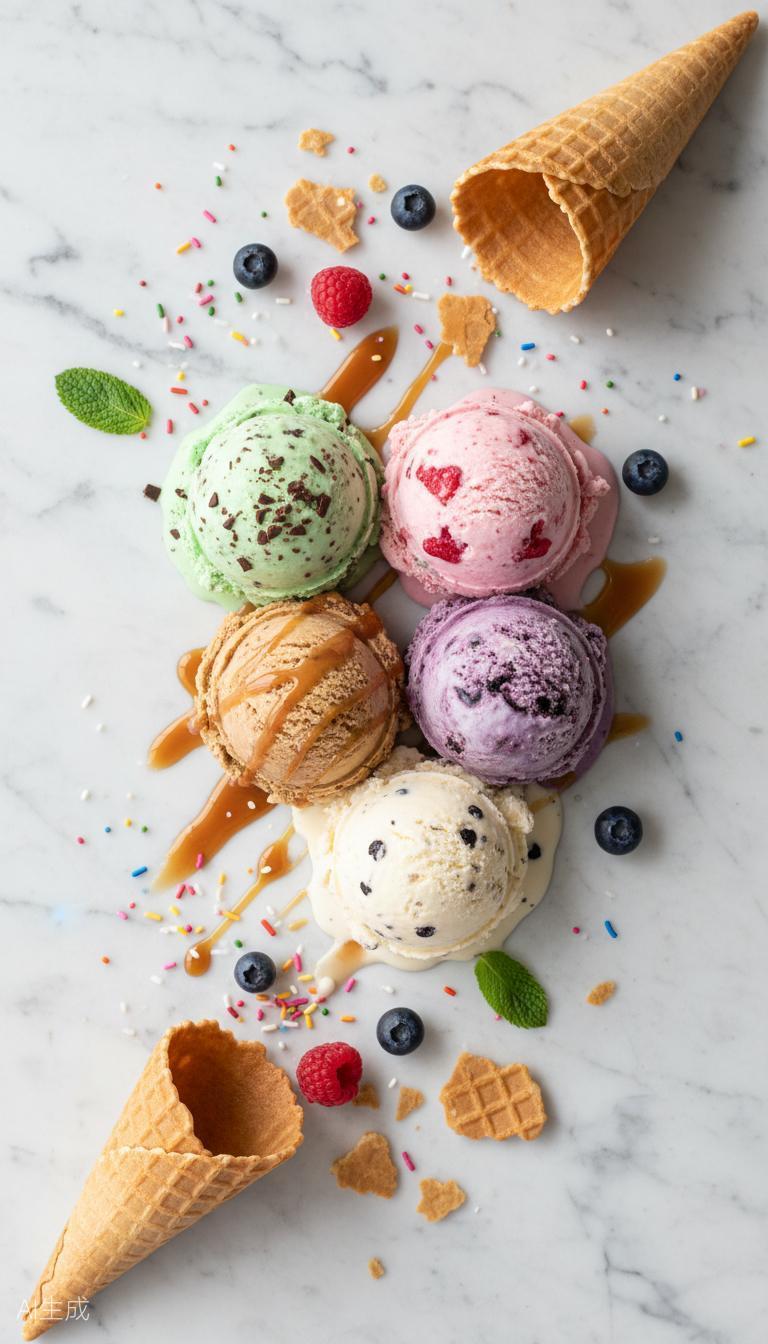
Symbolically, ice cream colors carry more weight than we admit. White vanilla is still the global default, suggesting purity even though real vanilla is a dark, sticky bean. Chocolate brown represents comfort so completely that it outsells every other flavor combined. Strawberry pink is associated with childhood and nostalgia. The green of pistachio or mint has become a signal of sophistication, the adult choice that says, “I am not basic.”
The most interesting color story is blue. For most of human history, blue ice cream did not exist. There were no natural blue foods except blueberries, which turn purple when mixed with dairy. The first commercial blue ice cream appeared in the 1950s, created entirely by artificial dye. It had no flavor association. It was pure novelty. Yet children responded to it instantly. Blue became the color of birthday parties and carnival nights. It is the only ice cream color with no natural reference point, which makes it the most honest.
What has changed? We now have charcoal black ice cream that stains your teeth, activated by the same ingredient used in emergency rooms to treat poison victims. We have rainbow swirls that exist only for social media, designed to be photographed more than eaten. We have ice cream that changes color when you lick it, using thermochromic pigments developed for mood rings. The color has become the product.
Yet the most powerful ice cream color is still the simplest. The pale yellow of real vanilla bean. The soft pink of crushed fresh strawberries. The milky white of a perfectly churned gelato. These colors do not shout. They whisper. They tell you that someone chose the ingredient over the effect, the taste over the photograph, the tradition over the trend.
Summer is when ice cream color matters most. The bright light of July makes every shade more vivid, every cone more photogenic, every scoop feel like a small rebellion against the heat. We do not eat white ice cream in winter. We eat color. We eat the idea that something cold can still look like a sunset.
And maybe that is the real magic. Ice cream was never meant to be white. It was meant to be whatever color makes you believe, for three minutes, that summer is endless.