There is a fruit so common that we forget it was ever foreign. It sits in every supermarket, every school lunchbox, every smoothie shop on Earth. Yet the banana traveled farther than most explorers to reach your kitchen. It crossed oceans, survived empires, changed governments, and nearly went extinct — all before breakfast.
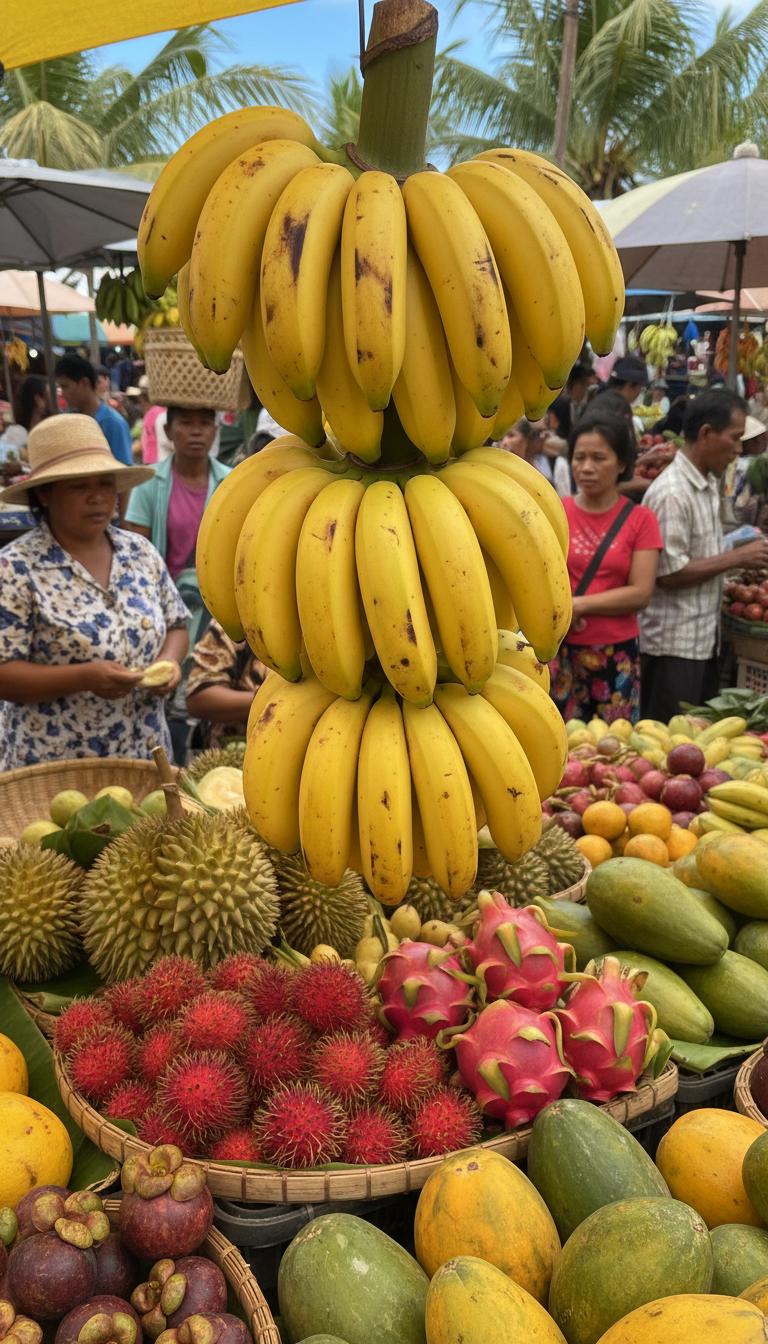
The banana’s true home is the humid tropics of Southeast Asia: modern-day Malaysia, Indonesia, the Philippines, and New Guinea. Archaeologists believe humans first cultivated it around seven thousand years ago, making it one of the oldest domesticated plants in history. Unlike apples or grapes, the banana does not grow from seed. It is a giant plant, not a tree, and every new plant is a clone of its parent. Ancient farmers learned to propagate it by splitting the rootstock, creating orchards of genetically identical siblings long before anyone understood what genetics were.
Alexander the Great encountered the banana in India in 327 BC and carried the news back to Europe. But the fruit itself remained a rumor for another two millennia. European soil was too cold, European sailors too slow. The banana turned black and rotted before it could survive a sea voyage. It was not until the fifteenth century, when Portuguese explorers established trade routes along the West African coast, that the banana began its march toward global domination. From Africa, it jumped to the Canary Islands, then to the Caribbean and Central America with Spanish colonists.
Why did it conquer? Convenience. The banana comes with its own biodegradable packaging, requires no washing, and delivers energy faster than almost any other natural food. A medium banana contains roughly 105 calories, 27 grams of carbohydrate, and about 400 milligrams of potassium — nearly 10 percent of your daily need. That potassium supports heart rhythm, muscle function, and blood pressure regulation. It also delivers vitamin B6, manganese, and a type of fiber called pectin that may help moderate blood sugar. Athletes eat it for cramps. Parents pack it for toddlers. Hikers carry it because it weighs nothing and fuels everything.
What do we make from it? The sweet dessert banana is only one variety. The starchy plantain, cooked green or yellow, feeds millions across Africa, Latin America, and the Caribbean. In Kerala, banana chips are fried in coconut oil. In the Philippines, turon wraps banana in spring roll pastry and deep-fries it with brown sugar. In the American South, banana pudding is a cultural institution. Banana bread, invented during the Great Depression as a way to use overripe fruit, is now the most searched bread recipe on Earth. And of course, the smoothie would not exist without the frozen banana, which creates a creamy texture that dairy cannot replicate.
Symbolically, the banana carries surprising weight. In Hindu tradition, the banana plant is sacred to Vishnu and Shiva. Its leaves are used as plates for feasts. In Buddhist cultures, the banana symbolizes fertility and abundance. In the West, it has been used as comedy, as phallic suggestion, and as a health symbol — often all at once. The yellow crescent is instantly recognizable across every alphabet and border.
Storage is where most people make mistakes. A green banana should never see a refrigerator. Cold temperatures below 13 degrees Celsius interrupt the ripening process and turn the skin gray while the flesh stays hard. The trick is ethylene. Bananas produce this natural gas heavily, which is why placing them in a paper bag speeds ripening, and why placing them next to other fruit will overripen everything in the bowl. Once a banana reaches your preferred yellow, you can move it to the refrigerator. The skin will turn black, but the flesh inside will stay firm and sweet for three to five days. If you have too many, peel and freeze them. A frozen banana lasts three months and transforms any blender into an ice cream machine.
Here is a fact that shocks most people. The bananas your grandparents ate were probably not Cavendish. They were Gros Michel — a creamier, richer variety that dominated the global market until the 1950s, when a soil fungus called Panama disease wiped it out. The entire industry switched to the Cavendish, a blander but disease-resistant clone. Today, the Cavendish faces the same threat from a new strain of that same fungus. Because every Cavendish is genetically identical, one disease could erase the global banana overnight. Scientists are now racing to engineer a replacement, or to resurrect the Gros Michel through gene editing.
What has changed? The banana went from a sacred Asian plant to a global commodity traded like oil. It is the most exported fruit on Earth, the fourth most valuable food crop overall after rice, wheat, and corn. Yet it is also one of the most vulnerable. We have traded diversity for convenience, creating a food system where a single pathogen could remove the world’s favorite fruit from the breakfast table.
So the next time you peel a banana without thinking, pause. You are holding seven thousand years of human ingenuity, a clone of a clone of a clone, and a fruit that is somehow both indestructible and endangered. Eat it quickly. History suggests it may not be around forever.