
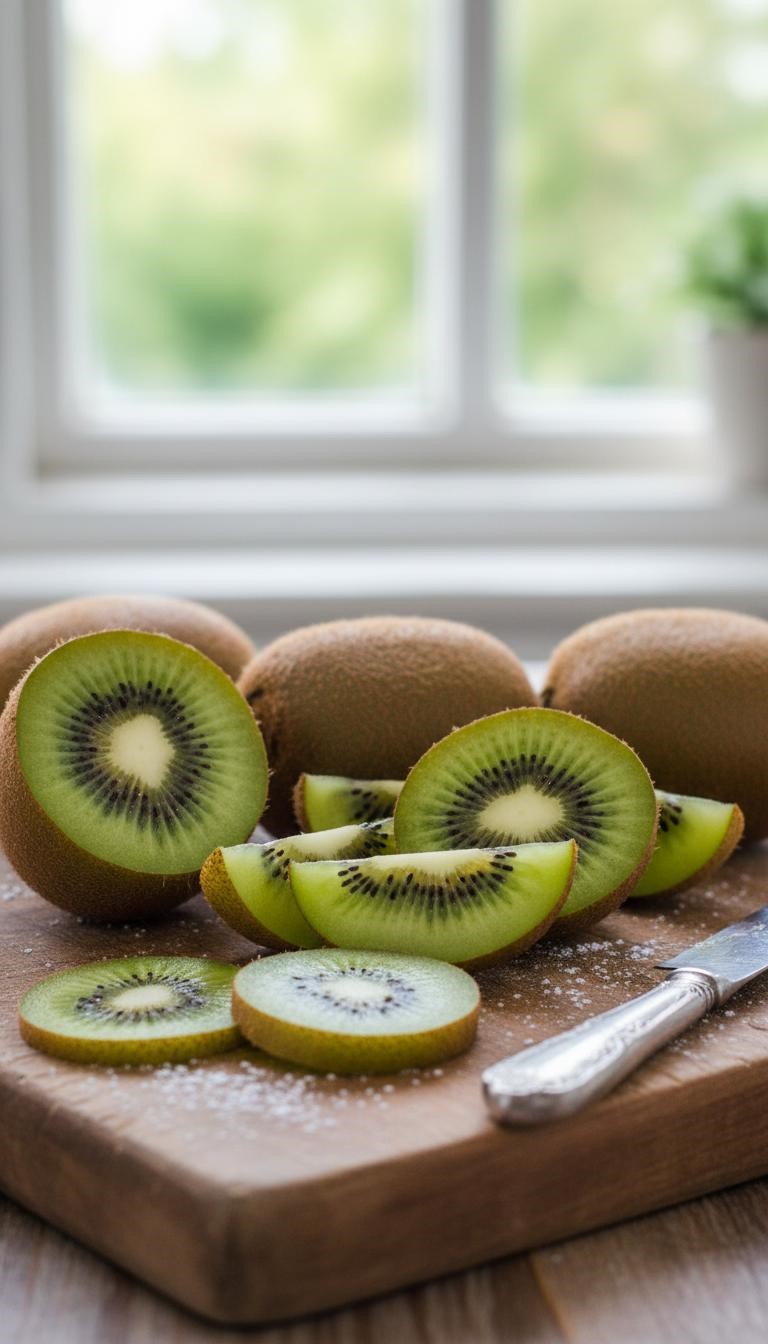
Long before it became a breakfast-table staple in Tokyo, Rome, or Los Angeles, the kiwi fruit was simply yang tao—the “strawberry peach”—growing wild in the misty valleys of central China. The first written record dates back to the 12th-century Song dynasty, though poets of the earlier Tang era had already alluded to its vines in verse. For centuries, it remained a creature of the forest, gathered by locals primarily for medicinal tonics rather than dessert. Curiously, despite its ancient roots in the East, the fruit never appears in biblical texts; the Scriptures speak of figs, pomegranates, and grapes, but the kiwi’s journey westward would not begin for another millennium.
The turning point arrived in 1904, when Mary Isabel Fraser, a New Zealand school principal, returned from China with a handful of seeds. She passed them to a farmer near Whanganui, and by 1910 the vines had produced their first modest crop. New Zealanders initially dubbed the oval produce the “Chinese gooseberry” for its tangy sweetness, yet the name never quite captured its exotic appeal. In 1959, exporters rechristened it “kiwi fruit,” drawing a playful comparison to the country’s small, flightless, brown-feathered national icon. The rebranding was masterful, and a star was born.
Botanically, the fruit belongs to the genus Actinidia, a family of roughly sixty species of climbing woody vines. The predecessor to today’s supermarket shelves was Actinidia deliciosa, a wild Chinese vine whose berries were small, variable, and largely uncelebrated. Modern cultivation transformed this obscure forest fruit into a global heavyweight. Today, more than a million tons are produced annually, with China having reclaimed its role as the world’s largest grower, followed by Italy, New Zealand, and Greece.
Of the countless cultivars developed over the past century, one variety has dominated above all others: the green-fleshed ‘Hayward,’ prized for its large size, bright emerald interior, and remarkable storage life. Yet horticultural history is littered with forgotten contenders. Early varieties such as ‘Abbott,’ ‘Bruno,’ and ‘Allison’ once flourished in experimental orchards but gradually vanished from commerce, undone by smaller fruit, lower yields, or an inability to survive the long refrigerated journey to foreign markets. Nature and consumer preference are unforgiving curators.
More recently, the palette has expanded dramatically. Golden-fleshed Actinidia chinensis varieties, with their tropical sweetness and smooth, bronze skin, have captured Asian markets in particular. Meanwhile, the bite-sized “kiwi berry” (Actinidia arguta), no larger than a grape and entirely hairless, offers a pop of flavor without the peeling. Red-centered cultivars, too, are emerging from breeding programs, proving that the fruit’s evolution is far from complete.
Symbolically, the kiwi carries layered meanings. In New Zealand, it represents agricultural ingenuity and national identity—a small country that took a foreign vine and taught the world to crave it. In China, where the fruit is now cultivated on an industrial scale, it has come to signify health and prosperity, often presented as a gift during Lunar New Year celebrations. Its popularity is staggering: what began as a medicinal curiosity in medieval Chinese pharmacopeia now sits in fruit bowls from São Paulo to Stockholm, available year-round thanks to advanced cold-storage and global shipping networks.
What has changed most profoundly is accessibility. A century ago, eating a kiwi required living near its vine. Today, it is a democratic luxury—affordable, nutritious, and versatile enough for salads, smoothies, or a simple spoon. The fuzzy berry that once hid in Chinese mountain thickets has become a quiet ambassador of globalization, proving that the most transformative journeys often begin with a single seed carried home in a traveler’s pocket.