
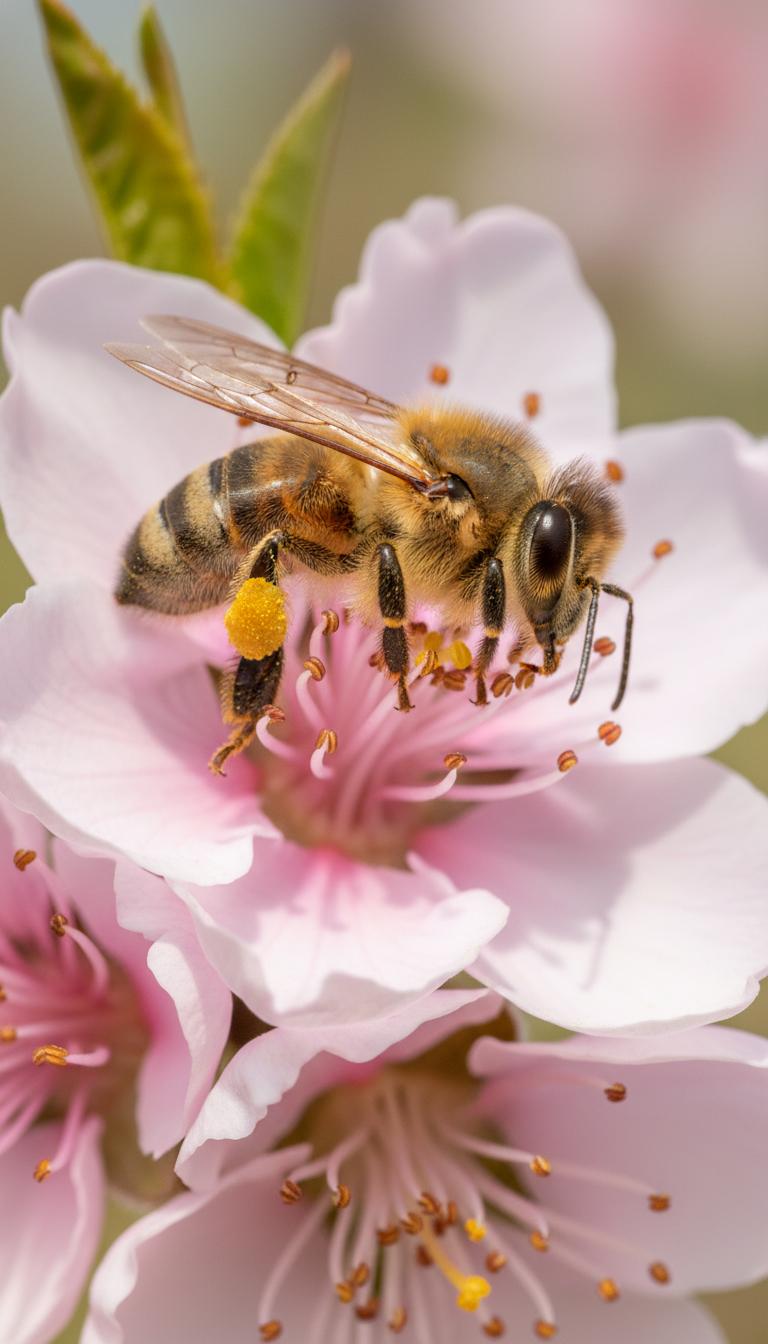
The honey bee did not arrive to serve humanity. For roughly 100 million years, it buzzed through forests that dinosaurs still roamed, evolving from solitary wasp ancestors into the complex social architects we know today. The earliest fossil evidence of a true honey bee dates to about 56 million years ago, a specimen trapped in Baltic amber that already carried the anatomical signatures of modern pollination. By the time early humans began painting on cave walls, the honey bee had established its colonies across Africa, Europe, and Asia, storing liquid gold in wax catacombs that would eventually draw hungry, curious hands.
Ancient Egypt was the first civilization to truly partner with the honey bee. Hieroglyphs from 2400 BCE depict beekeeping in organized rows, and jars of honey were placed in tombs as provisions for the afterlife. Pharaohs used the honey bee as a royal symbol; the bee was the emblem of Lower Egypt, appearing on the headdress of the king alongside the vulture of Upper Egypt. The Egyptians understood something that modern science has only recently quantified: without the honey bee, the agricultural abundance they relied upon would simply collapse.
The Bible is saturated with honey and bee imagery, though the specific insect is often implied rather than named. Judges 14:8 describes Samson finding a swarm of bees and honey in the carcass of a lion, a riddle that becomes a prophecy of strength arising from death. Psalm 119:103 declares that God’s words are “sweeter than honey to my mouth.” The Promised Land itself is described as “a land flowing with milk and honey” in Exodus, a phrase that anchored the honey bee in Western imagination as a symbol of divine blessing and abundance.
The mythology of the honey bee is woven into the very fabric of power. Napoleon Bonaparte adopted the bee as his personal emblem, associating himself with the industry and order of the hive. Charlemagne mandated beekeeping laws across his empire. The Mormon pioneers carried honey bees across the American plains to Utah, where the insect became a symbol of Deseret and industrious self-sufficiency.
The honey bee family contains remarkable extremes. The giant honey bee, Apis dorsata, builds massive single-comb colonies that can stretch nearly two meters across, hanging from cliff overhangs and high branches in South Asia. At the opposite extreme, the dwarf honey bee, Apis florea, constructs tiny exposed combs barely twenty centimeters across, often tucked into shrubbery. The Western honey bee, Apis mellifera, dominates global agriculture, transported by European colonists to every continent except Antarctica, where it now pollinates crops from California almonds to New Zealand kiwifruit.
Some honey bee varieties have vanished entirely. Apis nearctica, a prehistoric honey bee species, left only fossil traces in Nevada. The British black honey bee, Apis mellifera mellifera, was nearly eradicated by the twentieth century when imported Italian bees and the devastating Isle of Wight disease swept through the Isles. Wild honey bee colonies, once common in European forests, have largely disappeared due to habitat loss and pesticide exposure, leaving managed hives as the primary survivors.
What preceded the honey bee was the solitary hunting wasp, which began visiting flowers for nectar around 120 million years ago. The evolutionary leap to social behavior, pollen collection, and wax construction took millions of years, but it created an organism that would reshape terrestrial ecosystems.
Today, the honey bee underpins a global pollination industry worth over $200 billion annually. One-third of every bite of food consumed by humans depends on pollinators, with the honey bee as the single most important commercial species. Symbolically, it still represents industry, community, and resurrection—the hive’s apparent death in winter followed by explosive spring renewal.
What changed most profoundly is the relationship between the honey bee and its environment. Once a wild creature hunted by cavemen and revered by pharaohs, it is now a managed agricultural tool, shipped by the truckload across continents to pollinate monoculture crops. Colony Collapse Disorder, first identified in 2006, has wiped out millions of hives, reminding us that even the most domesticated honey bee remains fundamentally wild, vulnerable, and essential. The ancient contract between flower and insect, signed long before human agriculture, still demands its terms be met.