
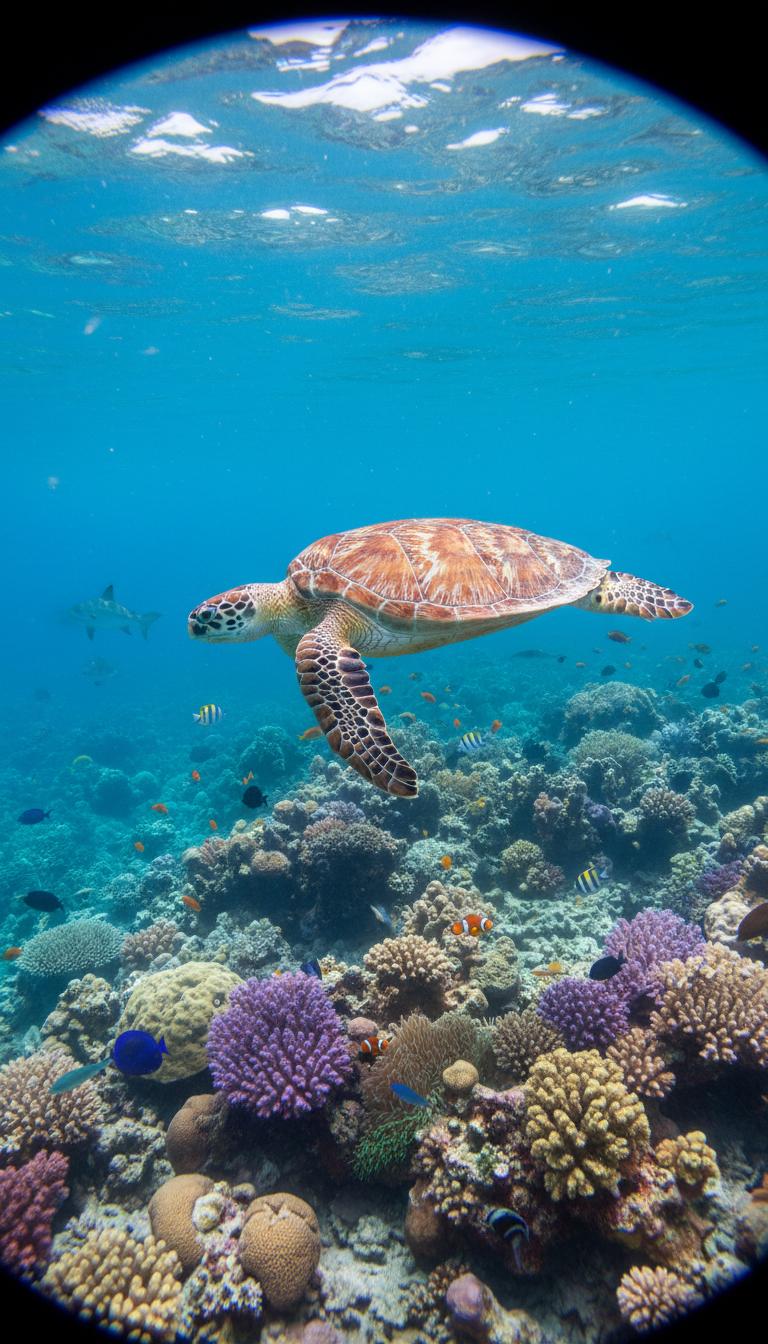
There is a profound humility in watching a sea turtle glide through the ocean. With a grace that predates human anxiety by millions of years, these creatures move as if the water itself was designed around their shells. Yet the sea turtle is far more than a serene symbol of summer snorkeling trips; it is one of evolution’s most enduring experiments, a living thread connecting modern beaches to the age of dinosaurs.
The fossil record places the earliest sea turtles roughly 110 million years ago, during the Cretaceous period, though some molecular biologists argue their lineage may stretch back even further, to the Jurassic. Imagine that: while Tyrannosaurus rex thundered across terrestrial landscapes, the ancestors of today’s green and loggerhead turtles were already paddling through ancient seas. The oldest definitive fossils, such as those of Santanachelys gaffneyi discovered in Brazil, reveal creatures remarkably similar to their modern descendants, suggesting that the sea turtle blueprint was essentially perfected early and needed little revision. Nature, it seems, recognized a design that worked.
For much of human history, sea turtles occupied a complex space between reverence and resource. Indigenous coastal communities across the Pacific, Caribbean, and Indian Ocean viewed them as ancestral spirits or navigational omens. Polynesian wayfinders believed that spotting a turtle indicated proximity to land, making these animals literal guides across the vast blue desert of the Pacific. In Hindu mythology, the world rests upon the backs of elephants, which in turn stand upon a giant turtle—an image of cosmic stability and infinite patience. Meanwhile, in classical Mediterranean cultures, turtle shells were fashioned into lyres and combs, a practice that speaks to an ancient tension between admiration and utility that persists in different forms today.
Symbolically, the sea turtle carries perhaps the richest semantic load of any marine creature. It represents longevity, resilience, and the wisdom of taking one’s time. Unlike the shark’s predatory sleekness or the dolphin’s playful intelligence, the turtle embodies a slower, more deliberate mode of existence. In an age of acceleration and burnout, this symbolism has become unexpectedly potent. Wellness influencers, mindfulness coaches, and environmental activists have all adopted the turtle as a kind of mascot for sustainable living, a creature that travels thousands of kilometers only to return, with unerring precision, to the exact beach where it was born.
That homing instinct is one of nature’s most beguiling mysteries. Sea turtles navigate using Earth’s magnetic field, effectively possessing a biological GPS calibrated to the planet’s geomagnetic signatures. Females will cross entire ocean basins, feeding in the meadows of the Caribbean or the coasts of West Africa, before returning to the same stretch of sand where they first scrambled toward the waves as hatchlings decades earlier. How they achieve this remains incompletely understood, though researchers believe magnetic imprinting during the earliest moments of life plays a crucial role.
What has changed over the centuries is not the turtle, but the world it must navigate. For millennia, human populations were too small and coastal development too limited to threaten these ancient travelers significantly. The 20th century, however, introduced industrial-scale fishing, plastic pollution, and the artificial lighting that disorients hatchlings, drawing them inland toward parking lots and beachfront resorts instead of the moonlit ocean. Climate change has added another insidious twist: the sex of developing turtle embryos is determined by incubation temperature. Warmer sands produce disproportionately female clutches, and in some populations, scientists are already recording ratios approaching ninety percent female. It is an evolutionary crisis unfolding in slow motion.
Yet the sea turtle has also become a flagship species for the modern conservation movement, and this is where its contemporary popularity achieves real significance. From community-led nest patrols in Costa Rica to satellite tagging programs in Australia, these animals have mobilized global attention and funding in ways that less charismatic species rarely manage. Their visibility on social media—videos of exhausted females digging nests, or triumphant releases of hatchlings racing toward the surf—has transformed them into ambassadors for ocean health. They are popular not merely because they are photogenic, but because their survival story is tangible. You can hold a hatchling in your palm; you cannot hold a melting ice cap.
The sea turtle reminds us that longevity is not the same as invincibility. Having survived asteroid impacts and ice ages, it now faces its greatest test in the form of human carelessness. But perhaps that is the final lesson these ancient mariners offer: that endurance is not passive, but an active negotiation with a changing world.