
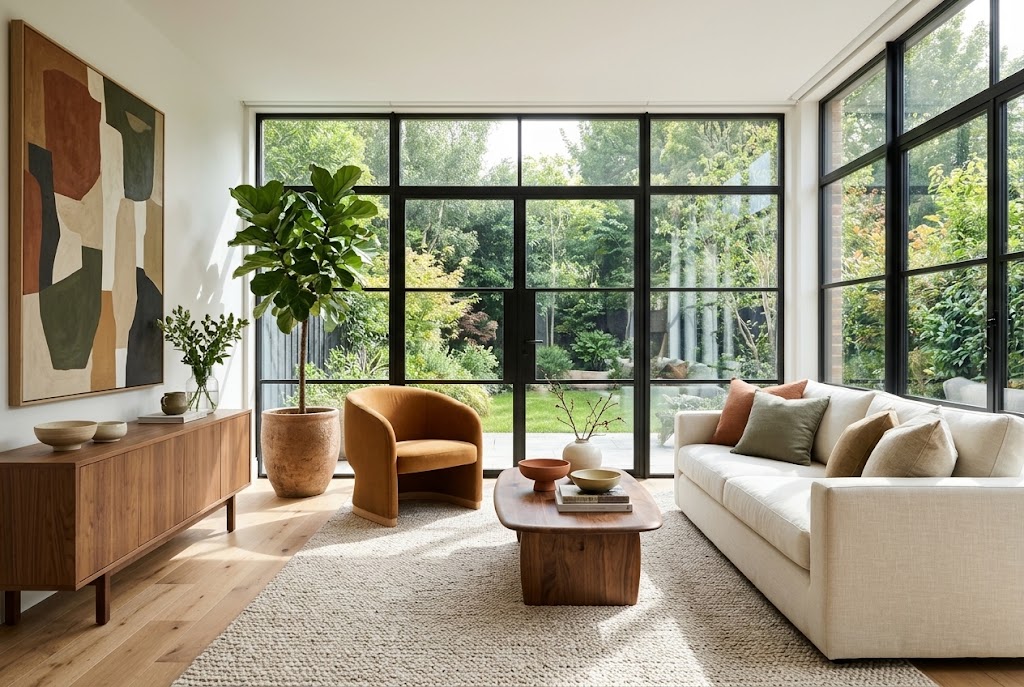
Remember when minimalism meant all-white rooms, cold surfaces, and owning exactly 37 possessions? Yeah, that’s over. In 2026, the trend that took over Pinterest feeds and design magazines isn’t cold minimalism — it’s warm minimalism: the art of having less, but making every single thing feel like a hug.
As the evenings get darker this October, more and more of us are craving homes that are calm and uncluttered — but also soft, textured, and deeply livable. Here’s exactly how to get the look, no matter your budget.
What Is Warm Minimalism?
Warm minimalism is minimalism’s cozier sibling. It keeps the core principles — fewer things, intentional choices, clean lines — but swaps the stark white and chrome for earthy neutrals, natural materials, and soft textures.
Think: a beige linen sofa with a chunky knit throw. A wooden coffee table with one ceramic vase and a lit candle. Bare walls, but in warm clay tones instead of clinical white.
The result? A space that feels edited, not empty. Calm, not cold.
Why It’s Trending in 2026
Three big reasons this trend exploded:
- We’re tired of visual noise. Between endless scrolling and information overload, our brains are begging for calmer spaces. Warm minimalism creates a mental exhale the moment you walk in.
- Cold minimalism felt unlivable. Beautiful in photos, brutal in real life — nobody actually enjoys sitting on a white bouclé chair in fear of spilling coffee.
- Budget-friendly by design. Buying less and choosing well is naturally kinder to your wallet — and to the planet.

The 7 Rules of Warm Minimalism
1. Start With a Warm Neutral Base
Forget pure white — warm minimalism lives in shades of cream, beige, oatmeal, taupe, terracotta, and soft brown. Paint your walls in a warm off-white (think “greige” or “alabaster”), and you’ve already done half the work.
2. Let Texture Do the Talking
In a minimal space, texture replaces color and clutter. Layer freely:
- Chunky knit or wool throws
- Linen or bouclé cushions
- Jute, wool, or vintage-style rugs
- Raw wood, rattan, and ceramics
If your room were an outfit, texture would be the accessories — the difference between “plain” and “pulled together.”
3. Choose Furniture With Soft Lines
Sharp, boxy furniture feels cold. Warm minimalism favors rounded edges, curved silhouettes, and organic shapes — think arched floor lamps, oval coffee tables, and slouchy linen sofas.
4. Edit Ruthlessly (But Keep What You Love)
Here’s the rule: every item should be useful, beautiful, or meaningful — ideally all three. That random gadget drawer? Gone. Your grandmother’s ceramic bowl that makes you smile every morning? It stays, and it gets a place of honor.
5. Bring in Nature
A warm minimalist home always has something alive in it: a potted olive tree, a vase of dried pampas grass, a bowl of seasonal pumpkins on the table. Natural elements add warmth that no throw pillow can fake.
6. Light It Warm
Lighting is 80% of cozy. Ditch the cold white bulbs (anything above 3000K) and go for warm white (2700K). Add layers: a floor lamp, a table lamp, candles. Overhead lighting alone is the enemy of warm minimalism — and honestly, of joy.
7. Leave Breathing Room
The final rule is the hardest: resist filling every surface. An empty corner isn’t a failure — it’s the whole point. Negative space is what makes the things you keep actually stand out.
Warm Minimalism on a Budget
You don’t need a designer budget for this look. In fact, warm minimalism is one of the cheapest aesthetics to pull off:
- Thrift stores are gold mines for ceramics, wooden pieces, and vintage textiles — and they have the worn warmth new items can’t replicate.
- One can of paint in a warm neutral transforms a whole room for the cost of a dinner out.
- Declutter first, shop second. You’ll be surprised how “designed” your home looks once surfaces are clear.
- Swap, don’t splurge: trade your cool grey cushions for oatmeal ones; that’s a $40 change with a huge visual impact.
The Mistake to Avoid
The biggest warm-minimalism trap? Going so neutral that your home feels like a hotel lobby. The fix is simple: every room needs one moment of personality — a piece of art you love, a stack of well-worn books, a handmade object. One is enough. That’s what makes it yours.