
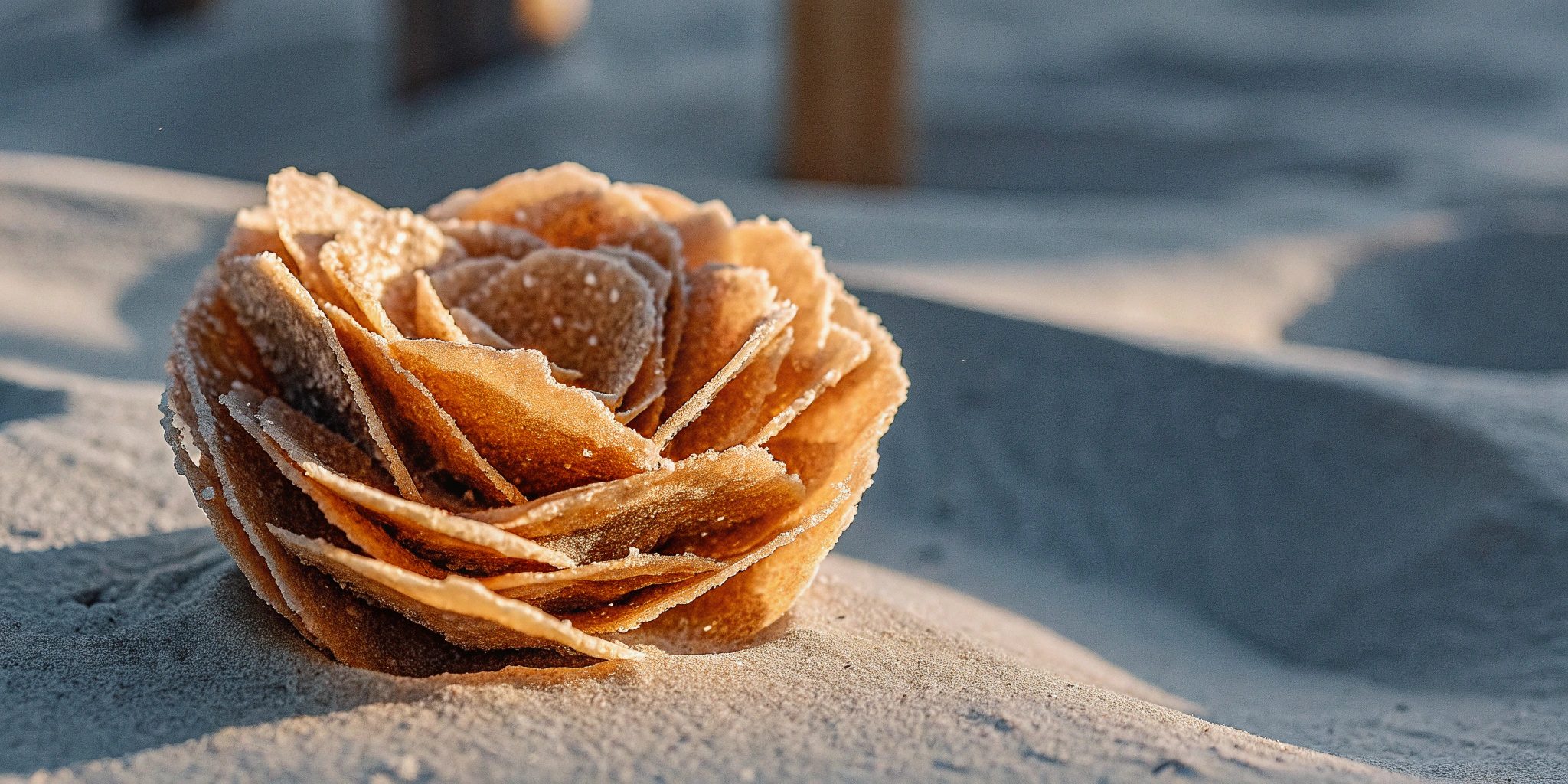
The first time you encounter a desert rose half-buried in ochre sand, you are almost certain it is a trick of the light. Its petals appear soft, organic, perhaps even wilting in the heat. Then you touch it, and the illusion shatters. It is stone—crystalline, sharp, and impossibly ancient. This mineral formation, which carries the romantic name rosa del deserto and the Arabic baryte rose, is not a plant at all, but a sculpture forged by evaporation, chemistry, and time.
Geologically, the desert rose belongs to the evaporite family. It forms when mineral-rich water—often calcium sulfate or barium sulfate—seeps into shallow desert basins and slowly evaporates under a relentless sun. As the water retreats, crystals begin to grow, incorporating surrounding sand grains into their structure. The result is a rosette cluster of flat, blade-like crystals radiating from a center, creating a blossom made entirely of mineral and silica. The process demands specific conditions: arid climate, saline groundwater, and stable geological basins. Left undisturbed, these formations can grow for thousands, even millions of years, though most specimens that surface today formed during the late Pleistocene or Holocene epochs.
Human awareness of the desert rose predates geology as a science. Nomadic peoples of the Sahara and Arabian Peninsula have known these formations for millennia, though they viewed them through a lens of mysticism rather than mineralogy. Bedouin tribes carried smaller specimens as protective talismans, believing the stone’s rose-like form could ward off evil eye and desert spirits. In the Tunisian salt flats of Chott el Djerid, local guides still tell travelers that the desert rose is the earth’s attempt to apologize for its barrenness, offering beauty where nothing else will grow.
The largest and most spectacular specimens are found in a belt stretching across North Africa, the Arabian Peninsula, and into the American Southwest. Tunisia, Algeria, and Morocco produce extraordinary gypsum roses from the Sahara’s evaporative basins. Saudi Arabia’s Al-Ahsa Oasis, a UNESCO World Heritage site, sits atop vast subterranean reserves where barite and gypsum roses intermingle. In the United States, Oklahoma’s Great Salt Plains yield some of the world’s finest barite desert roses, dense and reddish due to iron-rich clay inclusions. Australia’s Simpson Desert and Mexico’s Chihuahuan Desert also harbor significant deposits, though these remain less commercially exploited.
Two primary types dominate the mineral market. Gypsum desert roses are the most common—lighter, softer, and often delicately translucent. Barite desert roses are denser, harder, and frequently display more sharply defined geometric petals, making them prized by collectors. The barite variety is also significantly heavier; a palm-sized specimen can feel like a lead weight, a physical reminder that this flower is nothing if not serious.
Tourism has transformed the desert rose from a geological curiosity into an economic asset. In Morocco’s Erg Chebbi dunes, guides lead camel caravans specifically to outcrops where these mineral blooms emerge from the sand. The Tunisian desert near Douz has built part of its ecotourism identity around fossil and mineral hunting, with desert roses sold in every souk from Tozeur to Tataouine. In Oklahoma, the Great Salt Plains State Park permits visitors to dig for barite roses during designated seasons, creating a rare intersection of geology and family vacation.
Historically, the desert rose served practical purposes before it became decorative. In the Sahara, where timber is scarce, soft gypsum roses were sometimes crushed and mixed with lime for rudimentary plaster. Traders along the Trans-Saharan routes carried them as lightweight, high-value curiosities to Mediterranean ports, where they entered the cabinets of Renaissance collectors alongside coral and ammonites. The predecessor of modern desert rose appreciation was not science, but this early trade in natural wonders—objects that proved the traveler had reached the edge of the known world.
Symbolically, the desert rose carries extraordinary weight. It represents resilience, the possibility of beauty in conditions that seem to forbid it, and the slow, patient work of nature. In New Age spirituality, it is believed to carry grounding energy, helping to clear mental clutter and anchor the spirit. Interior designers value it as a conversation piece, a natural sculpture that bridges organic and mineral aesthetics.
What has changed most is the tension between preservation and commerce. Once abundant enough to be used as construction filler, desert roses are now protected in many national parks and heritage sites. Over-collection has stripped accessible outcrops in several regions, forcing governments to regulate harvesting. The specimen that once sold for pennies in a desert market now commands significant prices in mineral shops and online auctions.
From a Bedouin talisman to a protected geological treasure, the desert rose reminds us that the harshest environments do not merely destroy—they create. The desert does not apologize for its emptiness. It simply offers, in its own slow language, a flower that never dies.