Salt and leaves. That was the entire formula for what the Romans called herba salata—literally “salted herbs”—the ancestor of every bowl of mixed greens that followed. The word salad itself descends from the Latin sal, meaning salt, and that etymology reveals the dish’s original identity: not a side course, but a medicine. Long before it became a lunch option or a diet cliché, the salad was a tool for digestion, a palate cleanser, and a sobering agent for emperors who had indulged too deeply in wine.
The earliest traces lead to the ancient Mediterranean. Greeks and Romans gathered wild greens—chicory, purslane, mallow—and dressed them with salt, oil, and vinegar. The Roman statesman Cato the Elder recorded a recipe for salata in the 2nd century BCE that would not look out of place today: chopped herbs, vinegar, and a drizzle of oil. But the concept was older still. Persian nobility ate raw greens before meals to stimulate appetite, and Egyptian tomb paintings depict workers harvesting lettuce and onions with the same reverence reserved for grain. The predecessor was not a recipe, but the simple human instinct to eat uncooked plants and preserve them with the most available mineral: salt.
For centuries, the salad remained a humble, almost medicinal affair. Then the Renaissance arrived in Italy, and the dish underwent a transformation that would send it across Europe. By the 15th century, Italian cooks were composing elaborate insalate that arranged cooked and raw ingredients—vegetables, fruits, nuts, flowers—into architectural displays. These were not mere food; they were edible statements of wealth and botanical knowledge. When Catherine de’ Medici married into the French court in 1533, she brought her Florentine cooks with her, effectively transplanting Italian salad culture to France. From there, the composed salad spread through European courts, where it symbolized refinement, health, and the ability to command rare ingredients out of season.
Symbolism followed the salad like a shadow. In medieval Europe, raw food was often viewed with suspicion—fire was purification, and uncooked plants were associated with the peasant or the pagan. Yet by the 17th century, the salad had been rehabilitated as a virtuous dish, a counterweight to the heavy roasted meats of the aristocratic table. To choose salad was to signal restraint, sophistication, and a modern understanding of the body. It was, in essence, the first health food.
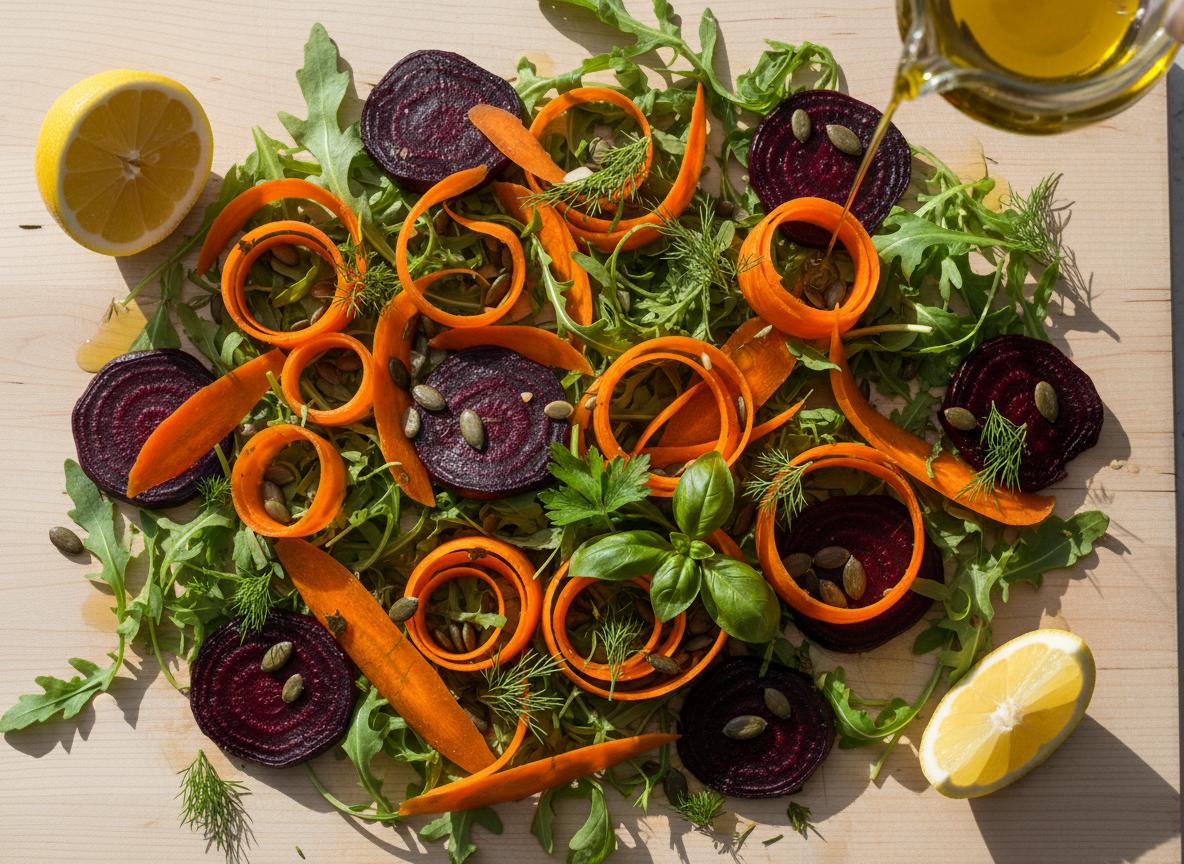
The taxonomy of salads today is vast. Leafy salads depend on tender greens and light vinaigrettes. Bound salads—think chicken or tuna salad—use mayonnaise as a structural glue. Composed salads arrange ingredients with deliberate geometry, while fruit salads and grain salads have expanded the category into dessert and main-course territory. The Caesar salad, invented in 1924 by Italian immigrant Caesar Cardini in Tijuana, Mexico, remains arguably the most popular single recipe globally, though the simple mixed green bowl—arugula, spinach, baby kale—has become the default of contemporary dining.
What changed most dramatically is the salad’s relationship to seasonality and labor. Until the 20th century, a fresh green salad in January was a luxury for the wealthy, who maintained forcing houses and hothouses. The rest of humanity ate preserved vegetables through winter. Refrigerated transport and global supply chains shattered this limitation. Today, a Londoner can eat Peruvian asparagus and Kenyan baby spinach in February, and the salad has evolved from a seasonal corrective to a year-round staple.
The modern impact is difficult to overstate. The salad anchors the global wellness industry, drives the fast-casual restaurant sector, and serves as the default language of dietary virtue. It has become a main course rather than a prelude, loaded with proteins, grains, and fermented dressings that would confuse a Roman physician. Yet the core transaction remains identical: raw nature, lightly disciplined by salt and acid, offered as a promise that we can eat our way toward better health.
From a Roman sobering remedy to a billion-dollar industry, the salad has proven that the simplest dishes often carry the deepest histories. It never needed fire to become essential. It only needed salt, and the human conviction that a bowl of leaves could mean something more than survival.