
Over one hundred thousand years ago, in the dark recesses of a cave in Southern Africa, someone threaded a perforated shell onto a sinew cord and wore it as ornamentation. Archaeologists discovered those Nassarius shells—brought from rivers twenty kilometers away—still clustered in groups that suggest necklaces or bracelets. That simple act of adornment marks the earliest known evidence of human jewelry, proving that seashells captivated our ancestors long before agriculture, cities, or written language existed.
The predecessor to the treasures we collect today was simply the exoskeleton of a soft-bodied mollusk—calcium carbonate secreted for protection and support. Once the creature inside dies, the empty architecture remains, offering humans a portable piece of oceanic art. Some seashells traveled vast distances inland through trade routes, becoming more valuable the farther they journeyed from the shore.
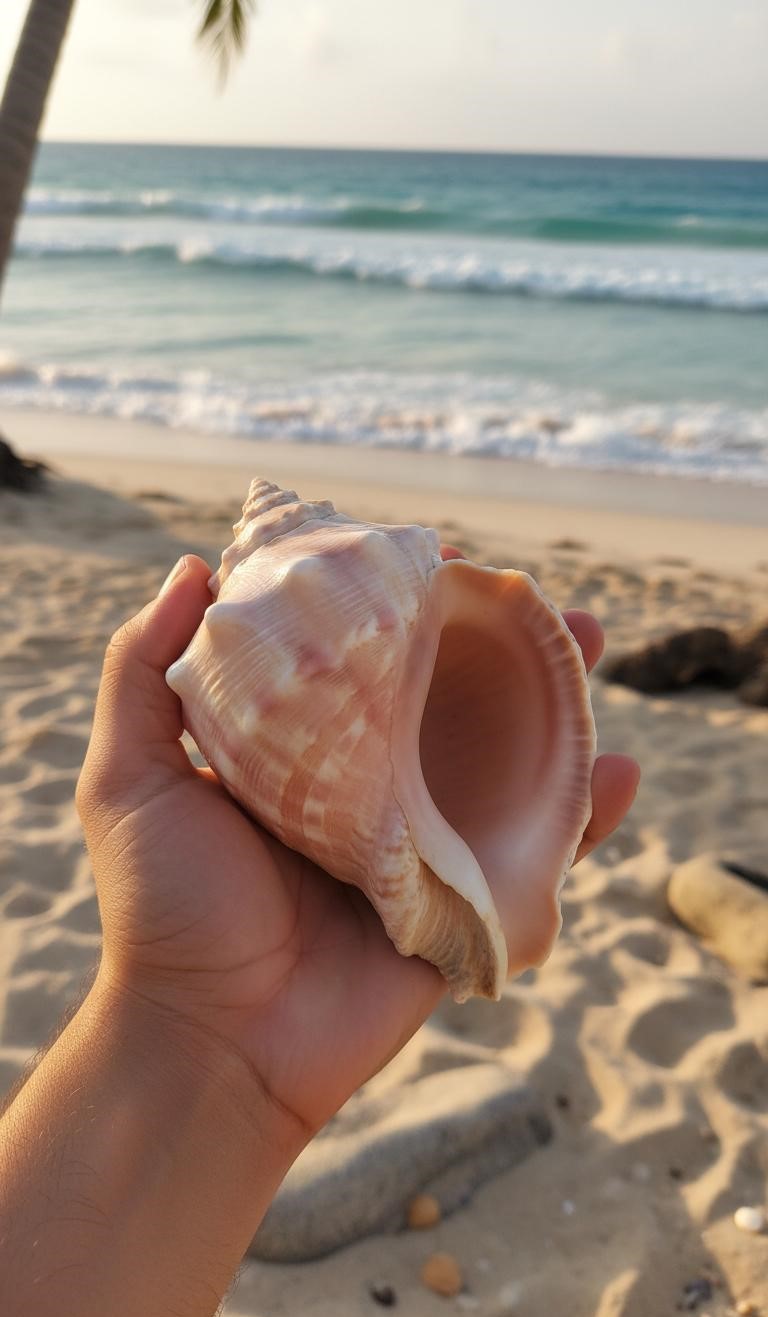
Today’s varieties reveal a staggering diversity of form and function. The conch shell, with its spiraling pink interior, has served as both musical instrument and ceremonial object across Caribbean and Pacific cultures. Cowrie shells—smooth, glossy, and shaped like a pregnant belly—became the most widely used currency in human history, traded across Africa, Asia, and the Middle East for millennia. The nautilus, a living fossil virtually unchanged for five hundred million years, inspired mathematicians with its perfect logarithmic spiral. Scallops, olives, moon shells, augers, murexes, and cockles each offer distinct silhouettes that have decorated homes and bodies for centuries.
Extreme specimens capture global imagination. The giant clam, Tridacna gigas, holds the record as the largest bivalve on earth. One specimen discovered off Sumatra in 1817 measured 137 centimeters across and weighed an estimated 250 kilograms alive. Another, found near Okinawa in 1956, reached 115 centimeters and tipped the scales at 340 kilograms. These massive shells can live for over a century, their mantles displaying iridescent patterns as unique as fingerprints. At the opposite end of the spectrum, tiny Conus shells barely larger than a lima bean were treasured enough to be buried with a child seventy-four thousand years ago in South Africa, coated in red ochre as a sign of love or protection.
Seashells began their ascent as collectibles during the 17th century, when Dutch traders returned from Indonesia with specimens no European had ever seen. The obsession earned a name—”Conchylomania”—as aristocrats filled cabinets of curiosity with exotic spirals and iridescent mother-of-pearl. Today, beachcombing remains one of the most accessible and beloved pastimes on earth. Children still fill buckets along shorelines, artisans craft jewelry from fragments polished by surf, and decorators use shells to evoke coastal tranquility in homes far from any ocean.
Symbolically, seashells carry layers of meaning that transcend culture. Their hard exterior and soft interior represent protection and vulnerability. Their association with water links them to emotions, fertility, and the feminine divine—from Venus rising on a scallop in Botticelli’s famous painting to African traditions connecting cowries with ocean spirits and safe childbirth. The spiral form of many shells suggests infinity and the cyclical nature of life, expanding outward like the human journey itself.
What changed most profoundly is perception and availability. Once used as actual currency and sacred ritual objects, seashells have become primarily decorative and symbolic. However, modern environmental awareness has introduced a new dimension of reverence. As coastal development and ocean acidification threaten mollusk populations, collecting practices have shifted toward sustainability. “Leave no trace” ethics now guide many beachgoers, while artists and jewelers increasingly work with vintage or ethically sourced specimens rather than harvesting live animals.
From a Paleolithic necklace to a pilgrim’s badge, from currency to coastal decor, seashells continue proving that humanity’s fascination with the ocean’s architecture is as deep and enduring as the tides themselves.