Silver scales flashing beneath the surface of the Mediterranean have captivated fishermen for millennia. Among the most prized catches swimming those ancient waters is the European sea bass, known to Italians as branzino and to the rest of the world increasingly as the star of Italian Grilled Branzino. This sleek, silvery predator has journeyed from Roman fishponds to the finest American restaurant menus, carrying with it a history as rich as its delicate, flaky flesh.
Ancient Romans worshipped this fish with almost religious fervor. The cookbook of Apicius, Rome’s most famous gastronome, dedicates entire sections to fish sauces and preparations. Wealthy citizens built elaborate piscinae—saltwater ponds carved into their coastal villas—to keep sea bass alive until the dinner bell rang. Pliny the Elder noted that one politician spent eight thousand sestertii on a single red mullet, a sum that could have purchased ten cows, revealing just how extravagantly the elite valued Mediterranean seafood. For those imperial diners, the ancestor of Italian Grilled Branzino represented the ultimate display of wealth and sophistication.
The predecessor to modern Italian Grilled Branzino was simply the wild European bass, Dicentrarchus labrax, hunted with spears and nets along rocky shorelines from Norway to West Africa. Slow-growing and elusive, the fish can reach up to three feet in length and weigh as much as twenty-six pounds, though most market specimens hover around two pounds. In 2014, French angler Guillaume Fourrier landed a world-record nineteen-pound sea bass after two decades of pursuit, a catch certified by the IGFA that still stands as the benchmark for the species.
Today’s varieties reveal a fish of many names and faces. In Italy it remains branzino; Greeks call it lavraki; the French know it as loup de mer; Spaniards order lubina. It belongs to the Moronidae family alongside striped bass and white perch, though it should not be confused with the unrelated Chilean sea bass, which is actually a Patagonian toothfish. Some regional populations have declined due to overfishing, making farm-raised Italian Grilled Branzino the standard in most markets. Greece and Turkey now lead global aquaculture production, supplying the portion-sized fish—typically one to one-and-a-half pounds—that American chefs prefer for plating whole.
The American love affair with this dish ignited surprisingly. During the 1990s, the United States imported a mere thirty-seven metric tons annually, mostly frozen. By 2019, that figure exploded to over nine thousand six hundred metric tons of fresh, whole fish, nearly all of it destined for upscale restaurants in New York and Los Angeles. What changed was perception: once a regional Mediterranean specialty, Italian Grilled Branzino became a shorthand for clean, healthy, sophisticated dining.
Symbolically, the fish carries auspicious weight across Mediterranean cultures. In Greece and Italy, serving whole fish at celebrations signals good luck and prosperity. The presentation—head and tail intact, flesh scored and stuffed with herbs—represents abundance and respect for the ingredient. The preparation itself has become a ritual. Italian fishermen traditionally grilled the fish over vine cuttings or hardwood, believing that smoke from the land should marry with the taste of the sea. Eating whole fish together remains an act of communion rather than mere sustenance.
What changed most profoundly is accessibility. Roman emperors kept live sea bass in private ponds; modern home cooks can find cleaned, scaled branzino at neighborhood grocery stores. The preparation remains elemental: fire, olive oil, lemon, and herbs. From the fishponds of ancient villas to backyard grills in California, Italian Grilled Branzino continues proving that the most enduring dishes often come from the simplest respect for the sea.
Italian Grilled Branzino
Ingredients:
- 2 whole branzino (about 1 to 1.5 lbs each), cleaned and scaled
- 1/4 cup extra virgin olive oil, plus more for drizzling
- 2 lemons — 1 sliced into thin rounds, 1 halved for serving
- 4 sprigs fresh rosemary
- 4 sprigs fresh thyme
- 4 cloves garlic, thinly sliced
- 1 teaspoon sea salt
- 1/2 teaspoon freshly cracked black pepper
- 1/4 cup fresh parsley, chopped
- 1 tablespoon capers, drained (optional)
Instructions:
Pat the fish completely dry inside and out with paper towels. This is the most important step — wet skin sticks to the grill.
Using a sharp knife, score both sides of each fish with three diagonal slashes, about 1/4 inch deep. Rub the entire fish — cavity and skin — with olive oil, salt, and pepper. Squeeze a little lemon juice inside the cavity.
Stuff each fish with lemon slices, rosemary, thyme, and garlic slices. Let them sit at room temperature while you heat the grill.
Preheat an outdoor grill or grill pan to medium-high, around 400°F. Brush the grates generously with oil.
Place the fish directly on the grill. Cook undisturbed for 5 to 6 minutes per side. Do not move them around — the skin needs contact with the heat to crisp. You will know they are ready when the skin is golden and charred and the flesh flakes easily near the backbone.
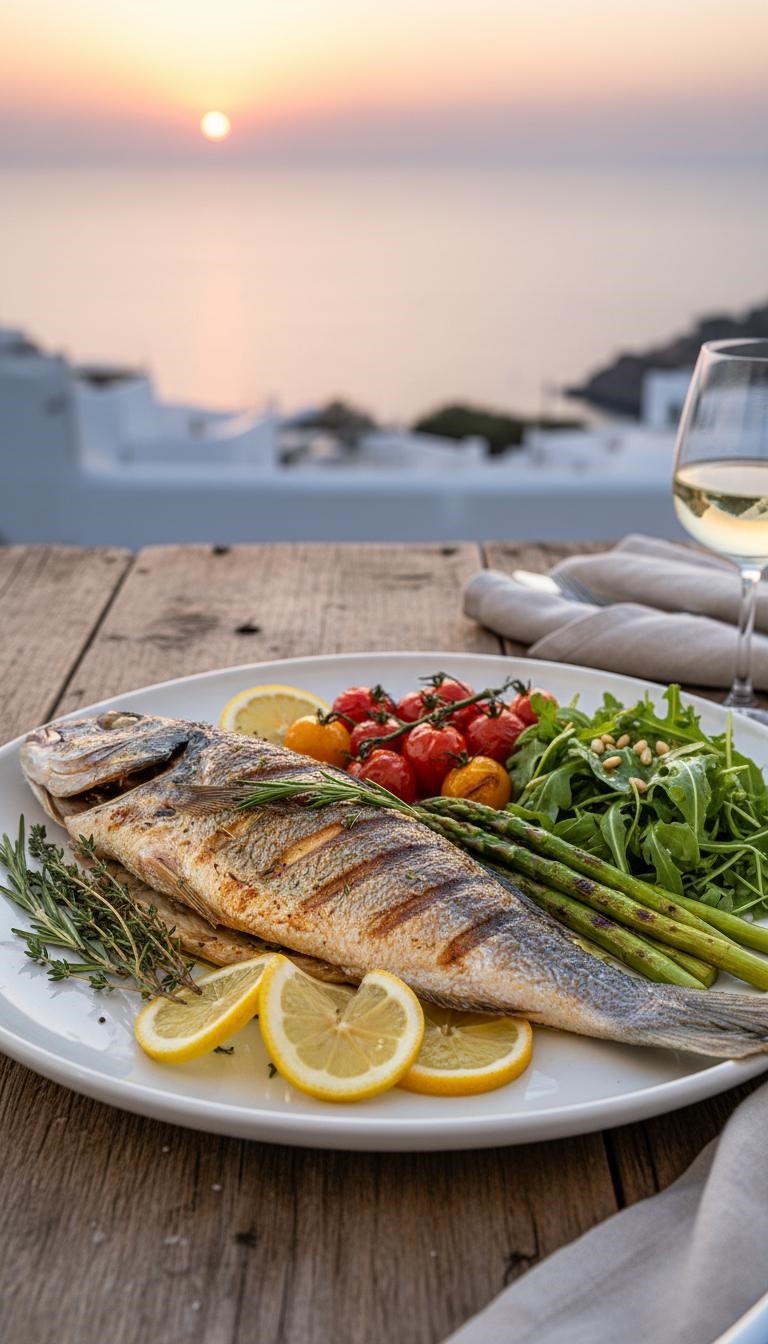
Transfer to a platter. Drizzle with fresh olive oil, squeeze the remaining lemon over the top, and scatter parsley and capers. Serve immediately with grilled asparagus, roasted cherry tomatoes, or crusty bread to soak up the juices.
Pro Tips:
- If the fish head and tail intimidate your guests, fillet it tableside with two spoons — the meat lifts right off the bone.
- No outdoor grill? A cast-iron grill pan on the stovetop works perfectly. Just open a window.
- The leftover carcass makes an incredible fish stock for tomorrow’s risotto.