Where did donuts originate? The answer is not an American diner counter, nor a Krispy Kreme conveyor belt, but the cold, windswept coast of the Netherlands in the sixteenth century. Dutch settlers brought olykoeks—literally “oily cakes”—to New Amsterdam in the early 1600s, frying balls of sweetened dough in pork fat until they puffed into golden, irregular spheres. These were not the neat rings of modern imagination but lumpy, filling-stuffed fritters that absorbed oil like sponges and required careful chewing to avoid raw centers. The donut as we recognize it—a ring of yeasted or cake dough, fried and glazed—was a later American refinement, born from the collision of immigrant tradition, mechanical ingenuity, and pure commercial ambition.
The spiritual architecture of donut culture echoes biblical themes of circularity and completeness. The ring shape, whether intentional or accidental, carries symbolic weight across cultures—the circle as eternity, as the cycle of life, as the halo of the divine. In some theological readings, the donut‘s empty center represents the void that only faith can fill, a reading that transforms the humble pastry into an accidental sacrament. More prosaically, the hole was likely invented to solve a practical problem: uneven frying and raw centers plagued early olykoeks, and removing the middle allowed heat to circulate evenly.
Legend credits the donut hole to a New England sea captain named Hanson Gregory in 1847, who allegedly punched a hole through the center of his mother’s fried dough with a ship’s tin pepper box to improve cooking. The story is probably apocryphal—food historians note that ring-shaped fritters appeared in cookbooks before Gregory’s supposed invention—but it captures the American impulse to mythologize even the simplest culinary innovations. By the 1870s, donuts were standard fare at county fairs and church socials across the Northeast, their cheap ingredients and quick frying time making them ideal for mass feeding.
True donut industrialization arrived in the 1920s. Adolph Levitt, a Russian-Jewish immigrant, invented the first donut machine in New York City in 1920, displaying it in his Harlem bakery window to attract crowds. The machine could produce eighty dozen donuts per hour, transforming a handmade specialty into a factory product. By 1934, the donut was celebrated at the Chicago World’s Fair as the “food hit of the Century of Progress,” and national chains began to emerge. Dunkin’ Donuts opened in 1950 in Quincy, Massachusetts, while Krispy Kreme had been selling its hot, glazed rings in Winston-Salem, North Carolina, since 1937.
Extremes of donut culture are both spectacular and absurd. Largest donut ever constructed was a nearly two-ton jelly-filled monster baked in New York in 1998, requiring a custom-built fryer and enough dough to feed a small town. At the opposite extreme, the “mini donut” phenomenon has produced confections barely larger than a coin, sold by the bagful at state fairs and sporting events. Most expensive donut in the world, created by a Brooklyn chef in 2012, incorporated gold leaf, champagne jelly, and Cristal-infused icing, retailing for $1,200—a grotesque elevation of the working-class staple.
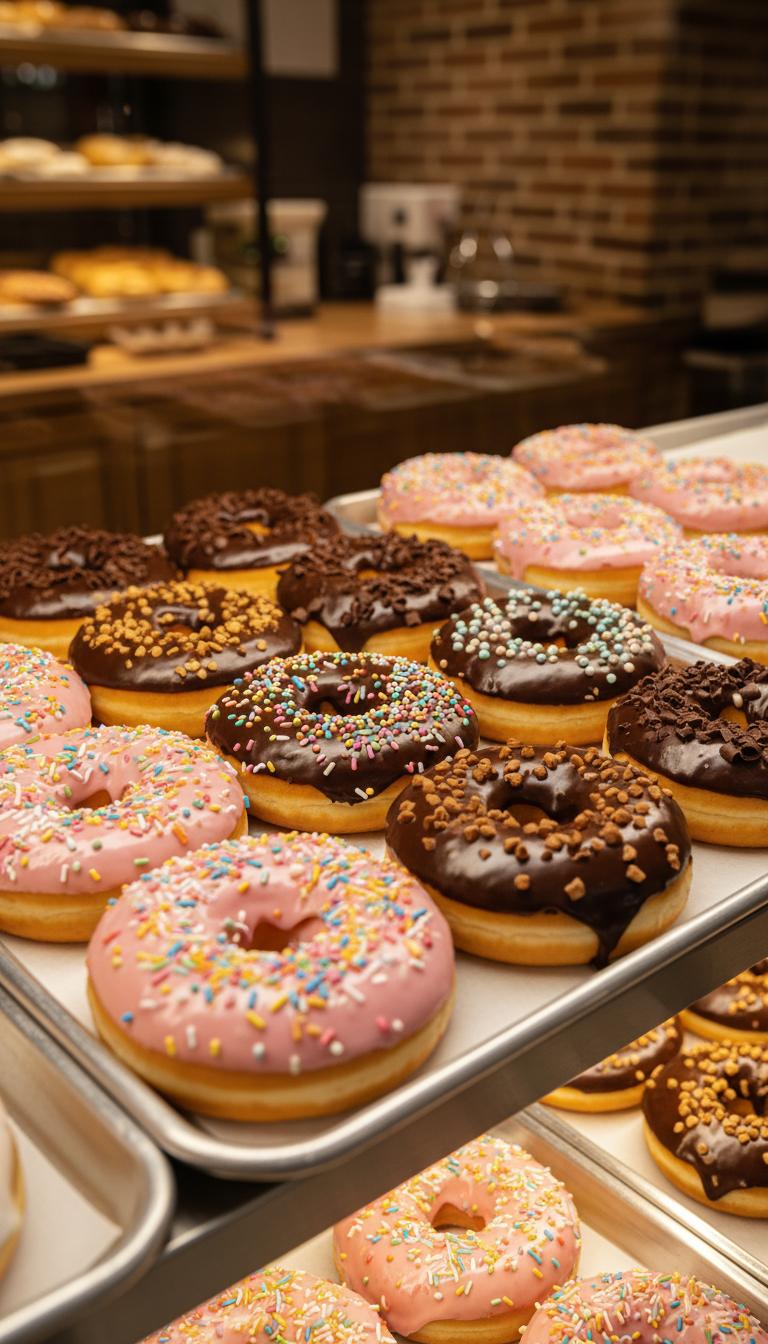
Today’s donut landscape is vast and varied. Yeasted donuts, with their light, airy crumb and ethereal glaze, dominate the American market. Cake donuts, denser and more substantial, offer a coffee-dunking alternative. The French beignet, square and pillowy, reigns in New Orleans. Italian bomboloni are filled with custard or jam, while the Portuguese malasada—introduced to Hawaii by immigrant workers—has become a Pacific staple. Korean kkwabaegi, twisted and sugar-dusted, and the Japanese pon de ring, with its segmented, pull-apart structure, demonstrate the donut‘s global adaptability. Yet some traditions have faded. The original Dutch olykoek, stuffed with apples or raisins and lacking any hole, has nearly disappeared from American consciousness, surviving only in specialty bakeries and historical reenactments. The cruller, once a twisted, ridged staple of East Coast coffee shops, has been eclipsed by simpler ring shapes.
What preceded the modern donut was the ancient tradition of frying sweetened dough, which existed independently in cultures from ancient Rome to medieval Arabia. The leap to the American ring required Dutch immigration, New England ingenuity, and the industrial revolution of the kitchen.
Today, the global donut market exceeds $40 billion annually, with chains and independent artisans competing for dominance. Symbolically, the donut represents indulgence, comfort, and the democratic pleasure of cheap sweetness. What changed most profoundly is its context. Once a handmade treat for church socials and county fairs, the donut is now a global commodity, available in airport terminals and drive-through windows at any hour. The machine that Levitt displayed in his Harlem window has multiplied into thousands, producing millions of identical rings daily. Yet the essential pleasure remains: the shatter of glaze, the yielding crumb, the sticky fingers that demand to be licked. The Dutch immigrant who first fried olykoeks in New Amsterdam would recognize the impulse, even if the machinery and the mythology have grown beyond anything he could have imagined. Where did donuts originate? In the oily smoke of a Dutch kitchen, in the hunger of immigrants, in the American genius for turning the humble into the iconic.