
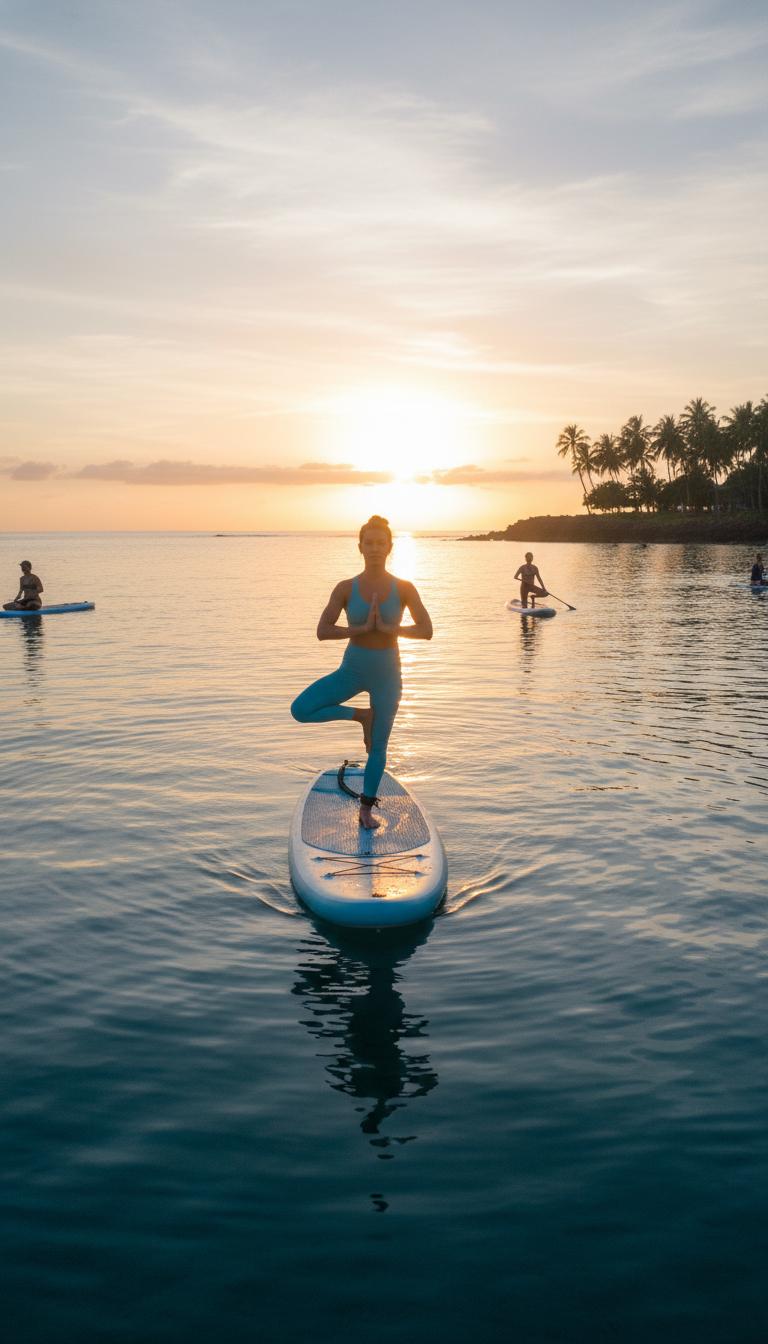
There is a particular image that now defines the season: a solitary figure in warrior pose, balanced on a paddleboard at dawn, the water below mirroring a sky streaked with rose and gold. It is the visual shorthand for modern summer wellness, yet the practice being performed carries roots that snake back through millennia of philosophy, colonial encounter, and reinvention. What looks like a simple stretch in a beautiful setting is, in fact, one of humanity’s oldest surviving disciplines, finally returning to the open air where it began.
The word “yoga” derives from the Sanskrit yuj, meaning to yoke or unite—a linguistic clue that reveals its original purpose. Long before it became a fitness category, yoga was a spiritual technology designed to unite individual consciousness with the universal. Its earliest echoes appear in the Rigveda, composed roughly 1500 BCE, where ascetic practices and breath control are mentioned alongside hymns to the gods. The true codification, however, arrived around 400 CE with Patanjali’s Yoga Sutras, which mapped an eight-limbed path toward moksha, or liberation. For most of its history, yoga was not a physical workout. The asanas were predominantly seated postures meant to prepare the body for hours of meditation, practiced by male Brahmins and wandering shramana ascetics in forests and caves across the Indian subcontinent.
The predecessor of modern yoga was not a gym class, but a lifestyle of renunciation. Early practitioners sought to transcend the body, not sculpt it. The dramatic shift toward physical dynamism came in the early 20th century, when Indian nationalist movements promoted hatha yoga as a means of building strong, disciplined citizens. Tirumalai Krishnamacharya, often called the father of modern yoga, transformed the practice in the Mysore Palace, creating flowing sequences that would eventually be transmitted to the West by his disciples—B.K.S. Iyengar, K. Pattabhi Jois, and Indra Devi.
When yoga reached Europe and America, it carried the perfume of the exotic. Swami Vivekananda’s address at the Parliament of the World’s Religions in Chicago in 1893 introduced the philosophy to Western intelligentsia, and by the 1960s, it had fused with counterculture, offering a spiritual alternative to industrial fatigue. In Europe, it initially signified rebellion against rigid convention; today, it signals membership in the global wellness economy. Beach clubs from Ibiza to Bali now list “sunrise vinyasa” alongside cocktails, and the ancient discipline has become a staple of summer tourism.
The types of yoga available today are dizzying. Hatha remains the foundational umbrella, while Vinyasa, Ashtanga, Kundalini, Yin, and Bikram (hot yoga) cater to different temperaments and physical goals. The most popular form globally is arguably Vinyasa flow, though summer has birthed its own hybrids—beach yoga, stand-up paddleboard yoga, and even aqua yoga—each capitalizing on the season’s promise of elemental immersion. The Surya Namaskar, or sun salutation, has become the unofficial anthem of summer practice. Though its modern sequence was likely developed in the 20th century, it channels an ancient reverence for the sun as the source of prana, or life force. Practicing it on warm sand at dawn is less an innovation than a homecoming.
What has changed most profoundly is the democratization of the practice. Yoga has migrated from ashrams to smartphone apps, from male spiritual elites to a predominantly female global fitness community. The goal has shifted from liberation in the next life to stress relief in this one. Yet the move outdoors—especially during summer—represents a curious return to origins. The ancient yogis practiced under banyan trees and open skies; we now unroll mats on piers and dunes. The setting is different, but the impulse to align breath with the rhythms of nature remains identical.
Today, yoga is an industry valued in the tens of billions, influencing medicine, psychology, fashion, and travel. It has been secularized and commercialized, yet its ethical framework—the yamas and niyamas—quietly shapes modern conversations about sustainability and conscious living. The woman on the paddleboard may not be seeking enlightenment. She may simply want a deep stretch and a photograph worthy of the morning light. But she is part of a current that began thousands of years ago, when someone first sat beneath a tree, closed their eyes, and tried to touch the infinite. The sun has not changed. The poses have simply moved closer to the water.