
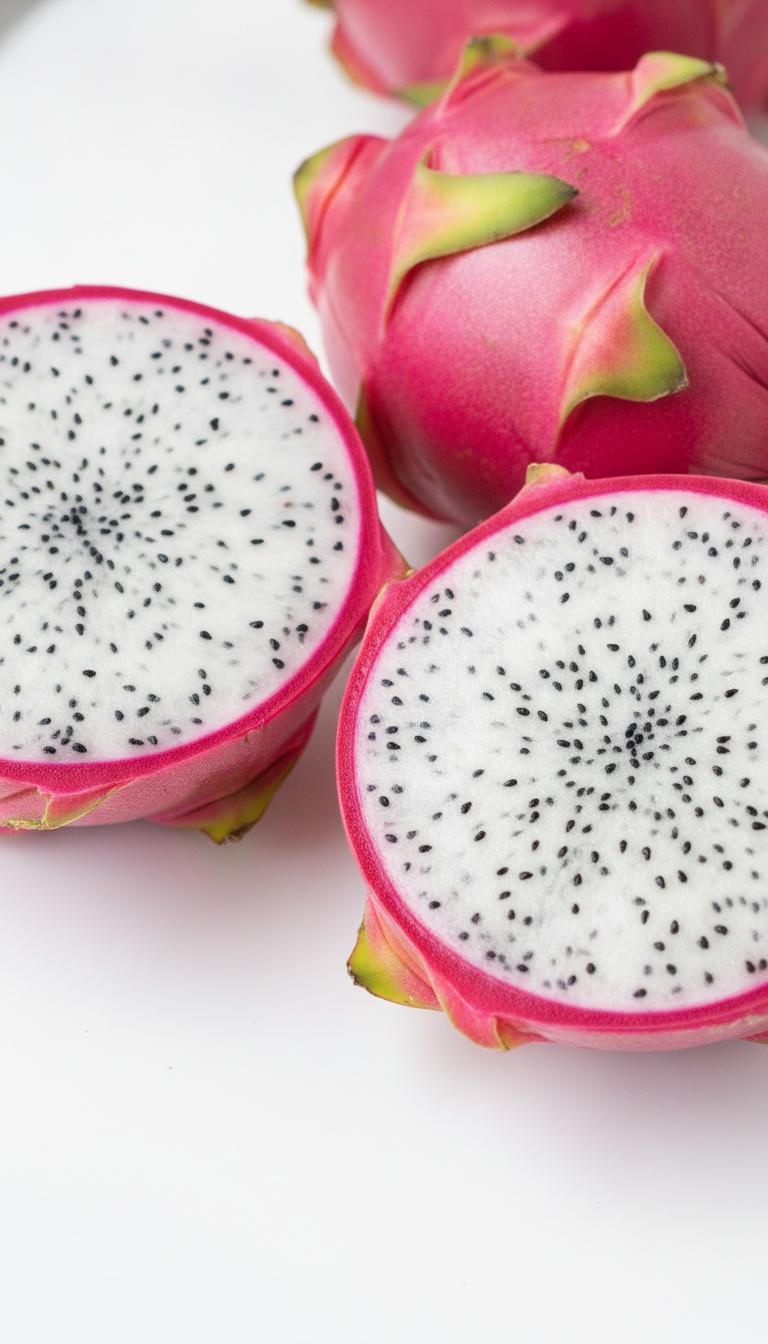
The first time you cut open a dragon fruit, the experience is almost theatrical. The exterior is pure spectacle—hot pink or golden yellow, covered in fleshy green scales that curl outward like flames frozen in mid-leap. Then the knife sinks in, and the interior reveals itself: either an opaque white or a deep magenta so vivid it stains the cutting board like beet juice, both studded with thousands of tiny black seeds that crunch between the teeth like mild poppy. The flavor, however, arrives as a surprise. After all that visual drama, the taste is subtle, almost shy—sweet, watery, with a faint floral note that some compare to kiwi, others to pear, and many find simply elusive. It is a fruit that promises intensity and delivers restraint, and that contradiction has carried it from Central American jungles to the smoothie bowls of Bali and the Instagram feeds of Los Angeles.
Botanically, the dragon fruit is the fruit of several cactus species in the genus Hylocereus, native to the tropical forests of southern Mexico, Central America, and northern South America. Unlike the desert cacti that most people picture, these are climbing or epiphytic plants that use aerial roots to anchor themselves to trees, sending long, serpentine stems toward the canopy in search of light. The name “dragon fruit” is a relatively recent English invention, derived from the Chinese huǒ lóng guǒ—”fire dragon fruit”—which itself refers to the scaly, flame-like appearance. In Spanish-speaking regions, it is pitahaya or pitaya, names that predate European contact and derive from indigenous Taíno or Carib languages. The Vietnamese call it thanh long, meaning “green dragon,” a reference to the color of the unripe skin.
The fruit’s history with humans begins in the pre-Columbian Americas, where indigenous peoples cultivated and consumed it long before the arrival of Spanish conquistadors. However, it remained largely confined to its native range until the late 19th and early 20th centuries, when French and British colonial botanists began transporting Hylocereus cuttings to Southeast Asia as ornamental plants. The cactus’s spectacular night-blooming flowers—large, white, and heavily fragrant, opening for a single evening before wilting by dawn—made it a prized garden specimen. The fruit was initially an afterthought, a bonus produced by a plant valued primarily for its floral display.
The Bible does not mention the dragon fruit, which is entirely expected given its geographic isolation from the biblical world. The ancient Near East and Mediterranean had no contact with American cacti, and the fruit’s absence from scripture has not prevented modern wellness marketers from claiming various spiritual properties for it. This is a common pattern with recently globalized foods: lacking ancient textual authority, they acquire new mythologies tailored to contemporary anxieties.
The dragon fruit’s transformation from garden curiosity to commercial crop began in earnest in Vietnam during the French colonial period and accelerated after the Vietnam War, when the government promoted its cultivation as an export commodity. Vietnamese farmers perfected techniques for trellising the cacti, hand-pollinating the night flowers, and harvesting the fruit at optimal ripeness. By the 1990s, Vietnam had become the world’s largest producer, a position it still holds today, followed by Mexico, Thailand, Malaysia, and Indonesia. The fruit’s arrival in Western markets coincided with the rise of visual food culture; its photogenic exterior made it irresistible to food bloggers and health influencers, who featured it in smoothie bowls, fruit platters, and cocktails where color mattered more than flavor.
The taxonomy of dragon fruit includes several distinct species and varieties. Hylocereus undatus produces the white-fleshed fruit with pink skin that is most common globally. Hylocereus costaricensis and Hylocereus polyrhizus yield the magenta-fleshed varieties, which command higher prices due to their dramatic color and slightly sweeter, more concentrated flavor. Hylocereus megalanthus, the yellow-skinned species with white flesh, is smaller, rarer, and often considered the most delicately flavored of all. The Selenicereus genus, closely related, includes the sour pitaya or pitaya agria, which is used primarily for aguas frescas and fermented beverages in Central America rather than eaten fresh.
What has changed most dramatically is the fruit’s cultural status. In its native range, the dragon fruit was a seasonal treat, consumed fresh during the brief harvest window or preserved as jams and candies. In its adopted homes of Southeast Asia, it became a symbol of prosperity and good fortune, displayed during Lunar New Year celebrations and given as gifts in elaborately arranged fruit baskets. In the West, it has been rebranded as a superfood, its antioxidant content, fiber, and vitamin C marketed with the same fervor applied to açaí and goji berries. The deep magenta varieties, in particular, have been promoted for their betacyanin pigments, which are chemically related to the betalains in beets and have shown potential anti-inflammatory properties in laboratory studies, though human clinical evidence remains limited.
The global dragon fruit trade now exceeds several billion dollars annually, with the United States, China, and the European Union representing the largest import markets. The fruit’s popularity has driven agricultural expansion into non-native regions, including Australia, Israel, and the southern United States, where greenhouse cultivation allows year-round production. This expansion has not been without ecological concerns; in some regions, escaped Hylocereus has become an invasive species, climbing over native vegetation and altering forest structure.
Symbolically, the dragon fruit occupies a space of pure contemporary aspiration. It represents the globalized palate, the wellness economy, and the triumph of visual appeal over flavor intensity. To eat dragon fruit in a smoothie bowl, photographed from above in natural light, is to participate in a ritual of health and beauty that transcends geography. The fruit itself is almost incidental; what matters is the gesture, the color, the implication of exotic knowledge and disciplined self-care.
From a Central American jungle cactus to a global lifestyle prop, the dragon fruit has proven that in the modern food economy, appearance is not merely important. It is everything. The flavor may be whispered, but the color shouts, and in a world of infinite scroll, shouting is what survives.