In the winter of 1860s Moscow, a Belgian-born chef named Lucien Olivier presided over the kitchen of the Hermitage restaurant, an elegant establishment tucked near the Trubnaya Square. It was there that Olivier salad was born, not as the humble potato dish known today, but as a lavish composition of grouse, crayfish tails, caviar, smoked duck, and capers, bound by a proprietary mayonnaise of extraordinary complexity. The original Olivier salad was a statement of imperial excess, priced so high that only Moscow’s aristocracy could afford a single portion.
The chef guarded his creation with theatrical secrecy. He prepared the mayonnaise alone, locking the kitchen door behind him, and personally plated every order. Yet the recipe could not be contained forever. A sous-chef named Ivan Ivanov, after Olivier’s death, reconstructed the dish from memory and sold a simplified version to a competing restaurant under the name “Stolichny” or “Capital Salad.” From that betrayal, the modern lineage of Olivier salad began its democratic descent.
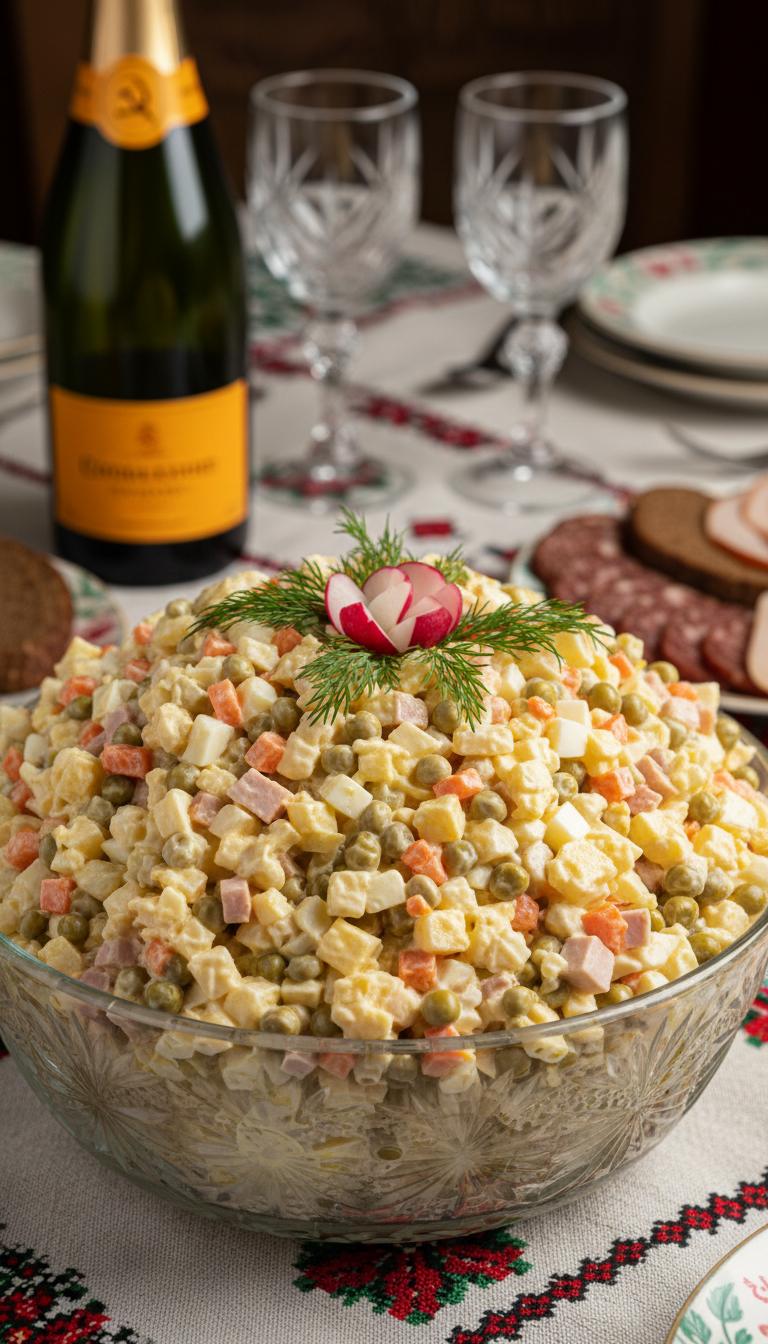
The story of this dish is inseparable from the Soviet experiment. After the revolution of 1917, the original ingredients—grouse, crayfish, caviar—vanished from Soviet kitchens along with the aristocrats who once consumed them. Cooks improvised with what the state provided: potatoes, carrots, canned peas, pickled cucumbers, and bologna. The result was a Soviet Olivier salad that became the mandatory centerpiece of every New Year’s Eve table from Minsk to Vladivostok. It was no longer luxury; it was survival dressed as celebration.
The extremes of scale are almost comical. The largest Olivier salad ever assembled weighed over four tons and was prepared in Russia as a New Year’s publicity stunt, while molecular gastronomy restaurants have served deconstructed versions on a single spoon. The dish mutated as it traveled. In Spain, it became ensaladilla rusa, often served as a tapa with tuna and olives. In Latin America, it appears at Christmas with apples and raisins. The Balkans adopted it as a holiday staple, while Iranian cooks add chicken and pickled vegetables. Yet the original 1860s recipe, with its game birds and secret sauce, has effectively disappeared, preserved only in culinary archives and the occasional heritage restaurant’s nostalgic reconstruction.
What preceded Olivier salad was the French tradition of salades composées—elaborate layered salads of the Second Empire, bound by mayonnaise and arranged with architectural precision. Lucien Olivier adapted that French sensibility to Russian ingredients and Russian appetites, creating a hybrid that outlived both empires.
Today, Olivier salad anchors a global comfort-food economy that stretches far beyond its Moscow origins. In Russia alone, tons of the salad are consumed during New Year’s celebrations, with families preparing it collectively as a ritual of domestic continuity. Symbolically, it represents improvisation and nostalgia in equal measure. For older generations, it recalls Soviet abundance-through-scarcity; for younger ones, it is simply the taste of home.
What changed most profoundly is the philosophy of the dish. The original Olivier salad demanded rare ingredients and culinary artistry. The modern version demands only a pot, a knife, and the willingness to boil vegetables until tender. It is a monument to adaptability, proof that a dish can survive the collapse of the class that created it, the revolution that expelled them, and the globalization that scattered their descendants. Every December, millions of hands chop the same ingredients, not because they must, but because the ritual itself has become the point. The secret mayonnaise is gone, but the gathering remains.