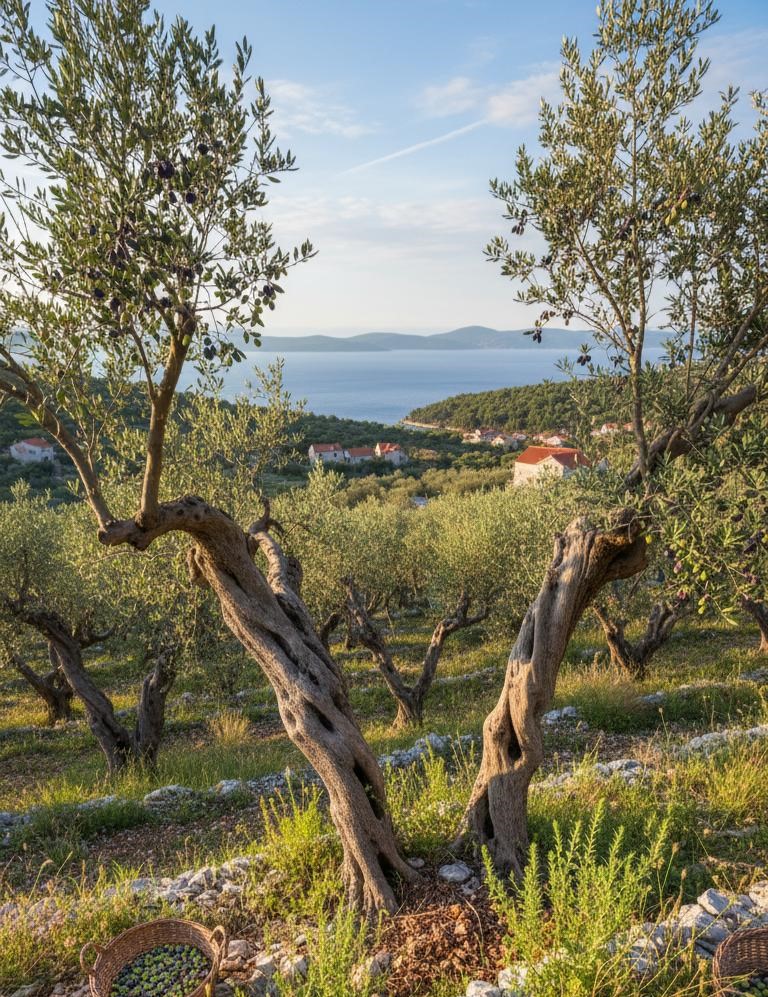
In the sun-baked hills of the eastern Mediterranean, something remarkable took root over six millennia ago. The olive tree, one of humanity’s oldest cultivated companions, began its journey in the Levant region around 4000–3500 BC, when early farmers recognized that this hardy evergreen offered far more than shade. Archaeological evidence places its systematic cultivation in the Bronze Age, though wild ancestors called oleasters had already thrived across the Mediterranean basin for tens of thousands of years. The Phoenicians later carried its seeds across the sea, establishing groves that would define the landscape from Spain to Syria.
Sacred texts elevate the olive tree to extraordinary spiritual heights. In Genesis 8:11, a dove returns to Noah with a freshly plucked olive leaf, signaling that floodwaters had receded and peace was restored between God and humanity. Deuteronomy describes the Promised Land as flowing with olive oil and honey, while Psalm 52 compares the faithful to a green olive tree flourishing in God’s house. Early kings of Israel and Greece were anointed with its oil, a tradition that continues in baptismal ceremonies today.
The predecessor to today’s cultivated varieties was the wild oleaster, a shrubby plant with small, bitter fruit that required patience and processing to become edible. Through millennia of selection, the olive tree transformed from a scrappy Mediterranean native into the source of over one thousand named cultivars worldwide. Some ancient varieties have vanished as DNA analysis reclassifies what were once considered distinct types, while modern agriculture favors high-yield cultivars suited to mechanized harvesting and consistent flavor profiles.
Today’s most popular varieties reveal the olive tree’s remarkable range. Kalamata from Greece delivers large, wine-dark table olives with a tangy, almost smoky depth. Spanish Manzanilla dominates the green olive market with its firm, meaty texture perfect for stuffing with almonds or pimientos. Arbequina and Picual from Spain anchor the global olive oil industry—the former producing delicate, fruity oils, the latter yielding robust, peppery extractions with exceptional shelf stability. Greek Koroneiki offers intensely herbaceous, polyphenol-rich oil prized by connoisseurs for drizzling over salads.
Extreme specimens capture global imagination. In the Lebanese village of Bechealeh, the “Sisters of Noah” stand as possibly the oldest olive trees on earth, with local tradition suggesting they may be the very source of the leaf carried by Noah’s dove. One sister boasts a trunk perimeter of roughly 28 meters. In Israel’s Bethlehem district, the Al-Badawi olive tree reaches approximately 5,000 years of age, while Crete’s Vouves tree, estimated at 4,000 years, supplied branches for the victors’ wreaths at the 2004 Athens Olympics. At the opposite end of the spectrum, compact Arbequina trees grow barely ten feet tall, thriving in containers and small orchards where space is precious.
Symbolically, the olive tree carries unmatched weight across civilizations. Ancient Greek athletes wore wreaths of its branches as crowns of glory, and heralds carried olive branches to declare sacred truces during the Olympic Games. Athena’s gift of the olive tree won her patronage of Athens over Poseidon’s salt spring. Today the United Nations emblem features crossed olive branches as the universal symbol of peace.
What changed most profoundly is the olive tree’s role in daily life. Once reserved for religious anointing, Olympic victory, and lamp oil in ancient temples, it now anchors the multi-billion-dollar Mediterranean diet industry. Global production exceeds three million tons of table olives annually, with Spain, Italy, and Greece leading cultivation. Health-conscious consumers worldwide have embraced extra virgin olive oil as a cornerstone of heart-healthy eating, driving demand to unprecedented levels. From Noah’s dove to modern kitchen counters, the olive tree continues proving that the most ancient gifts of nature often carry the deepest resonance.