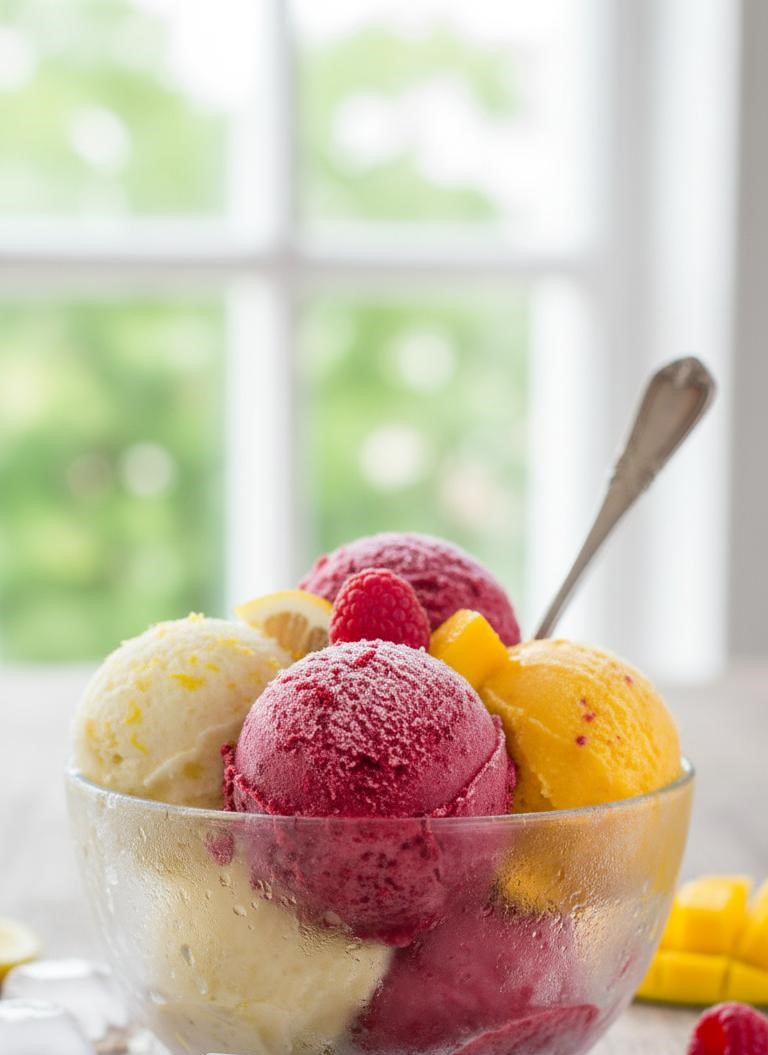
Frozen fruit puree whipped into silky, jewel-toned scoops has offered relief from summer heat for centuries, yet the precise origins of fruit sorbet remain surprisingly contested. Ancient Roman emperors dispatched runners to the Apennine mountains to collect snow, which was then flavored with honey and wine — an early precursor that lacked the smooth texture we now associate with the dessert. The true breakthrough arrived around the ninth century in the Arab world, where a sweetened fruit syrup called sharbat was cooled with snow or underground ice. This technique spread through Sicily and southern Spain during Islamic rule, establishing the template that would eventually become modern fruit sorbet.
By the Renaissance, Italian courts had refined the process significantly. The Medici family in Florence employed dedicated sorbettieri who prepared frozen desserts for lavish banquets. Catherine de’ Medici brought these artisans to France when she married Henry II in 1533, introducing the concept to northern European palates. The word sorbet itself derives from the Italian sorbetto, which traces back through Turkish and Persian to the Arabic sharbat, meaning “a drink.” This linguistic journey mirrors the dessert’s physical migration across cultures and continents.
Several distinct types define the contemporary landscape. Citrus sorbets — lemon, lime, and orange — remain the most technically demanding due to their high acidity and low sugar content, requiring precise balance to achieve smooth texture without iciness. Berry sorbets, particularly raspberry and strawberry, dominate commercial production for their vivid color and intense flavor. Tropical varieties featuring mango, passion fruit, and guava have surged in popularity as global trade made these fruits accessible year-round. Wine-based sorbets, technically a separate category called sgroppino in Italy, blend Prosecco with lemon sorbet for an effervescent cocktail. Some historical forms have faded. Medieval versions that relied on snow rather than mechanical freezing produced grainy, short-lived results that would seem primitive today. The original Arab sharbat, a thin, drinkable syrup, survives in Middle Eastern cuisine but has largely diverged from its frozen descendant.
Extremes in scale capture global attention. The largest fruit sorbet ever produced was created for a festival in Sicily, using industrial batch freezers and hundreds of kilograms of Sicilian lemons to feed thousands. At the opposite end, molecular gastronomy restaurants serve sorbet portions measured in grams, often presented as palate cleansers between courses in hollowed citrus peels or on chilled spoons. The predecessor to all modern fruit sorbet was the simple snow cone or flavored ice, a universal solution to summer heat that predates organized cuisine.
Global impact continues expanding. The frozen dessert market, including fruit sorbet, generates billions annually, with demand surging among health-conscious consumers seeking dairy-free alternatives to ice cream. What began as a luxury for Renaissance nobility has become a supermarket staple, available in every flavor from conventional lemon to exotic dragon fruit. From Arab sharbat to modern gelato shops, fruit sorbet demonstrates that the simplest frozen pleasures often carry the most complex cultural histories.
Original Recipe: Lemon Basil Fruit Sorbet
Ingredients:
- 2 cups fresh lemon juice, strained (approximately 8-10 lemons)
- 1 cup granulated sugar
- 1 cup water
- ¼ cup fresh basil leaves, lightly packed
- Zest of 2 lemons, removed in wide strips with a vegetable peeler
- Pinch of salt
Method: Combine sugar and water in a small saucepan over medium heat. Stir until sugar dissolves completely, then add basil leaves and lemon zest strips. Bring to a gentle simmer, remove from heat, and let steep for 30 minutes. This infusion extracts the basil’s aromatic oils without bitterness. Strain the syrup through a fine sieve, pressing on the basil leaves to release all liquid. Discard solids and chill the syrup thoroughly, at least 2 hours or overnight.
Whisk the fresh lemon juice and pinch of salt into the chilled basil syrup. The salt is essential; it amplifies the lemon’s brightness and prevents the sorbet from tasting flat. Pour the mixture into an ice cream maker and churn according to manufacturer’s instructions until it reaches the consistency of thick soft-serve, typically 20-25 minutes.
Transfer immediately to a shallow, freezer-safe container. Press plastic wrap directly onto the surface to prevent ice crystal formation, then seal with a lid. Freeze for at least 4 hours until firm enough to scoop. For the smoothest texture, let the sorbet sit at room temperature for 5 minutes before serving.
Yield: Approximately 1 quart
Serving suggestion: Scoop into chilled glasses and garnish with a small basil leaf and a thin lemon wheel. The herbal note surprises first-time tasters, then becomes addictive. This sorbet cleanses the palate between rich courses or stands alone as a bright finish to summer meals. It keeps well for one week in the freezer, though the basil flavor mellows after day three.