

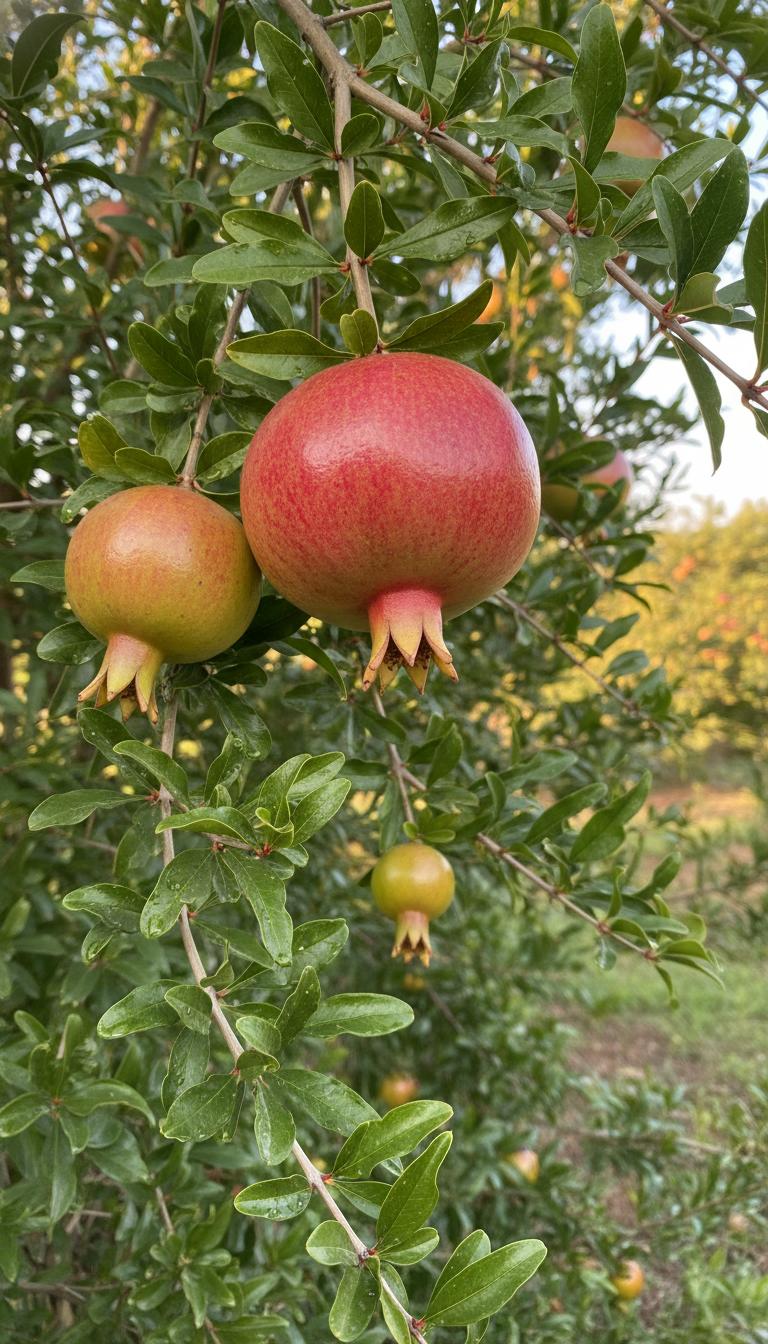
There are fruits that simply feed the body, and then there are fruits that seem to feed the imagination itself. The pomegranate belongs decisively to the latter category. With its crown-like calyx, its leathery crimson skin, and the jewel-like arils that burst between the teeth like sweetened rubies, this ancient fruit has been threading its way through human civilization for millennia, leaving a trail of mythology, medicine, and culinary devotion in its wake.
Botanists place the pomegranate’s origins in the region stretching from modern-day Iran to northern India, where it has been cultivated for at least five thousand years. Some of the earliest archaeological evidence comes from Bronze Age Jericho, where desiccated seeds have been found in tombs dating to around 3000 BCE. The fruit was clearly prized beyond its nutritional value; in ancient burial sites, pomegranates were placed alongside the dead as offerings, suggesting that even in the afterlife, their presence was considered essential. This was not mere superstition. The fruit’s remarkable ability to store well in dry climates made it a literal lifeline for desert travelers, and its juice was among the first concentrated syrups humanity learned to produce.
The pomegranate’s literary debut is arguably its most famous. In the Hebrew Bible, it appears repeatedly as a symbol of righteousness, fertility, and the abundance of the Promised Land. When the Israelites sent scouts into Canaan, the explorers returned carrying pomegranates, figs, and grapes to prove that the territory flowed with sustenance. The fruit adorned the priestly robes of the Temple, woven into the hem of the ephod alongside golden bells. King Solomon compared the cheeks of his beloved to “a slice of pomegranate” in the Song of Songs, a line that has puzzled and delighted translators for centuries. Some scholars believe the reference alludes to the blush of arousal; others suggest the fruit’s segmented interior, hidden behind a modest exterior, made it an ancient metaphor for concealed beauty. In the book of Exodus, the pomegranate is specified as one of the decorative motifs on the columns of Solomon’s Temple, cementing its status as sacred architecture rendered in botanical form.
The ancient Greeks carried the symbolism into darker territory. In the Homeric Hymn to Demeter, Persephone is abducted by Hades after eating a handful of pomegranate seeds in the underworld. Because she consumed food in the realm of the dead, she is bound to return for a portion of each year, creating the cycle of seasons. The myth transformed the pomegranate into the fruit of fate, of irreversible decisions, and of the binding contracts that govern both nature and human life.
Cultivation spread along the trade routes of the Silk Road, reaching the Mediterranean basin by the second millennium BCE. The Phoenicians likely carried it westward, and by the time of classical Rome, the fruit was known as malum punicum—the Carthaginian apple—though it had nothing to do with apples or Carthage specifically. The Romans used it medicinally, pressing the rind for tannins that treated intestinal ailments and dyeing leather with its deep red juice. In medieval Europe, the pomegranate became a status symbol among the nobility. Catherine of Aragon, Henry VIII’s first wife, adopted it as her personal emblem, and it appears in countless Renaissance paintings tucked into the hands of the Virgin Mary or scattered across banquet tables in Dutch still lifes.
Today, the world’s largest producers are Iran, India, China, and Turkey, with California and Arizona dominating the American market. What has changed most dramatically is the fruit’s medical validation. Ancient healers suspected the pomegranate was powerful; modern science has confirmed it. The fruit is extraordinarily rich in punicalagins and anthocyanins, antioxidants that support cardiovascular health and reduce inflammation. Its juice has been studied for potential effects on blood pressure, memory retention, and even prostate health. The arils are now marketed as superfoods, tossed into salads and smoothies by wellness enthusiasts who may never know they are consuming the same fruit that once decorated the robes of high priests.
From biblical temples to Instagram smoothie bowls, the pomegranate has proven itself endlessly adaptable. It is popular today not simply because it is healthy, but because it carries the weight of thousands of years of meaning in every crimson seed. To eat a pomegranate is to taste history itself—sweet, complicated, and impossible to consume without leaving a stain.



3 responses to “The Pomegranate: A Fruit of Blood, Myth, and Eternal Promise”
Just to say there is literary use of the pomegranate symbol as far back as 2400BCE in Mesopotamia
Thank you very much! We truly appreciate your comment and the valuable information.❤
They are often associated with the goddess Inanna/Ishtar