
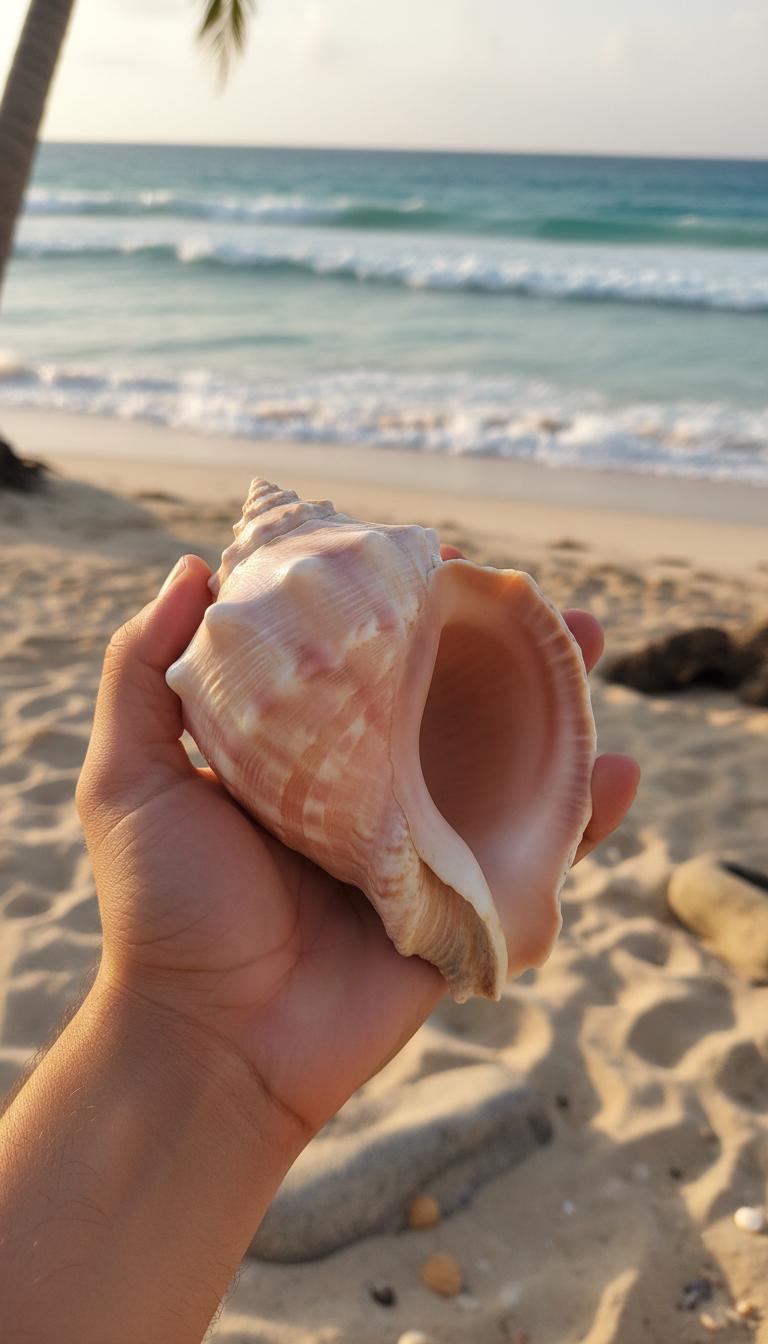
Pick up a shell from the tideline, and you are holding a structure built without hands, a calcium carbonate cathedral secreted one microscopic layer at a time by a creature with no brain. The seashell is one of nature’s most paradoxical inventions: impossibly fragile to a hammer blow, yet durable enough to outlast the animal that made it by thousands of years. It is jewelry, currency, trumpet, spoon, and symbol, and its history with humans is as layered as the nacre that lines its interior.
The shell’s biological origins stretch back over five hundred million years to the Cambrian explosion, when the first mollusks began secreting protective exoskeletons from minerals dissolved in seawater. This was not merely defense; it was engineering. The shell’s spiral geometry, governed by logarithmic growth patterns, distributes stress with mathematical elegance. The nacreous interior—mother-of-pearl—reflects light through overlapping platelets of aragonite, creating the iridescent play of color that has obsessed jewelers and poets alike. A pearl, that most coveted of gems, is simply the shell’s defensive response to irritation: layer upon layer of nacre coating an intrusive grain of sand until the irritant becomes the jewel.
The Bible mentions shells with the same ambivalence it applies to many natural wonders. In the Old Testament, the Hebrew word shoham—translated in various versions as “onyx” or “beryl”—may have referred to mother-of-pearl or shell inlays used in the priestly breastplate and the decorative elements of Solomon’s Temple. The most explicit shell reference appears in Deuteronomy, where the tachash—a mysterious animal whose skin covered the Tabernacle—is sometimes interpreted as a dugong or sea cow, but more plausibly refers to a marine mammal whose hide was processed into a durable, shell-like leather. The Psalms speak of the sea’s treasures in broad terms, and the shell, as the sea’s most portable and beautiful artifact, would have been understood as part of that divine abundance.
The earliest human use of shells was practical and predates recorded history by tens of thousands of years. Homo erectus gathered shells for tools and ornaments along African and Asian coastlines. Neanderthals in Italy pierced Callista chione shells and wore them as beads sixty thousand years ago. By the Upper Paleolithic, shell jewelry was widespread across Europe, Africa, and Australia, traded over distances of hundreds of kilometers and buried with the dead as status markers. The shell was, in essence, the first global currency, valued not for scarcity but for beauty and portability.
The prehistoric predecessor of shell collecting was probably scavenging: beachcombers gathering whatever the tide delivered. Systematic collection, classification, and trade emerged alongside the first civilizations. The Sumerians imported marine shells from the Persian Gulf for inlay work and cylinder seals. The Minoans of Crete crafted elaborate vessels from Triton’s trumpet shells, their spiral forms mimicking the shape of the bull’s horn in religious ritual. The Phoenicians, those great maritime traders of the ancient Mediterranean, distributed cowrie shells from the Red Sea and Indian Ocean across their network, where they functioned as currency from China to West Africa for millennia.
The cowrie deserves particular attention. Monetaria moneta, the money cowrie, is small, durable, and almost impossible to counterfeit, making it the most successful natural currency in human history. In parts of Africa, cowries remained in circulation into the 20th century, long after metal coins had colonized most of the world. The very word “porcelain” derives from the Portuguese porcelana, meaning cowrie shell, because the translucent white ceramic reminded traders of the shell’s smooth interior.
The taxonomy of shells collected and valued by humans is vast, but certain species have achieved iconic status. The giant clam, Tridacna gigas, can exceed a meter in length and was once believed to trap divers by snapping shut on their legs—a myth, but a persistent one that shaped pearl-diving culture across the Pacific. The chambered nautilus, Nautilus pompilius, with its logarithmic spiral and gas-filled chambers, became a symbol of mathematical perfection and inspired the design of early submarines. The conch, particularly Strombus gigas of the Caribbean, has served as trumpet, horn, and religious instrument from ancient Peru to modern Tibet, where it announces the arrival of monks during ceremonies. The scallop, Pecten, with its radiating ribs and fan shape, became the emblem of Saint James and the pilgrimage to Santiago de Compostela, worn by medieval travelers as proof of completed journey.
What has changed most dramatically is the shell’s relationship to abundance and scarcity. For most of human history, shells were collected from beaches and shallow waters, their numbers seemingly infinite. The 19th and 20th centuries changed this. Industrial harvesting for the shell button industry—at its peak, billions of mother-of-pearl buttons were produced annually—decimated mollusk populations in the Mississippi River and Pacific Island lagoons. The fashion for natural shell jewelry and tourist curios drove further exploitation. Today, many species are protected by international convention, and the shell trade is regulated by CITES, the same treaty that governs elephant ivory and rhinoceros horn.
The modern shell collector operates in a landscape of ethical tension. Beachcombing remains legal in most places, but removing live shells is increasingly restricted. The rise of sustainable aquaculture has created new sources for pearls and mother-of-pearl without wild harvest, though purists debate whether farmed pearls carry the same mystique. Meanwhile, the shell has migrated into contemporary art and design, where it appears not as natural object but as motif—printed on fabrics, cast in ceramic, rendered in wallpaper patterns that quote the Rococo without the guilt.
Symbolically, the shell remains one of the most loaded forms in human culture. It is the pilgrim’s badge and the tourist’s souvenir, the mermaid’s comb and the scientist’s specimen. It represents the womb, the tomb, and the ear that listens to the sea. The spiral echoes cosmic patterns from galaxies to DNA. The pearl within represents transformation, the alchemy of irritation into beauty. Even the sound—the hollow resonance when held to the ear, which is actually the amplification of ambient blood flow and oceanic white noise—has been read as the voice of the divine.
From a Neanderthal necklace to a CITES-regulated commodity, the seashell has proven that beauty needs no explanation to travel. It simply waits on the beach, shaped by forces indifferent to human desire, and lets us project whatever meaning we need onto its perfect, empty form.