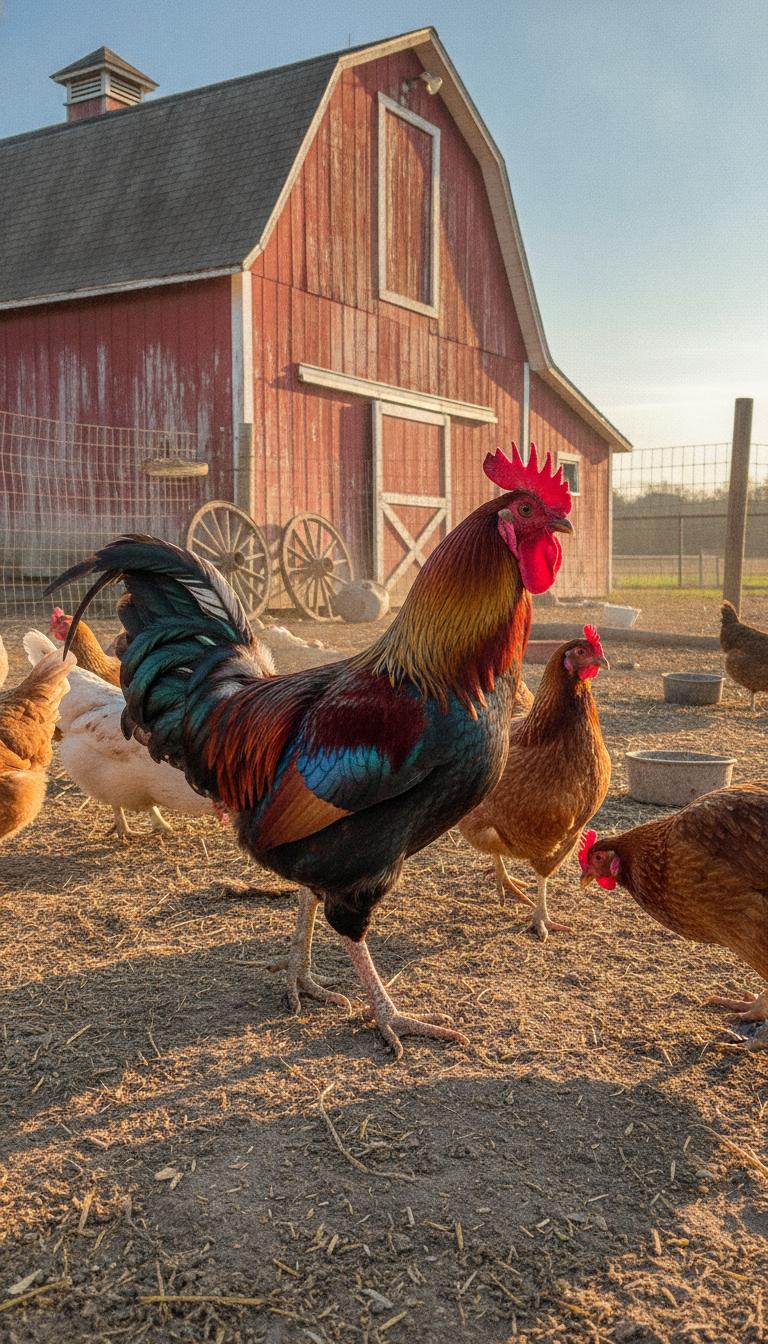

The domestic chicken did not begin its career in a barnyard. Its ancestor, the red junglefowl of Southeast Asia, was a skittish forest creature that would have vanished at the first human footfall. Yet somewhere in the misty valleys of what is now Thailand or Vietnam, roughly 8,000 years ago, a human hand offered grain instead of a spear. The relationship that followed reshaped agriculture, warfare, religion, and global diet in ways that no other bird can claim.
The rooster carries a darker weight. In all four Gospels, Christ warns Peter that before the cock crows twice, the disciple will deny him three times. That prophecy fulfilled in the courtyard of the high priest transformed the rooster into a symbol of vigilance, repentance, and the breaking of dawn itself. By the Middle Ages, church steeples across Europe crowned themselves with copper rooster weather vanes, the gallus watching the horizon for both sunrise and Judgment Day.
The ancient world treated these birds with a reverence that modern factory farms would find unrecognizable. Archaeologists have found chicken bones in Indus Valley settlements dating to 2000 BCE, suggesting the bird traveled trade routes from Southeast Asia into the cradle of civilization. The Persians kept them as sacred animals; the Egyptians, initially, seem to have regarded them as exotic curiosities before integrating them into daily life. It was the Greeks who turned the rooster into a spectacle, staging cockfights with a ferocity that made the bird a symbol of martial courage. The Romans carried this further, using chickens in augury—divination by observing their feeding behavior. In 249 BCE, the Roman consul Publius Claudius Pulcher famously threw his sacred chickens overboard during the Battle of Drepana because they refused to eat, an act of impiety that was followed by catastrophic defeat. The bird that could not be ignored had been ignored, and the empire paid the price.
The scale of the chicken kingdom is staggering. The Jersey Giant, bred in New Jersey in the late nineteenth century, produces roosters that can exceed fifteen pounds, towering over their jungle ancestors. The Malay chicken holds the record for height, standing nearly three feet tall with a serpentine neck that seems more dinosaur than barnyard. At the opposite extreme, the Malaysian Serama bantam weighs less than a can of soda, a bird so tiny it can perch in a teacup and is judged in competitions as much for its confident strut as for its size.
Today’s industrial landscape is dominated by breeds that would astonish ancient Romans. The White Leghorn lays an egg nearly every day, fueling the global breakfast. The Cornish Cross, a hybrid broiler, reaches slaughter weight in just six weeks, a biological acceleration that has made chicken the cheapest meat in human history. Heritage breeds like the Rhode Island Red, the Plymouth Rock, and the fluffy, ornamental Silkie survive in backyards and boutique farms, but thousands of regional landraces have vanished beneath the economic logic of mass production. The bird that once held divine status in Persia now lives in warehouses where it never sees sunlight.
What preceded the backyard coop was the red junglefowl, Gallus gallus, a bird that still scratches through the leaf litter of Himalayan foothills. The leap from forest to farm was likely driven not by hunger but by spectacle—cockfighting and religious ritual came first, with eggs and meat as secondary benefits.
Today, the global chicken population exceeds thirty billion, making it the most numerous bird on Earth by orders of magnitude. The poultry industry generates hundreds of billions of dollars annually, while the backyard chicken movement has exploded across suburbs and cities, complete with Instagram accounts and “chicken math”—the inexplicable phenomenon whereby a hobbyist who planned for three birds ends up with thirty. Symbolically, the rooster still crows from European church spires and the emblem of France, while the hen remains the universal metaphor for nurturing warmth.
What changed most profoundly is the contract. For millennia, humans kept chickens in small flocks, valued for their dual purpose and their presence. The industrial revolution of the twentieth century broke that pact, turning the bird into a protein machine measured in grams-per-feed. Yet the ancient impulse persists. Every morning, in backyards from Portland to Paris, a rooster still throws back his head and announces the day—a sound that connects the listener to 8,000 years of dawn, and reminds us that this bird was never merely livestock. It was a companion, a clock, and a mirror.